Question: Is it true that the
Prophet (peace be upon him) told us to dunk the fly into our drink if it
falls into it? If so, how do we explain this scientifically? Also, are we
required in Islam to do this even if we do not want to?
Answered by the
Fatwa Department Research Committee - chaired by Sheikh `Abd al-Wahhâb
al-Turayrî
|
This is an authentic hadîth.
The Prophet (peace be upon him) said: "If a fly falls into the
drink of any one of you, he should dunk it all the way in and then remove it,
because on one if its wings is disease and on the other is its cure." [Sahîh al-Bukhârî (3320, 5782)]
These are the words of our Prophet (peace be upon him).
As far as our scientific knowledge of the fly is concerned, we know
that the fly is a carrier of numerous harmful microorganisms. We also know
that the surface and internal environments of the fly are both complex
biological environments in which thrive numerous microorganisms, some of
which are harmful to humans, some of which are benign to us, and still others
of which prey upon the harmful microorganisms or otherwise keep the
populations of those harmful microorganisms in check.
The microbiota of the fly - as these microorganisms are collectively
referred to - is very diverse and the ecology of that microbiota is extremely
complex.
R. J. Dillon of the University of Bath, Department of Biology and
Biochemistry, mentions that new kingdoms of life have been found among the
microorganisms living on or within insects. He writes:
Molecular studies have revealed unrecorded microbial sequences in
many natural samples to the extent that new kingdoms of life have been
discovered in the Domain Archaea.
He also writes, discussing how some of the microbiota of the housefly
(Musca domestica) has the ability to
suppress disease-causing bacteria:
A few studies have examined the impact of the gut microbiota on the
establishment of human pathogens and parasites in their insect vectors.
Gnotobiotic insects (Greenberg et al, 1970) were used to provide evidence of
the bacterial pathogen-suppressing ability of the microbiota of Musca domestica and Lucilia sericata.
We will not be so bold as to say conclusively that the microbiota of
the housefly - both the disease causing microorganisms and the other
microorganisms that suppress them - are exactly what the Prophet (peace be
upon him) was referring to. We must show some caution and self-restraint when
dealing with the sacred texts and interpreting what they mean.
This is especially true since our scientific knowledge is quite
limited. What we know about the natural world is by far less than what we are
ignorant of. There could be other qualities of the biological environment of
the fly's surface and internal environments that we still do not know about.
Therefore, it could very well be that the Prophet (peace be upon him) was
referring to something else about the fly for which we have yet to acquire
scientific knowledge.
*************************************
Some of us might find the idea of dunking a fly in our beverage,
removing it, and then taking a drink unsettling to say the least. This is
especially the case if we have had the privilege of living our lives in a
modern society, free of hunger and starvation, where a certain standard of
cleanliness is maintained in the environment and it is relatively easy to
protect our food and drink from flies and other pests.
However, a ruling such as the one mentioned in the hadîth becomes
painfully relevant to those who live with hunger and in less sanitary
environments where protecting food from flies is not so simple and throwing
away food and drink is not so easy an option. Such an environment was that of
Arabia 1400 years ago, and regrettably, there are still many places in the
world where we find scarcity and what by today's assessment are sub-standard
living conditions.
People under such circumstances quite often do consume food and drink
that has come in contact with flies. If they had to discard all such foods,
it would impose a serious hardship upon them.
Also, this hadîth is not obligating Muslims to drink beverages in
which flies have fallen. It is just advising them as to what to do in case
they wish to do so. A Muslim does not have to eat or drink anything that he
feels an aversion to consuming. Today, most of us would understandably be
repelled by the notion of drinking a beverage from which a fly had taken a
sip, let alone fallen into.
Islamic Law takes such natural aversion into account. We can see how
Prophet Muhammad (peace be upon him), when he was served a spiny-tailed
lizard to eat, refrained from partaking of it. Khâlid b. al-Walîd noticed
this and asked if eating the meat of the spiny-tailed lizard was unlawful.
The Prophet (peace be upon him) replied: "No. It is just that it is not
found in the land of my people, and I find myself disinclined to it." He
did not eat it, simply because it did not agree with his disposition. It was
not a question of whether or not its flesh was permitted by Islamic Law.
We can apply the same ruling to a drink in which a fly has landed.
And Allah knows best.
-----------------
Narrated Abu
Hurairah (RAA): The Prophet said,
“If a
housefly falls into the drink of anyone of you, he should dip it (all) in the
liquid, for one of its wings has the disease, and the other has the cure.21” Bukhari and Abu Dawud related it. Abu Dawud added in
his narration, “It puts forward the one
containing the
disease.22
21- It is not meant in this Hadith that
the person must drink the liquid inwhich the fly has fallen, the Prophet is only guiding the Muslims to the way in
which to protect themselves from being infected by microbes, should they want
to continue drinking after throwing way the fly.
22 - i.e. falls in the liquid with the wing containing
the: disease (the microbes)
|
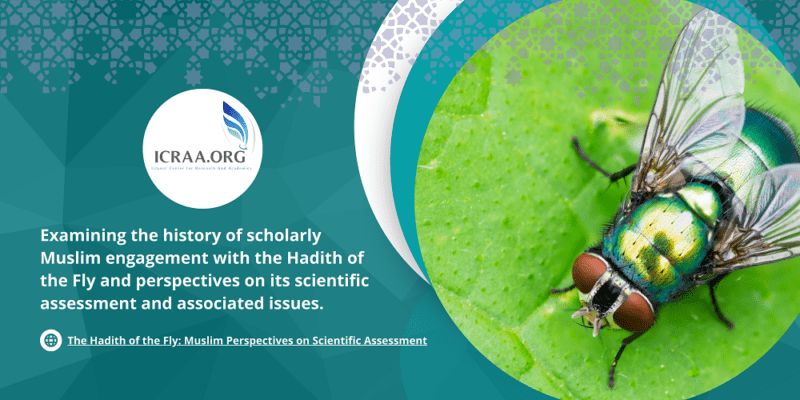
The Hadith of the Fly: Muslim Perspectives on Scientific Assessment
Waqar Akbar Cheema
Abstract
This article critically examines the Hadith of the Fly, investigating its various textual forms and reviewing the possible meanings of key words used. It explores the historical engagement of Muslims with this hadith, spanning centuries, focusing on whether it laid out a legal obligation. The article also delves into the complex relationship between the hadith and scientific findings, arguing that while scientific evidence may not definitively prove the veracity of the hadith, it cannot outright falsify it either. Furthermore, the article presents research studies that offer substantial confirmation for the hadith, bolstering its significance. Through a comprehensive analysis, this article reflects on the possible positions held by Muslims regarding the scientific truth of the hadith while also reconnecting the discussion to observations on key elements of the hadith and its legal nature.
1. Introduction
The Hadith of the Fly, “If a housefly falls in the drink of anyone of you, he should dip it all (in the drink), and take it out, for one of its wings has a disease, and the other has the cure for the disease,” has become a highly debated and controversial topic in modern times. Many individuals view it as a prime example of what they perceive as the vulnerability of Islamic teachings. The religious directive that suggests intentionally dipping a fly in a drink before consuming it is not only regarded as scientifically inaccurate but also seen as a manifestation of dogmatic absurdity. Critics argue that it contradicts our current scientific knowledge and understanding of microbiology, and furthermore, it violates basic principles of hygiene.
This hadith has been subject to criticism for the past century or so. In the early twentieth century, it was one of the most discussed hadith reports as the modernists like Tawfiq Sidqi (d. 1920) and Mahmud Abu Rayya (d. 1970) objected to it in the light of scientific knowledge of the day. Even Maurice Bucaille (d. 1998), renowned for his work showing congruence between Qur’an and modern science, did not have a favourable view of this hadith. Discussing a few hadith reports, including the Hadith of Fly, he wrote, “It is possible to conclude that certain hadiths exist which are scientifically unacceptable.”[1]
Let us analyse this hadith’s text and traditional interpretation, considering old and contemporary sensibilities and their various interactions.
2. Textual Analysis of the Hadith of the Fly
The hadith has come down to us through multiple companions of the Prophet (ﷺ), namely, Abu Huraira,[2] Abu Sa’id Al-Khudri,[3] Anas,[4] and ‘Ali b. Abi Talib.[5] As in Sahih Bukhari (no. 3320), Abu Huraira related that the Messenger of Allah (ﷺ) said:
إذا وقع الذباب في شراب أحدكم فليغمسه ثم لينزعه، فإن في إحدى جناحيه داء والأخرى شفاء
~
If a housefly falls in the drink of anyone of you, he should dip it (in the drink) and take it out, for one of its wings has a disease, and the other has a cure.
In Sunan Abu Dawud (no. 3844), it has a bit more.
إذا وقع الذباب في إناء أحدكم، فامقلوه فإن في أحد جناحيه داء، وفي الآخر شفاء، وإنه يتقي بجناحه الذي فيه الداء فليغمسه كله
~
When a fly alights in anyone’s vessel, he should plunge it all in, for in one of its wings is a disease, and in the other is a cure. It prevents the wing of which there is a cure, so plunge it all in (the vessel).
It is likewise reported from Abu Sa‘id al-Khurdi, by Ibn Majah (no. 3504)), that the Prophet (ﷺ) said:
في أحد جناحي الذباب سم، وفي الآخر شفاء، فإذا وقع في الطعام، فامقلوه فيه، فإنه يقدم السم، ويؤخر الشفاء
~
On one of the wings of a fly, there is a poisonous substance; on the other is the cure. If it falls into the food, dip it into it, for it puts the poison first and holds back the cure.
3. Significance of Terminology: Fly and its Wings in the Hadith
The term used in the hadith is “al-dhubab,” which can generally refer to any fly. A report mentions that the Prophet (ﷺ) stated, “All flies (dhubab) will go to Hell except the honeybee (dhubab al-nahl).”[6] While the initial impression might suggest that it refers to the common housefly (Musca domestica), the word allows for further specification. In discussions about this hadith, some scholars have noted that it had been observed to be true for a particular type of fly known as “dhararih,”[7] which refers to the cantharis or Spanish Fly.[8]
Next, the hadith uses the word ‘janah’, commonly translated as ‘wing.’ While this is the most frequently understood meaning of the word, it can also refer to a side or a part of a body,[9] not necessarily the appendages used for flying.[10] In the Qur’an, the word ‘janah’ is used to describe arms as well, as seen in the verse urging people to be kind to their parents: “And lower to them the wing of humility (janah al-dhul), out of mercy” (Qur’an 17:24). In fact, it is comparable to the English word ‘wing,’ which can also be used to denote a side or a part of something in general, besides its specific meaning as the body part that aids flying creatures in their flight.
4. Historical Engagement with the Hadith of the Fly
The hadith, known for its implications in both the medicinal[11] and purification aspects,[12] has encountered objections from individuals of a particular intellectual inclination. Among those who questioned its validity were the Mu’tazlites, who raised specific concerns. Their objections did not revolve around the notion of a fly containing an antidote to a poisonous substance per se; instead, they focused on the coexistence of poison and its antidote within the same body. Furthermore, some raised doubts about a fly’s ability to discern which wing carried harmful substances and which wing held the cure. In response to these queries and objections, notable scholars such as Ibn Qutaiba (d. 276/889),[13] Al-Tahawi (d. 321/933),[14] Al-Khattabi (d. 388/998), and Ibn al-Qayyim (d. 751/1350)[15] provided comprehensive explanations, addressing, and clarifying these concerns. Al-Khattabi wrote:
Someone who has no righteousness in him says with regard to this tradition, ‘How is this, and how do a cause of disease and its remedy happen to exist in the two wings of a fly? How does the fly know that, so as to advance the wing containing the cause of disease and to hold back the one containing the remedy, and what leads it to do that?’ These are the questions of an ignorant person or one affecting to be ignorant for he who finds in himself and the rest of animals, an union of heat and cold and of moisture and dryness, – two opposite elements destroying each other when they meet together, – and then sees that God has joined them together and forced them to be united, causing such union to be the source of powers of animals, whose existence and good state depend upon it, would be disposed not to deny the fact of a disease and its remedy being united together in two members of the body of one and the same animal. He who has inspired the bee to construct a house of exquisite workmanship and to produce honey in it, and who has inspired the ant to earn its food by labour and to store it up for times of its need for it, is the One who has created the fly and given it the right guidance, so that it advances one wing and withholds the other one. He has intended it as a trial, which is the way of devotion, and as a test, which is the field of exercise for striving (in devotion), and He has wisdom and an indication in everything, which none but person of understanding remember.[16]
5. Does the Hadith Impose an Obligation?
Another aspect of the traditional engagement of this hadith is whether it was understood as establishing an obligatory practice [In other words, what is the ruling of housefly in food and drinks in Islam ? or, can you eat food after a fly lands on it ?]. Was it interpreted as a legal requirement for every Muslim to fully submerge the fly in the drink each time it falls into it and then consume it? After mentioning the hadith, the well-known author of legal theory (usul al-fiqh), Al-Shashi (d. 344/955), states:
The context of the speech indicates that to submerge [the wing] is to repel harm from us and not [intended] as ritual due on us by the Shariah. Hence it is not an obligation.[17]
Al-Qastalani (d. 923/1517),[18] Al-Munawi (d. 1031/1622),[19] Al-Amir Al-San‘ani (d. 1182/1768),[20] and Al-Bujmiri (d. 1221/1806),[21] among others, have also expressed that the mentioned hadith is merely by way of advice (irshad) regarding what is beneficial, rather than a religious obligation. The well-known contemporary Saudi scholar Muhammad ibn al-Uthaimin (d. 2001) shared a similar opinion, emphasising that one is not religiously obligated to take such a drink if they do not desire it. He supported his viewpoint by citing the example of the mastigure (al-dhabb), a herbivorous lizard, which was presented to the Prophet (ﷺ), and he declined to eat it, stating, “It is a food that is unfamiliar in the land of my people, and I do not like it.”[22]
Accordingly, certain scholars have taken the liberty to restrict the application of hadith. Anwar Shah Al-Kashmiri (d. 1934) writes:
While the instruction to dip the fly in a drink appears general in the hadith, in my understanding, it is limited to cases where the food or drink is not hot. This limitation is because dipping the fly in a hot drink only exacerbates the harm.[23]
These points confirm against the notion that a Muslim is obligated to consume a drink if a fly happens to fall into it, without any regard for other factors or considerations.
6. Muslim Perspectives on the Scientific Assessment of the Hadith
In recent times, however, the discussions have been focused on the factual truth of the fly carrying antidotes on one of its wings. The question is of critical importance because it is widely accepted in Muslim scholarship that any statement made by the Messenger of Allah (ﷺ) that he had not subsequently retracted or corrected is considered factually accurate, even if it pertains to a field like medicine, which is not within the primary domain of prophethood.
6.1 Timeless Muslim Perspective: The Hadith’s Validity and the Limits of Scientific Assessment
Therefore, when confronted with scientific objections to this hadith, the consistent and universal Muslim response, applicable to both the past and present, is that such objections stem from a lack of knowledge and are, therefore, at best, arguments from ignorance. At most, one can only say that there is presently no conclusive evidence to verify the accuracy of this hadith or to validate the claims being made. However, labelling it as scientifically unacceptable would be akin to a 19th-century physician deriding the notion of fungus (Penicillin) serving as an antibiotic, later recognised as a ‘miraculous’ breakthrough during World War II. Hence, while current scientific knowledge may not validate the assertions of the hadith, it does not disprove them.
Hence, for the average Muslim, the approach advocated by classical scholars like Muhammad bin Abi Ishaq Al-Bukhari (d. 380/990), a medieval Transoxanian Hanafi author, is adequate. Discussing this hadith, he stated:
It may contain a disease that harms the body, and the Messenger of Allah (ﷺ) knew the remedy for that disease and informed us about it, even if he did not disclose its exact nature. And Allah knows best. [24]
This rationale is sensible considering the fact that the hadith does not impose an obligation, and an individual is still at liberty to dispose of a drink in which a fly has fallen, as elucidated earlier.
6.2 Scientific Validation of the Hadith
Nevertheless, Muslim scholars have also referred to some studies claiming they confirm the point mentioned in the hadith. Dr Muhammad Muhsin Khan (d. 2021) says in the annotation of this hadith:
Medically it is well-known now that a fly carries some pathogens on some parts of its body, as mentioned by the Prophet (before 1400 years approx. when the humans knew very little of modern medicine.) Similarly, Allah created organisms and other mechanisms which kill these pathogens e.g. Penicillin fungus kills pathogenic organisms like Staphylococci and others etc. Recently, experiments have been done under supervision which indicate that a fly carries the disease (pathogens) plus the antidote for those pathogenic organisms. Ordinarily, when a fly touches a liquid food it infects the liquid with its pathogens, so it must be dipped in order to release also the antidote for those pathogens to act as a counterbalance to the pathogens. Regarding this subject I also wrote through a friend of mine to Dr. Muhammad M. El-Samahy, chief of Hadith Dept. in Al-Azhar University, Cairo (Egypt), who has written an article upon this hadith, and as regards medical aspects, he has mentioned that the microbiologists have proved that there are longitudinal yeast cells living as parasites inside the belly of the fly and these yeast cells in order to repeat their life cycle protrude through respiratory tubules of the fly and if the fly is dipped in a liquid, these cells burst in the fluid and the content of those cells in an antidote for the pathogens which the fly carries.[25]
A recent study confirms this in saying.
M. domestica is known to have a diverse microbiome with antagonistic or antimicrobial properties that can impede the growth of pathogenic bacteria originating from the previous substrate. Antagonistic activities from these bacteria may be associated with their abilities to secrete enzymes or compounds that function antagonistically and/or as an antimicrobial…
B. subtilis isolated from the right wing and body surface of M. domestica effectively inhibited the growth of Pseudo-monas spp. B. subtilis plays an important role in the production of antibiotic enzymes, and other secondary metabolites that possess a broad spectrum of antimicrobial activities against pathogenic microbes. The right wing of M. domestica contains B. subtilis and B. circulans that can neutralize E. coli contaminated drinks due to their antibiotic effects …. Furthermore, the right wing contains bacteriophage which is thought to produce endolysins (phage lysins) which causes bacteria cell lysis.[26]
These observations appear to confirm the observations of classical Muslims even in identifying the right wing of the fly as a carrier of the curative essence.[27] Nevertheless, as was discussed above, the hadith may pertain to a specific kind of fly. At the same time, it remains possible that its body parts, other than wings, could also be involved as the location of the harmful substances and their corresponding antidote.
7. Summary and Conclusion
The statements made by the Messenger of Allah (ﷺ) regarding diseases and the healing properties of different substances are considered valid, even if human knowledge at any particular time in history has not advanced enough to appreciate it.
The Hadith of the Fly, which contains a positive statement from the Messenger of Allah (ﷺ) and is narrated authentically, requires Muslims to believe in it. However, it does not mandate them to dip the fly entirely and consume the drink if it lands upon it.
Hence, it can be said that while the absence of laboratory evidence does not justify doubting such hadiths, individuals can decide whether to practice them.
References & Notes:
[1] Bucaille, Dr Maurice, The Bible, the Qur’an, and Science, (New York: Tahrike Tarsile Qur’an, Inc., 2003) 262-263
[2] al-Bukhari, Muhammad b. Isma‘il, al-Sahih, (Riyadh: Darussalam Publishers, 1997) Hadith 3320. See also, Al-Bukhari, al-Sahih, Hadith 5782; al-Sijistani, Abu Dawud, al-Sunan, (Beirut: al-Resalah Publishers, 2009) Hadith 2302; Al-Qazwini, Ibn Majah, al-Sunan, (Riyadh: Darussalam Publishers, 2007) Hadith 3505; Al-Madani, Isma‘il b. Ja‘far, Ahadith Isma‘il b. Ja‘far, (Riyadh: Maktaba al-Rushd, 1998) Hadith 433; Ahmad b. Hanbal, al-Musnad, Ed. Shu‘aib al-Arna’ut (Beirut: Resalah Publishers, 2001) Hadith 7141, 7359, 7572, 8485, 8657, 9168, 9721; Al-Tahawi, Abu Ja‘far, Sharh Mushkil al-Athar, Ed. Shu‘aib al-Arna’ut (Beirut: Resalah Publishers, 1994) Vol. 8, 340-342 Hadith 3289-3290;
[3] Ibn Majah, al-Sunan, Hadith 3504; al-Tiyalsi, Abu Dawud, al-Musnad, (Cairo: Dar Hijr, 1999) Hadith 2302; Ahmad bin Hanbal, Al-Musnad, Hadith 11189, 11643; Al-Tahawi, Sharh Mushkil al-Athar, Vol. 8, 339-340 Hadith 3291-3295 – classified as sahih by al-Albani and Shu‘aib Al-Arna’ut.
[4] al-Bazzar, Abu Bakr, al-Musnad, (Madina: Maktaba al-‘Ulum wa al-Hikam, 1997) Hadith 7323; Al-Tabarani, Abu al-Qasim, al-Mu‘jam al-Awst, (Cairo: Dar al-Haramain, n.d.) Vol.3, 141 Hadith 2753;Al-Haithmi mentions its narrators are those of Sahih Al-Bukhari,. See, Al-Haithami, Nur al-Din, Majm‘ Al-Zawa’id, (Jeddah: Dar al-Minhaj, 2015) Vol.11, 84 Hadith 8063.
[5] Al-Albani, Nasir al-Din, Sahih Al-Jami’ Al-Saghir, Hadith 4249
[6] Al-Bazzar, Abu Bakr/al-Haithami, Kashf al-Astar fi Zawa’id Musnad al-Bazzar, (Beirut: al-Resalah Publishers, 1979) Hadith 3498; See also, Al-San ‘ani, ‘Abdul Razzaq, al-Musannaf, (Dabhel: Majlis al-‘Ilmi, 1983) Hadith 9415; al-Mawsali, Abu Ya‘la, al-Musnad, Ed. Hussain Salim Asad (Damascus: Dar al-Ma’mun, 1984) Hadith 4231; Ibn Hajar says its isnad is acceptable (la ba’sa bihi). See, al-‘Asqalani, Ibn Hajar, Fath al-Bari, (Beirut: Dar al-Ma‘rifa, 1379 AH) Vol.10, 250. al-Tabarani, Abu al-Qasim, al-Mu‘jam al-Awst, Hadith 1575, 3482; al-Tabarani, Abu al-Qasim, al-Mu‘jam al-Kabir, (Cairo: Maktaba Ibn Taimiya, 1994) Vol.10, 207; Vol.11, 65 Hadith 11058. It goes without saying that flies would not go to Hell to be punished, rather they would be a cause of punishment for the dwellers of Hell. One report related in the name of Abu Huraira from the Prophet (ﷺ) adds this clarification, “All flies will go to Hell. They will be made a punishment for the people of Hell, except the honeybee.” See, al-Tirmidhi, Hakim, Nawadir al-Usul, (Cairo: Maktaba al-Imam al-Bukhari, 2008) Vol.1, 405 no. 582; al-Qurtubi, Shams al-Din, al-Jami‘ li Ahkam al-Qur’an, (Cairo: Dar al-Kutab al-Misriyya, 1964) Vol.10, 134. See also, al-Jahiz, Abu ‘Uthman, al-Haywan, (Beirut: DKI, 1424 AH) Vol.3, 187; al-Munawi, Zain al-Din, al-Taisir bi Sharh Jami‘ al-Saghir, (Riyadh: Maktaba al-Imam al-Shafi‘i, 1998) Vol.2, 21
[7] Al-Dhahabi, Abu ‘Abdullah, al-Tibb al-Nabawi, (Beirut: Dar Ihya’ al-‘Ulum, 1990) 120; Ibn Tulun, Shams al-Din, al-Manhal al-Rawi fi al-Tibb al-Nabawi, (Hyderabad Deccan: Anwar al-Ma‘arif, 1987) 219
[8] Lane, Edward William, Arabic-English Lexicon, (Beirut: Librairie du Liban, 1968) Vol.3, 960;
[9] Al-Zabidi, Murtada, Taj al-‘Urus min Jawahir al-Qamus, (Kuwait: Wizarat al-Irshad wa al-Anba’, 1969) Vol.6, 350; Lane, Arabic-English Lexicon, Vol.2, 400;
[10] Miftahi, Shu‘aib Ullah, Hadith-i-Dhubab: Aik Mutali‘a, (Bangalore: Jamia Islamia Maseehul Uloom, n.d.) 9-10
[11] Al-Bukhari placed this report in the Chapters on Medicine (kitab al-tibb) in his Sahih (No. 5782).
[12] Ibn Khuzaima, Abu Bakr, al-Sahih, (Beirut: Maktab al-Islami, 2003), Chapter on mentioning the evidence that the falling of a fly into water does not render it impure (Bab dhikr al-dalil ‘ala anna suqut al-dhubaab fi al-ma’ la yunajjisuhu) Hadith 105
[13] Al-Dainwari, Ibn Qutaiba, Ta’wil Mukhtalif Al-Hadith. (Doha: Mo’assasa Al-Ishraq, 1999) 334-339
[14] Al-Tahawi, Sharh Mushkil al-Athar, Vol.8, 343-344
[15] Al-Jawziyya, Ibn al-Qayyim, Za‘ad al-Ma’ad fi Hadyi Khair al-‘Ibad, (Beirut: al-Resalah Publishers, 1994) Ed. 27 Vol.4, 101-103
[16] Al-Khattabi, Abu Suleman, Ma‘alim Al-Sunan ( Halab, Matb’ Al-‘Ilmiya, 1932) Vol.4, 258; translated in Jayakar, A.S.G., Ad-Damiri’s Hayat Al-Hayawan – A Zoological Lexicon, (London/Bombay: Luzac/Tarapoewala, 1906-08) Vol.1, 822
[17] Al-Shashi, Nizam Al-Din, Al-Usul, (Beirut: Dar Al-Kutab Al-‘Arabi, n.d.) 93; translated in ash-Shashi, Nizam ad-Din, Usul ash-Shashi – Principles of Islamic Jurisprudence, Translation & Introduction by Mansur Ali (London: Turath Publishing, 2017) 89-90
[18] Al-Qastalani, Ahmad Shihab Al-Din, Irshad Al-Sari li-Sharh Sahih Al-Bukhari, (Cairo, Matb’ Al-Amiriya, 1323 AH) Vol.5, 315
[19] Al-Munawi, Al-Taisir Bi-Sharh Al-Jami’ Al-Saghir, Vol.1, 134
[20] Al-San‘ani, Al-Amir Muhammad bin Isma’il, Al-Tanwir Sharh Jami Al-Saghir, (Riyadh, Darussalam, 2011) Vol.2, 235
[21] Al-Bujmiri, Suleman, Tuhfa Al-Habib ‘ala Sharh Al-Khatib. Beirut, Dar Al-Fekr, 1995. Vol.1, 93
[22] Ibn al-‘Uthamin, et al., al-Fatawa Islamiyya, (Riyadh: Dar al-Watan, 1415 AH) Vol.4, 99; See, Al-Bukhari, al-Sahih, Hadith 5391; al-Nasa’i, al-Sunan, Hadith 4317, et al.
[23] Al-Kashmiri, Anwar Shah, Faiḍ Al-Bari ‘ala Sahih Al-Bukhari, (Beirut, Dar Al-Kotob Al-Ilmiya, 2005) Vol.4, 337
[24] Al-Bukhari, Muhammad bin Abi Ishaq, Bahr Al-Fawa’id (Ma’ani Al-Akhbar), (Beirut, Dar Al-Kotob Al-Ilmiya, 1999) 240
[25] Khan, Dr. Muhsin, Translation of the Meanings of Sahih Bukhari, (Riyadh, Darussalam, 1997) Vol.4, 332
[26] Niode, Nurdjannah Jane et al. “A Review of the Antimicrobial Potential of Musca domestica as a Natural Approach with Promising Prospects to Countermeasure Antibiotic Resistance.” Veterinary medicine international vol. 2022 9346791. 30 Dec. 2022, doi:10.1155/2022/9346791
[27] al-‘Asqalani, Ibn Hajar, Fath al-Bari, Vol.10, 251


