

And No One Had The Name Yaḥya (= John?) Before: A Linguistic & Exegetical Enquiry Into Qur'an 19:7
Islamic Awareness
© Islamic Awareness, All Rights Reserved.
First Composed: 8th July 2000
Last Updated: 18th August 2000
| Tweet |  | Save |
Assalamu ʿalaykum wa rahamatullahi wa barakatuhu:
In the chapter of the Qur'an that carries the name Mary (Surat Maryam), the story of the miraculous birth of Jesus (19:16-34) is immediately preceded by the story of the miraculous birth of the Yaḥya to the aged Zechariah and his old and barren wife (19:1-15). Yaḥya has been traditionally identified as being none other than John the Baptist. The Christian missionaries have pointed to a difficulty arising at verse 19:7 where the birth of the Yaḥya is announced:

"O Zakariya! We give thee good news of a son: His name shall be Yaḥya: on none by that name have We conferred distinction before." [Qur'an 19:7]
They claim that this verse is in error. According to their understanding of verse 19:7, the name Yaḥya (John) is unique, and no human being prior to the birth of Yaḥya (John) ever had such a name, yet in the Old Testament there are more than twenty-five references to the name John:
In fact, there are 27 instances of the name "Johanan" mentioned in the Old Testament.
Thus the name John (Yaḥya) is neither unique nor exceptional and the Qur'anic error is clearly apparent. It seems that the original source of this controversy is Abraham Geiger who wrote the book entitled Was hat Mohammed aus dem Judenthume aufgenommen?:
He [i.e., Muḥammad] actually asserts that before John the Baptist no one had borne the name of John. Had he known anything of Jewish history he would have been aware that, apart from some historically unimportant people of the name mentioned in Chronicles, the father and the son of the celebrated Maccabean priest, Mattathias, were both called John. This mistake must have been obvious to the Arabic commentators, for they try to give another meaning to the clear and unmistakable words.[1]
Geiger did not cite any Muslim commentators to support his claims, and, as will be demonstrated in the sections below, one has to wonder whether the claim that "this mistake must have been obvious to the Arabic commentators" is purely his own invention.
As the missionaries are unable to shed any further light on this issue, it is left to us to investigate and supply the essential missing information. Are the names Yaḥya and John one and the same? Does the ayah (verse) actually means what the translation says? This paper will examine the various issues surrounding the name Yaḥya.
2. Is The Name John Linguistically Equivalent To Yaḥya?According to the Christian Missionaries the name Yaḥya is the Arabic form of John:
John: Hebrew: Johanan, Arabic: Yaḥya. Greek: Ioannes
The fact is that the Arabic equivalent of John of the New Testament is Yuḥanna not Yaḥya. And similarly, the Arabic equivalent of John of the Hebrew Bible is Yuḥanan not Yaḥya. Anyone who possesses a basic knowledge of Semitic languages will straight away point out that the names Yaḥya and John (Yuḥanan or Yuḥanna) are two entirely different names. One do not need to be an expert in Semitic languages to verify this claim; a simple Arabic translation of the Bible will suffice.
The name John of the Hebrew Bible as listed in Strong's Concordance is Yowchanan in Hebrew:
Yowchanan {yo-khaw-nawn'} a form of 3076; n pr m AV - Johanan 24; 24 Johanan = "Jehovah has graced" | |
|
In Arabic Bibles this name is rendered as Yuḥanan as shown in the texts below

I Kings 25:23

I Chronicles 3:15

I Chronicles 3:24

Ezra 8:12
Let us now take examples from the New Testament. The name John (the Baptist) in Greek is Ioannes according to Strong's Concordance :
| Ioannes {ee-o-an'-nace} of Hebrew origin 3110; n pr m. AV - John (the Baptist) 92, John (the apostle) 36, John (Mark) 4, John (the chief priest) 1; 133 John = "Jehovah is a gracious giver" | |
|
In Arabic Bibles the name John, as used in the Maccabees and the New Testament, is Yuḥanna:

1 Maccabees 2:2

John 1:6
Needless to say, the Gospel according to John, is also Yuḥanna:

Gospel according to Yuḥanna (John)
Thus the Arabic equivalent of John (Yowchanan) of the Hebrew Bible is Yuḥanan not Yaḥya, and the Arabic equivalent of John (Ioannes) of the New Testament is Yuḥanna not Yaḥya. By blindly following every cheap anti-Islamic polemic, such as those of Abraham Geiger, the Christian missionaries have been lead astray.
3. The Meaning Of The Name YaḥyaThe names "Yaḥya" and "John" (Yuḥanan or Yuḥanna) are entirely different names. The Qur'an speaks of Zechariah's son as Yaḥya not John. The Qur'an does not mention the name John whether Yuḥanna or Yuḥanan.
Biblical scholars stress that the names Yuḥanna and Yuḥanan are one and the same. In the Hebraic translation of the Gospels they do not make use of Yuḥanna but they revert it to the original Yuḥanan. They also give both names the same meaning. Both names contain "Yu", the short form of Jehovah, the Hebraic name of God. As for ḥanan or ḥanna, both derive from the Aramaic root ḥanan (the same as the Arabic root for ḥanna) which means "tenderness / indulgence of God" exactly like the Hebraic name Ḥanania.
Is the name Yaḥya Arabic or foreign? In Arabic, the present form Yaḥya is the third person of the Arabic root ḥaya. The Arabic root ḥaya (which could be written with a lean alif or an upright alif in both the present and past form) has two meanings:
- The first is derived from al-ḥayah, i.e., life which is the opposite of death like when it is said: lan ansa laka hadha as-saniʿa ma hayit, i.e., "I won't forget this favour of yours as long as I live" meaning as long as I am alive and did not die.
- The second meaning of the Arabic root ḥaya is derived from al-ḥaya' ending with a hamzah meaning shyness/chastity. In this second sense it is said: ḥayitu minhu meaning that one is shy or confused from someone. The origin of al-ḥaya' comes from al-inqibad and al-inziwa', i.e., introversion. This is why the snake is called ḥayyah since it gathers its body around itself in the shape of a disc.
However, there seems to be a difference of opinion among the Muslim scholars concerning the origin of this name. Al-Suyuṭi states in his Al-Itqan fi ʿUlum al-Qur'an:
Yaḥya: The son of Zakariyya, the first one to bear that name according to the Qur'an. He was born six months before Jesus, and was given prophethood while young, and was killed unjustly. God moved Nobukhod Nosor and his armies against his murderers. Yaḥya is a non-Arabic name, but it is also said [by some] to be of Arabic origin. According to al-Wahidi: In both cases the name does not permit nunation.
Al-Kirmani stated: In the second case [i.e., the name is Arabic in origin], it has been said that: he was so-called because God made him live with faith, that the womb of his mother became alive with him, and that he was martyred, because martyrs are alive [bal ahya'un ʿinda rabbihim yurzaqun].
It was also said that its meaning is "yamut", i.e., "he dies" like when we use "mafazah" to mean "mahlakah" and "salim" to mean "ladigh".[2]
The name Yaḥya has also perplexed many orientalists. Paul Casanova is of the opinion that Yaḥya is an "error" which needs to be "corrected":
Therefore I hesitated for a long time to suggest the corrections that seemed more likely to me. What decides me today to do so is, I must note, that the Western scholars tend more and more to free themselves of the superstitious respect they had for the absolute integrity of the Qur'an, and that a "semitizing" German scholar, Barth has also suggested fairly important corrections among which one interests me particularly, since I have been thinking about it for a long time and I am happy to see it presented as I have imagined it myself. It is the correction Youḥanna for Yaḥya, Youḥanna instead of Yaḥya, the name of Saint John the Baptist. I did not dare to publish it, firstly for the general reason stated earlier, because it leads to an odd coincidence. Indeed, the Mandaeans or pseudo-Christians of Saint John, identified with the Sabians of the Qur'an, have a book where their principal Prophet is called Yahio [sic!]. If that name was due to a misreading of the writers of the Qur'an, the book would necessarily be older than the diffusion of the canonical Qur'an and all the theories built on that identification would fall apart.[3]
Mingana, following the footsteps of Margoliouth[4], believed that the pre-Islamic poetry is a post-Islamic forgery (a theory which has now been well-refuted by Muslim and non-Muslim scholars alike). Therefore, for Mingana, the Qur'an is the first book in Arabic whose "author" had:
... immense difficulties. He had to adapt new words and new expressions to fresh ideas, in a language that was not yet fixed by any grammar or lexicography.[5]
Mingana resorted to heavy application of Syriac in order to understand the "origin" of word Yaḥya: He states:
To express "John" the Kur'an of our days has the strange form Yaḥya. I believe with Margoliouth[6], that the name is almost certainly the Syriac Yoḥannan.[7]
He also makes a rather strange pronouncement that in the early and undotted Qur'anic manuscripts, the Arabic letters y-ḥ-y of the name Yaḥya could be read as:
Yoḥanna, Yoḥannan, or Yaḥya, and the Muslim kurra' who knew no other language besides Arabic adopted the erroneous form Yaḥya.[8]
Arthur Jeffery believes that the above suggestion[9] is worthy of endorsement but at the same time he informs us that:
... there appears to be no trace of the name [i.e., Yaḥya] in the early literature [of the Arabs].[10]
A rhetorical question should be asked: If there is no trace of the name Yaḥya in the pre-Islamic Arabic literature, then why should the undotted text be read as Yaḥya (y-ḥ-y)? Why can it not be read as something else, such as t-ḥ-t? C. C. Torrey, like Casanova and Jeffery, also believes that the Qur'anic Yaḥya is a misreading of Yuḥanna,[11] but all the qira'at are unanimous in stating that the undotted y-ḥ-y can only be read as Yaḥya and not as Yuḥanna or Yuḥanan. Furthermore, these Orientalists whose opinions are cited above also believe Yaḥya to be of foreign (i.e., non-Arabic) origin, but their suggestions that the name Yaḥya is an "error" is stated without any proof what-so-ever! Although most Western scholars (unlike Geiger or Christian missionaries) are aware that the names Yaḥya and John (Yuḥanan or Yuḥanna) are two entirely different names derived from two different rootst, they can only conjecture at the origin of the name.
4. The Mandaeans - "The Christians Of St. John"Has John the Baptist ever been known as Yaḥya by any group of people?
The Mandaeans are a community that live in Iraq and Iran, and speak a dialect of Aramaic (or Mandaic as it is usually referred to in the literature). They claim to be the followers of John the Baptist and are sometimes (wrongly) referred to as "Christians of St. John" a title first used by Portuguese Christian missionaries. They are colloquially known as Ṣubba (singular Ṣubbi). The appellation Ṣubba is accepted as referring to their principal religious ritual - Baptism by immersion. The name used by themselves to described their religion and race is Mandai, or Mandaeans.[12]
Before we go further, let us deal briefly with the identification of Sabians or Ṣabi'un. There has been a great deal of speculation about the identification of Ṣabi'un, a religious group, mentioned thrice in the Qur'an. The Qur'anic commentators had theorized about the possible identity of this group. We will only sum up the various viewpoints. Interested readers may consult this subject that has been dealt with at length by Jane Dammen McAuliffe.[13]
Some of the Qur'anic commentators have credited Ṣabi'un with worshipping angels and some with monotheism; the Ṣabi'un praying towards the qibla, and they are different from Jews, Christians and Magians. They were usually identified with a group of people from Iraq.
The Western scholarship on the identification of Ṣabi'un of the Qur'an perhaps began with the encyclopaedic work of Daniel Chwolson.[14] A brief summation of Chwolson's view was done by John Pederson.[15] Chwolson postulated a two fold identification of Ṣabi'un.[16] Mandaeans, who are monotheists, was one such group and the other was thought to be the pagan star-worshippers in Ḥarran whom Muslim historians claimed to have adopted the name Ṣabi'un in order to be included in the category of People of the Book.
Pederson, however, took an exception to Chwolson's two-fold identification. He says that Ṣabi'un should be identified with the hanifs as
They too are people who believe in God, neither Jews nor Christians; the nearest model for the believers, as Abraham himself was ḥanif.[17]
This identification by Pederson came about by equating hanif and gnostic. The result of this is that he harmonizes between the common designation of Mandaeans and Ḥarranians as Ṣabi'un.
Pederson's harmonization is also supported by E. S. Drower; but she recognizes within the latter community a division between the the priestly class, known as Naṣoraeans, and the ignorant or semi-ignorant laity who are called Mandaeans.[18] Bayard Dodge's position is that there is insufficient evidence for this identification. He is quite comfortable with the correlation of Ṣabi'un and the Mandaeans, but beyond that he is not willing to go by admitting that
... we do not know how their originated or what groups might have been Sabians.[19]
Mandaeans call their teacher John the Baptist Yahia Yuhana.[20] In their canonical prayer book one can read:
King Yahia-Yuhana,
Healing and victory be thine;[21]
One of their holy books is called Drasha d. Yahia or The Book of Yahia. Examples of the presence of the name Yahia can be found in The Book of John (see chapter 3 and chapter 4).
A Mandaic Dictionary throws further light on the names "iahia" and "iuhana" as used in their holy books:[22]


Note the absence of the emphatic "ḥ" in Yahia Yuhana (the "h" sound in Yahia Yuhana is soft) unlike its Arabic and Aramaic counterparts. In the Aramaic dialect of Mandaeans, the emphatic "ḥ" did exist at one time; but its vocalisation now has vanished.[23]
The name Yahia in Yahia Yuhana has puzzled many Western scholars. According to them, Yahia is not an Aramaic name but rather an Arabic one but as we have already discussed, there is a difference of opinion among Arab linguists concerning the origin and meaning of the name Yaḥya. The Arabic word haya, has its counterpart in Aramaic and Hebrew, and are certainly cognates, identical in origin.[24,25] In Syriac, the verb hy, (that's the past tense) is "to live; recover; lighten (of pain)"; the present/future tense third person singular being nehhe. And in many other forms of Aramaic it is yeḥye or yaḥye;[26] the latter is similar to the Arabic Yaḥya and with imalah (in Arabic) it is read Yaḥyei.[27] We present the various Qiraa'aat of verse 19:7 as audio files in the Real Audio format.
In the qira'at of Ḥafṣ, it is read as Yaḥya without imalah.

Coming back to Aramaic, adjective ḥayya is "alive, raw (uncooked), pure (unmixed), flowing (water)", ḥayye is "life, salvation", ḥayutha "life", ḥaywtha "animal", ḥaytha "midwife", etc.
In order to resolve this puzzle (i.e. the presence of the name Yahia in Yahia Yuhana) Western scholars have suggested various explanations ranging from the name Yahia being inserted into the scriptures at a later date to Muslims forcing its use upon Mandaeans![28] None of these theories are supported by any historical evidence.
This is perhaps the right time to discuss the significance of name Yahia in Mandaic literature. Every Mandaean has two names, his malwasha, or Zodaical name, and his laqab or the worldly name. E. S. Drower explains the difference between the malwasha and laqab names.
The latter is usually a Muhammadan name and is used for all lay purposes, the former [i.e., malwasha] is his real and spiritual name and is used on all religious and magic occasions.[29]
So, in Yahia Yuhana, Yahia is a malwasha name or the real name and Yuhana is a laqab or a lay name as one can see from the entry in the Mandaic dictionary. What is interesting here is that the Qur'an uses only the real and spiritual name, i.e., Yaḥya; but what about Yuḥanna?
5. Wa ḥananan min ladunna.... : Attributes Of Yaḥya As Mentioned In The Qur'an 19:13The Mandaean use of Yahia Yuhana for John the Baptist is quite interesting as we have seen in the earlier section. Here we will briefly digress and discuss some of the attributes of Yaḥya as mentioned in the Qur'an. The Qur'an mentions Yaḥya but what about Yowchanan/Yuḥanna? We know that Yowchanan/Yuḥanna means tenderness of God or Jehovah (the Hebraic name of God) is a gracious giver. It is composed of two words "Yu", short form of Jehovah in the Hebrew Bible and ḥanna, derived from ḥanan. Incidently God says in the Qur'an:
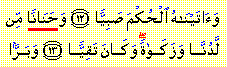
wa ḥananan min ladunna wa zakatan wa kana taqiyya, i.e., "And tenderness [ḥananan] from Us and purity, he was devout." [Qur'an 19:13]
In other words, Yaḥya was a ḥananan from God; this is nothing but a paraphrase of what Yowchanan/Yuḥanna actually means, i.e., Jehovah [or God] is a gracious giver! What is even more interesting is that the word ḥananan occurs only once in the Qur'an,[30] i.e., in connexion with Yaḥya in the above verse (19:13). It is to be reminded that the root word ḥanan has a similar meaning in Aramaic, Hebrew and Arabic.
Attention should also drawn to the name Yuḥanna. Etymologically speaking, "Yu" in Arabic does not mean God unlike in Hebrew; hence making the word "Yuḥanna" quite meaningless. The Arabic word for the God is "Allah". It appears that Yuḥanna was borrowed into Arabic either from Syriac or Hebrew for the sake of usage.[31]
Let us now see what the tafsirs say concerning verse 19:13. Below is an excerpt from Tafsir of Ibn Kathir about verse 19:13.
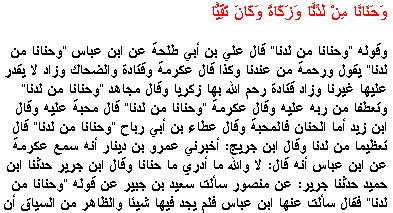
wa ḥananan min ladunna wa zakatan wa kana taqiyya, i.e., "And tenderness from Us and purity, he was devout,"
"And tenderness from Us": `Ali Ibn Abi Ṭalḥah narrated from Ibn `Abbas his saying wa ḥananan min ladunna means "mercy [Arabic: raḥmah] from Us" and similarly spoke `Ikrimah and Qatadah and al-Dahhak and he added "None is capable of such [mercy] except Us". Qatadah added "a mercy from God to Zakariyya". Mujahid said wa ḥananan min ladunna means "a pity from his Lord towards [English??] him". `Ikrimah said wa ḥananan min ladunna means "love upon him". Ibn Zayd said: As for "ḥanan" it means love. `Aṭa' Ibn Abi Rabaḥ said: wa ḥananan min ladunna means "exaltation/elevation from Us" [Arabic: ta`dhim]. Ibn Jurayj told us, `Amr Ibn Dinar told me that he heard `Ikrimah narrate from Ibn `Abbas his saying: "Nay, by Allah, I don't know what hanan means". Ibn Jarir said: Ibn Ḥumayd told us, Jarir narrated to us from Manṣur: I asked Sa`id Ibn Jubayr about wa ḥananan min ladunna, he said: I asked Ibn `Abbas about it and he did not know much about it. [...][32]
Many Islamic references like Tafsir of al-Qurṭubi and Al-Itqan by al-Suyuṭi and others narrated similar reports from Ibn `Abbas concerning "ḥanan".
6. Exegesis Of Verse 19:7... lam najʿal lahu min qablu samiyya.
... on none by that name have We conferred distinction before.
[Qur'an 19:7]
Ibn Kathir said in his tafsir concerning this verse:
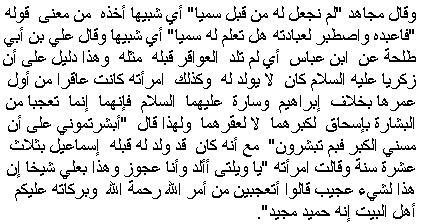
The translation of which is:
And Mujahid said:
lam najʿal lahu min qablu samiyya,
[samiyya means] shabihan - someone like him.He drove this meaning from God's speech [verse 19:65]
... fa`budhu wastabir liʿibadatihi hal taʿlamu lahu samiyya,
...so worship Him, and be constant and patient in His worship: knowest thou of any who [qualifies to be] His samiyya?Meaning [of samiyya is] shabihan - someone like him.
ʿAli Ibn Abi Ṭalḥah narrated from Ibn ʿAbbas that it means: No barren woman gave birth to someone like him before.
This also proves that Zakariyya was sterile[33] as was his wife [who was sterile from the beginning of her life] unlike Abraham and Sarah. The reason for their [Abraham and Sarah's] amazement at the glad tidings of Isaac was due to their old age and not to infertility. This is why Abraham said [in amazement]:
abashshartumuni ʿala an massaniya al-kibaru fabima tubashshirun,
i.e., Do ye give me glad tidings even though old age has seized me? Of what, then, is your good news? [verse 15:54]even though had Ismaʿil 13 years earlier.
Likewise, his wife said:
ya waylata a'alidu wa ana ʿajuzun wa hadha baʿli shaykhan inna hadha lashay'un ʿajib. Qalu ataʿjabina min amrillahi raḥmatullahi wa barakatuhu ʿalaykum ahla al-bayti innahu ḥamidun majid,
i.e., She said: "Alas for me! shall I bear a child, seeing I am an old woman, and my husband here is an old man? That would indeed be a wonderful thing!". They said: "Dost thou wonder at Allah's decree? The grace of Allah and His blessings on you, o ye people of the house! For He is indeed worthy of all praise, full of all glory! [verses 11:72-73].[34]
The key word here is samiyya and a detailed analysis of this word is given in the Appendix A. The word samiyya occurs only twice in the Qur'an:[35] at verse 19:7 in connection with Yaḥya and in 19:65 in reference to Allah.
Using the method of using the Qur'an to explain the Qur'an, Ibn Kathir drives home the point that the birth of Yaḥya was unlike the birth of any other. This explanation is also supported by the hadith from Ibn Abbas. Ibn ʿAbbas said that what is meant here is that there had never been a boy similar to Yaḥya in the sense of being born to an aged father and a barren mother. Although Isaac was born to parents who were also old, neither of them were infertile. It is for this reason that Isaac was unlike Yaḥya in his birth.
And al-Suyuṭi says the following in his tafsir:
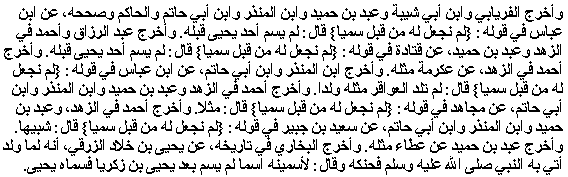
The translation of which is:
Narrated al-Faryabi and Ibn Abi Shaybah and ʿAbd Ibn Ḥumayd and Ibn al-Mundhir and Ibn Abi Ḥatim and al-Ḥakim who declared it Sahih that Ibn ʿAbbas said: lam najʿal lahu min qablu samiyya.
Narrated ʿAbd ar-Razzaq and Aḥmad in Al-Zuhd and ʿAbd Ibn Ḥumayd that Qatadah said concerning lam najʿal lahu min qablu samiyya.
Aḥmad narrated the same report in Al-Zuhd from the way of ʿIkrimah. Ibn al-Mundhir and Ibn Abi Ḥatim narrated that Ibn ʿAbbas said concerning lam najʿal lahu min qablu samiyya: "No barren woman gave birth to child like him".
Narrated Aḥmad in Al-Zuhd and ʿAbd Ibn Ḥumayd and Ibn al-Mundhir and Ibn Abi Ḥatim that Sa`id Ibn Jubayr said concerning lam najʿal lahu min qablu samiyya: He said: [samiyya means] shabihan - someone like him.
ʿAbd Ibn Ḥumayd narrated a similar report from the way of ʿAṭa'. Al-Bukhari narrated in his Tarikh from Yaḥya Ibn Khallad al-Zarqi that when he [Yaḥya] was born, he was brought to the Prophet who fed him a chewed date and said: "I shall give him a name that was never given [to anyone] before: Yaḥya Ibn Zakariyya" and so he called him Yaḥya.[36]
From the above discussion, we see that scholars hold two opinions concerning the verse lam najʿal lahu min qablu samiyya:
- Samiyy, means shabihan or mithlan, i.e., someone like him. The verse is interpreted to mean that the birth of Yaḥya was unlike the birth of others, as he was born to an aged father and a barren mother.
- No one prior to the birth of Yaḥya was ever given that name by God.
Al-Ṭabari provides reports for both interpretations, but opines that the latter seems to be more correct. Al-Qurṭubi mentions both opinions but did not express a preference. And Ibn Kathir, who cites al-Ṭabari's opinion (see above), also does not express any preference.
7. ConclusionsGeiger and the Christian missionaries have pointed to a difficulty arising at verse 19:7 where the birth of the Yaḥya is announced. According to their understanding, the name Yaḥya is the Arabic equivalent of the name John. They also understand that the name Yaḥya is unique, and no human being prior to the birth of Yaḥya ever possessed such a name. However, in the Old Testament there are more than twenty-five references to the name John, and it is for this reason that the Qur'an is in error. This study has shown conclusively that the names Yaḥya and John (Yuḥanan or Yuḥanna) are two entirely different names derived from two different roots. Geiger and the missionaries have failed to investigate the linguistic origins of the two names, and have wrongly concluded that the Qur'an is in error.
The verse at 19:7 which reads lam najʿal lahu min qablu samiyya may be interpreted in two ways:
- Samiyy, means shabihan or mithlan, i.e., someone like him. The verse is interpreted to mean that the birth of Yaḥya was unlike the birth of others, as he was born to an aged father and a barren mother.
- The name Yaḥya is unique, and no one prior to the birth of Yaḥya was ever given such a name by God, a point conveniently overlooked by the missionaries.
Was Yaḥya also called Yowchanan [or Yuḥanna]? It appears to be so, and God knows best. It is through the Mandaeans we get the dual name Yahia Yuhana. According to Mandaic literature Yahia is a malwasha name or the real name and Yuhana is a laqab or a lay name. The Qur'an uses only the real and spiritual name, i.e., Yaḥya; Yuḥanna is expressed as a paraphrase in the verse 19:13 perhaps due to the fact that "Yu" in Arabic does not mean God, hence making the word "Yuḥanna" etymologically meaningless. Presumably, "Yuḥanna" was borrowed into Arabic through Hebrew or Syriac sources. Interestingly, the Encyclopaedia Judaica under the entry 'John the Baptist'[37] mentions only the Arabic name: Yaḥya ibn Zakariyya. There follows no discussion concerning the name, unlike the entries for Moses, Jesus, etc.
The use of the name Yahia Yuhana among the Mandaeans is certainly interesting. It should also be noted that much of their surviving literature is relatively late. There do exist Mandaean incantation bowls that are dated from pre-Islamic period.[38] Further research and discoveries would throw more light on the origins of Mandaic literature, insha'allah.
Once again the Christian missionaries have failed to show a "historical" contradiction in the Qur'an. Had they bothered to probe this controversy, even slightly, they would never have made such blunders. But as it stands, there is a preference among Christian missionaries to blindly follow each and every cheap polemic, and had this "contradiction" not been so widely circulated, we would not have bothered with its response.
And as always Allah knows best!
Acknowledgements
One of the authors (MSMS) would like to thank Professor Robert Hoberman, Dr. Geoffery Khan and Mr. Shibli Zaman for stimulating discussions on comparative linguistics. Professor Robert Hoberman and Dr. Geoffery Khan are not associated with Islamic Awareness.
Appendix AThe note made by al-Ṭabari in his tafsir regarding the pattern of samiyy being faʿil pushed us to look up its root in an Arabic lexicon. Below are some interesting excerpts from the famous Arabic lexicon Lisan al-`Arab. We do not quote it in its entirety, due to unnecessary length:[39]

The translation of which is:
Sama: "as-sumuww" means elevation and highness.
You say: "samawtu" and "samaytu" [i.e., I rose] in the same pattern of "`alawtu" and "`alaytu" and "salawtu" and "salaytu", according to Tha`lab.And "sama ash-shay'u" [i.e., something rose] "yasmu" [i.e., it rises] "sumuwwan" [i.e., raising] fahuwa "samin" [i.e., it is elevated]. And [you say] "sama bihi" and "asmahu" meaning: made someone or something high. And you say to the noble: "qad sama".
And when you raise your eyes to something, you say: "sama ilayhi baṣari" [i.e., my eyes rose to it]. And when a remote thing is elevated for you so that you see it distinctly, you say: "sama li shay'un".
And [you say] "sama li shakhsu fulan" [literally: the person of someone rose to me] meaning that he rose until I saw him distinctly. And [you say] "sama baṣaruh" [i.e., his eyes rose] meaning that they went up.
Further we read:
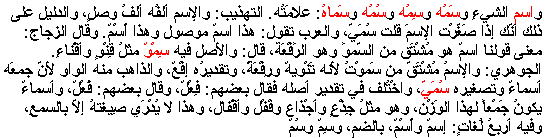
The translation of which is:
Something's "ism" [i.e., its name], and its "sam", "sim", "sum" and "sama" is its [distinctive] sign.
In Al-Tahdhib: the alif of "ism" is classified as "alif wasl" [i.e., it does not belong to the root] and the proof is that its diminutive form is "sumayy".
The Arabs say "hadha-smun mawṣul" and "hadha [???]".
Al-Zajjaj said: The meaning of the word "ism" [i.e., its name] is derived from "as-sumuww" which is highness. He said: it's origin is "simw" [i.e., the third letter of the word is an omitted waw] like the word "qinw" and [the plural] "aqna'".
Al-Jawhari said: "ism" [i.e., its name] is derived from "samawtu" because it denotes highness and it's pattern is "if`", and the omitted letter is a waw because it's plural is "asma'" and its diminutive form is "sumayy". There was disagreement on the pattern of its origin. Some said: "fi`l" and others said "fu`l" and the plural "asma'" is possible for this pattern also illustrated in "jidh`" and "ajdha`" and "qufl" and "aqfal" and this could not be settled except through listening [to the native Arabs] and it has four ways: "ism" and "usm" with an u, and "sim" and "sum".
And going further we see:

And your "samiyy": the one who bears your name. You say: He is the "samiyy" of someone when their names match like when you say his "kaniyy" [to the one who has the same nickname].
And in the Holy Scripture: lam naj`al lahu min qablu samiyya: None before him was his 'samiyy';
Ibn `Abbas said: None before him was given the name Yaḥya. It was also said: It means none before him was equivalent to him or like him. It was also said: He was called Yaḥya because he "ḥaya" lived with knowledge and wisdom. With regard to Almighty's speech: hal ta`lamu lahu samiyya, i.e., "knowest thou of any who [qualifies to be] His samiyy?" meaning "nadhir" [i.e., equivalent] who deserves the same name.
From the above quotations, we learn that samiyy is derived from the root "sin+mim+waw" which refers to highness and elevation. Besides all the linguistic details, when we get to the root, we learn that the word samiyy has two meanings. It means "namesake" and it can also refers to a like or someone equivalent. Both these meanings are discussed in tafsir literature.
References
[1] A. Geiger, Judaism And Islam (English Translation Of Was hat Mohammed aus dem Judenthume aufgenommen?), 1970, Ktav Publishing House Inc.: New York, pp. 19.
[2] Jalaluddin `Abd ar-Raḥman al-Suyuṭi, Al-Itqan fi `Ulum al-Qur'an, 1987, Dar al-Kutub al-`Ilmiyyah: Beirut, First Edition, Volume 2, Section 69: "The Names, Surnames and Titles that Occur in the Qur'an", pp. 304-305.
[3] P. Casanova, "Idris et Ouzaïr", Journal Asiatique, 1924, Volume CCV, p. 357. Since ours in not the official translation, we publish the original.
Aussi ai-je hésité longtemps à proposer les corrections qui me paraissaient vraisemblables. Ce qui me décide aujourd'hui, c'est que, je dois le constater, les érudits occidentaux tendent de plus en plus à s'affranchir du respect superstitieux qu'ils avaient jusqu'alors pour l'intégrité absolue du Coran, et qu'un savant sémitisant allemand, feu Barth a proposé à son tour des corrections assez importantes, entre autres une qui m'intéresse particulièrement, car il y a longtemps que j'y avais pensé et je suis heureux de la voir présentée, tells que je l'avais imaginée moi-même. C'est la correction Youḥanna pour Yaḥya Youhanna au lieu de Yaḥya, nom de saint Jean-Baptiste. Je n'osais pas la publier, d'abord pour la raison générale énoncée plus haut, ensuite parce qu'elle entraine une curieuse conséquence. En effet, les Mandaïtes ou pseudo-Chrétiens de saint Jean, qu'on identifie aux Sabiens du Coran, ont un livre où leur principal prophète est appelé Yahio. Si ce nom est du à une erreur de lecture des rédacteurs du Coran, le livre est nécessairement postérieur à la diffusion du Coran canonique et toutes les théories édifiées sur cette identification s'écroulent.
[4] D. Margoliouth, "The Origins Of Arabic Poetry", Journal Of The Royal Asiatic Society, 1925, pp. 417-449.
[5] A. Mingana, "Syriac Influences On The Style Of The Kur'an", Bulletin Of The John Rylands Library Manchester, 1927, Volume II, p. 78.
[6] D. Margoliouth, "Textual Variations Of The Koran", The Moslem World, 1925, Volume XV, p. 343.
[7] A. Mingana, "Syriac Influences On The Style Of The Kur'an", Bulletin Of The John Rylands Library Manchester, 1927, op. cit., p. 84.
[8] Ibid.
[9] Arthur Jeffery, The Foreign Vocabulary Of The Qur'an, 1938, Oriental Institute: Baroda, p. 290.
[10] Ibid., p. 291.
[11] C. C. Torrey, The Jewish Foundation Of Islam, 1967, Ktav Publishing House, Inc.: New York, pp. 50-51.
[12] Further details concerning this community can be found in Encyclopaedia Britannica under Mandaeanism. And information concerning their beliefs can be found here.
[13] J. D. McAuliffe, "Exegetical Identification Of The Ṣabi'un", The Muslim World, 1982, Volume LXXII, pp. 95-106.
[14] D. A. Chwolson, Die Ssabier und der Ssabismus (In two volumes), 1856, St. Petersburg.
[15] J. Pedersen, "The Sabians" in T. W. Arnold & R. A Nicholson (editors), A Volume Of Oriental Studies Presented To Edward G. Browne On His 60th Birthday, 1922, Cambridge At The University Press, pp. 383-391.
[16] See also Vaux's article for some support to this hypothesis. B. Carra De Vaux, "Al-Sabi'a", Encyclopaedia Of Islam (Old Edition), 1934, E. J. Brill Publishers: Leyden & Luzac & Co.: London, p. 387.
[17] J. Pedersen, "The Sabians", in T. W. Arnold & R. A Nicholson (editors), A Volume Of Oriental Studies Presented To Edward G. Browne On His 60th Birthday, 1922, op. cit., p. 387.
[18] E. S. Drower, The Secret Adam: A Study Of Naṣoraean Gnosis, 1960, Oxford At The Clarendon Press, p. ix.
[19] B. Dodge, "The Sabians Of Ḥarran" in Fu'ad Sarruf & Suha Tamim (Eds.), American University Of Beirut Festival Books, 1967, p. 63.
[20] E. S. Drower, The Mandaeans Of Iraq And Iran, 1962, E. J. Brill: Leiden, pp. 2-3.
[21] E. S. Drower, The Canonical Prayer Book Of The Mandaeans, 1959, E. J. Brill: Leiden, p. 106. See also p. 152.
[22] E. S. Drower & R. Macuch, A Mandaic Dictionary, 1963, Oxford At The Clarendon Press, see p. 185 for 'iahia' and p. 190 for 'iuhana'.
[23] ibid., p. 171.
[24] C. Brockelmann, Lexicon Syriacum, 1928, Halix Saxonum, Sumptibus Max Niemeyer, pp. 228-229. See also p. 220.
[25] J. Payne Smith (ed.), A Compendious Syriac Dictionary, 1967, Oxford At The Clarendon Press, pp. 138-139.
[26] We are grateful to Professor Robert Hoberman for pointing this out.
[27] `Alawi Ibn Muḥammad Ibn Aḥmad Bilfaqih, Al-Qira'at al-`Ashr al-Mutawatir, 1994, Dar al-Muhajir, p. 305. In the Qiraa'aat, for example, of Ḥamzah, al-Kisa'i, Warsh and Khalaf, with imalah it is read Yaḥyei. In the Ḥafṣ Qiraa'aat, it is read as Yaḥya without imalah.
[28] E. M. Yamauchi, Gnostic Ethics And Mandaean Origins, 1970, Harvard University Press: Cambridge (MA), p. 5.
[29] E. S. Drower, The Mandaeans Of Iraq And Iran, 1962, op. cit., p. 81.
[30] Muḥammad Fu'ad `Abd al-Baqi, Al-Mu`ahjam al-Mufahris li al-Fadh al-Qur'an al-Karim, 1997, Dar al-Fikr: Beirut (Lebanon), p. 279.
[31] We are grateful to Professor Hoberman and Dr. Geoffery Khan for a detailed discussion on the etymological issues surrounding the word "Yuḥanna" in both Hebrew and Arabic.
[32] Tafsir Ibn Kathir, available online.
[33] This is a rather strange assertion by Ibn Kathir unsupported by any evidence.
[34] Tafsir Ibn Kathir, available online.
[35] Muḥammad Fu'ad `Abd al-Baqi, Al-Mu`ahjam al-Mufahris li al-Fadh al-Qur'an al-Karim, 1997, op. cit., p. 451.
[36] Jalaluddin `Abd ar-Raḥman al-Suyuṭi, Al-Durr al-Manthur, downloadable from al-Muhaddith website.
[37] Under "John the Baptist", Encyclopaedia Judaica (CD-ROM Edition), 1997, Judaica Multimedia (Israel) Limited.
[38] W. S. McCullough, Jewish And Mandaean Incantation Bowls In The Royal Ontario Museum, 1967, University Of Toronto Press. Five terracotta bowls are discussed in this book.
[39] Ibn Mandhur, Lisan al-`Arab, downloadable from al-Muhaddith website.


