Saturday, 23 September 2017

Literal


Cursed are those who refuse to do the LORD's work, A curse on anyone who keeps their sword from bloodshed! (Jeremiah 48:10)

---------------------

Just for the record, this is not a metaphorical statement it's literal. Yes when the verse say's "A curse on anyone who keeps their sword from bloodshed!" means just that. We have good evidence from Jewish source that this statement was taken literally. Take for example
Joab the son of Zeruiah, was the nephew of King David and the commander of his army, according to the Hebrew Bible. What did Joab say about this statement?

-------------------------

Joab took a sword to kill him. The teacher said to him: Why do you want to kill me? Joab said to him: As it is written: “Cursed is he who does the work of the Lord with a slack hand”(Jeremiah 48:10), and you taught me incorrectly. The teacher said to him: Leave that man to remain as cursed. This is a sufficient punishment; there is no need to kill me. Joab said to him: It is also written: “And cursed is he who keeps back his sword from blood”(Jeremiah 48:10).  (Talmud Bava Batra 21b:2)


Notice how Joab the nephew of king David killed the teacher because he did not teach joab correctly by following the lord. Joab was quoting Jeremiah 48:10 to prove this was a literal commandment from yahweh. Ask yourself are Christians doing the work of the Lord by following the Torah ? They  say every word in the Bible is from God, yet reject the teachings of the Old Testament.

next time they say, the Bible does not promote violence ask them why then did yahweh curse those who slack doing his work and refrain from using their sword? Heres more teaching from the Mishna

 It is explicitly stated in the Tradition that, “Cursed be he who does the work of G-d sluggishly, and cursed be he who keeps back his sword from blood” (Jeremiah 48:10). However, anyone who does fight with all his heart without fear, and his intentions are only to Sanctify the Name, is promised that he will not be harmed and nothing bad will happen to him. He will build an upright home in Israel, and he and his children will earn merit forever, and merit The World To Come, as it says, “certainly, G-d shall make for my master a faithful house, for the wars of G-d does my master fight and no evil will be found with you all your days…And the soul of my master will be bound with the living, with the Lord your G-d…” (I Samuel 25:28-29). (Mishneh Torah, Kings and Wars 7:15)

the teaching from Jeremiah is clear, you are cursed unless your sword is drenched in blood.

Friday, 22 September 2017

Certificate

Alhumdulillah i have completed my course on, "The Resurrection of  Jesus". I've had the privilege to study under Dr. Gary Habermas a PhD professor specialized in the Crucifixion and  Resurrection of Jesus along side Micheal Patterson MA in theology. I've learnt and a lot and In Shaa Allah in due time i will share my thought with you guys .


Wednesday, 20 September 2017

Ancient Jewish Sects: Pharisees and Sadducees

written by Dr. Bart D Ehrman

I was about to launch into a discussion of the different views of the afterlife among various Jewish sects (those that held to the idea of the resurrection and those that apparently did not), but then realized that first I need to give some information about what the groups themselves were all about.  So I’ll devote two posts to the question, lifting the discussion from my textbook The New Testament: A Historical Introduction to the Early Christian Writings.
******************************************************
THE FORMATION OF JEWISH SECTS
It was during the rule of the Hasmoneans, and evidently in large measure in reaction to it, that various Jewish sects emerged. As we have seen, the Jewish historian Josephus mentions four of these groups; the New Testament refers to three. In one way or another, all of them play a significant role in our understanding of the life of the historical Jesus.
I should emphasize at the outset that most Jews in Palestine did not belong to any of these groups. We know this much from Josephus, who indicates that the largest sect, the Pharisees, claimed 6,000 members and that the Essenes claimed 4,000. The Sadducees probably had far fewer. These numbers should be considered in light of the overall Jewish population in the world at the time; the best estimates put the number at something like 4 million.
What matters for our purposes here, however, is not the size of these groups, for they were influential despite their small numbers, but the ways in which they understood what it meant to be Jewish, especially in light of the political crises that they had to face. Members of all of the sects, of course …

Members of all of the sects, of course, would have subscribed to the basic principles of the religion, as sketched earlier in the chapter: each believed in the one true God, the creator of all things, who was revealed in the Hebrew Scriptures, who had chosen the people of Israel, and who had promised to protect and defend them in exchange for their committed devotion to him through following his laws. The groups differed in significant ways, however, in their understanding of what obedience to God’s laws required and in how they responded to the rule of a foreign power and to the presence of a high priest from a line other than Zadok’s.
Pharisees
The Pharisees represent probably the best-known and least-understood Jewish sect. Because of the way they are attacked in parts of the New Testament, especially in Matthew, Christians through the ages have wrongly considered the Pharisees’ chief attribute to be hypocrisy.
It appears that this sect began during the Maccabean period as a group of devout Jews intent above all else on keeping the entire will of God. Rather than accepting the culture and religion of the Greeks, these Jews insisted on knowing and obeying the Law of their own God to the fullest extent possible. One of the difficulties with the Law of Moses, however, is that in many places it is ambiguous. For example, Jews are told in the Ten Commandments to keep the Sabbath day holy, but nowhere does the Torah indicate precisely how this is to be done. Pharisees devised rules and regulations to assist them in keeping this and all the other laws of Moses. These rules eventually formed a body of tradition, which, to stay with our example, indicated what a person could and could not do on the Sabbath day in order to keep it holy, or set apart from all other days. Thus, for example, when it was eventually determined that a faithful Jew should not go on a long journey on the Sabbath, it had to be decided what a “long” journey was, and consequently what distance a Jew could travel on this day without violating its holiness. Likewise, a worker who believed that he or she should not labor on the Sabbath had to know what constituted “work” and what therefore could and could not be done.
Or a second example: the Law of Moses commands Jewish farmers to give one-tenth of their crops, that is, a tithe, to the priests and Levites (e.g., Num 18:20–21). Priests performed sacrifices in the temple, and Levites were their assistants. Since they themselves were not allowed to farm, the tithes they received represented their financial support for serving God. What should a person do, however, who purchased food from a farmer, not knowing whether the food had been properly tithed? To be on the safe side, some Pharisees maintained that they should tithe the food they purchased, as well as the food they grew. This way they could be certain that God’s law was being followed. And if it got followed twice in this case, so much the better—especially for God’s priests and Levites!
The rules and regulations that developed among the Pharisees came to have a status of their own and were known in some circles as the “oral” Law, which was set alongside the “written” Law of Moses. It appears that Pharisees generally believed that anyone who kept the oral Law would be almost certain to keep the written Law as a consequence. The intent was not to be legalistic but to be obedient to what God had commanded.
The Pharisees may have been a relatively closed society in Jesus’ day, to the extent that they stayed together as a group, eating meals and having fellowship only with one another, that is, with those who were like-minded in seeing the need to maintain a high level of obedience before God. They did not have close ties with those who were less stringent in maintaining purity before God, and avoided, therefore, eating meals with common people.
It is important to recognize that the Pharisees were not the “power players” in Palestine in Jesus’ day. That is to say, they appear to have had some popular appeal but no real political clout. In some ways they are best seen as a kind of separatist group; they wanted to maintain their own purity and did so in relative (not complete) isolation from other Jews. Many scholars think that the term “Pharisee” itself originally came from a Persian word that means “separated ones.” Eventually, however, some decades after Jesus’ execution, the Pharisees did become powerful in the political sense. This was after the Jewish War (which I will describe more fully later in Chapter 17), which culminated in the destruction of Jerusalem and the Temple in the year 70 C.E. With this calamity the other groups passed from the scene for a variety of reasons, and the descendants of the Pharisees were given greater authority by the Roman overlords. The oral tradition continued to grow and to be invested with greater authority. It was eventually written down around the year 200 C.E. and is today known as the Mishnah, the heart of the Jewish sacred collection of texts, the Talmud.
Sadducees
It is difficult to reconstruct exactly what the Sadducees stood for because not a single literary work survives from the pen of a Sadducee, in contrast to the Pharisees, who are represented to some extent by the later traditions of the Talmud; by Josephus, who was a Pharisee; and by the one Pharisee who left us writings before the destruction of the Temple (after he had converted to Christianity), the apostle Paul. To understand the Sadducees, however, we must turn to what is said about them in other sources, such as Josephus and the New Testament.
During Jesus’ own day, the Sadducees were evidently the real power players in Palestine. They appear to have been, by and large, members of the Jewish aristocracy in Jerusalem who were closely connected with the Jewish priesthood in charge of the Temple cult. Most of the Sadducees were themselves priests (although not all priests were Sadducees). As members of the aristocracy, granted some limited power by their Roman overlords, Sadducees appear to have been conciliatory toward the civil authorities, that is, cooperative with the Roman governor. The local Jewish council, commonly called the Sanhedrin, which was occasionally called together to decide local affairs, was evidently made up principally of Sadducees. With their close connection with the Temple, Sadducees emphasized the need for Jews to be properly involved in the cultic worship of God as prescribed in the Torah. Indeed, it appears that the Torah itself, that is, the five books of Moses, was the only authoritative text that the Sadducees accepted. In any event, we know that they did not accept the oral traditions formulated by the Pharisees. Less concerned with the regulation of daily affairs such as eating, travel, and work, the Sadducees focused their religious attention on the sacrifices in the Temple and expended their political energy on working out their relations with the Romans so that these sacrifices could continue.
It may have been their rejection of all written authority outside of the five books of Moses that led the Sadducees to reject several doctrines that later became characteristic of other groups of Jews. They denied, for example, the existence of angels and disavowed the notion of the future resurrection of the dead. Their views of the afterlife may well have conformed, essentially, with those of most non-Jews throughout the empire: either the “soul” perishes with the body, or it continues on in a kind of shadowy netherworld, regardless of the quality of its life here on earth.

Monday, 18 September 2017

The Bible and Its Divorce Contradiction


Welcome to Bismika Allahuma, containing Muslim responses to anti-Islam polemics. If you are new here, you may want to check out our Sitemap to get an idea of what we cover. Thank you for visiting!
According to the Bible, can a person get divorced and remarry without committing adultery? Remarriage after divorce is prohibited because it is adultery. Jesus clearly says so.
    Mark 10:2-5, 9-12: “And the Pharisees came to him, and asked him, Is it lawful for a man to put away his wife? tempting him. And he answered and said unto them, What did Moses command you? And they said, Moses suffered to write a bill of divorcement, and to put her away. And Jesus answered and said unto them, For the hardness of your heart he wrote you this precept…What therefore God hath joined together, let not man put asunder. And in the house his disciples asked him again of the same matter. And he saith unto them, Whosoever shall put away his wife, and marry another, committeth adultery against her. And if a woman shall put away her husband, and be married to another, she committeth adultery.”1
Hence the logical notation or form of the prohibition on remarriage based on the above verse is:
    (x)(Dx & Rx => Ax)
where D is for “divorced,” R is for “remarried,” and A is for “commits adultery.” It is read, “For anything x, if x is divorced and x is remarried, then x commits adultery.” This is universal and applies without exception to any x, according to the above quotations from Jesus. “Whosoever” means “anyone”. Jesus also says this applies for any divorced man and any divorced woman:
“Whosoever shall put away his wife, and marry another, committeth adultery against her. And if a woman shall put away her husband, and be married to another, she committeth adultery.” 2
Other parts of the Bible also state that if someone divorces, the person is not to remarry.3
So no one who divorces can remarry without committing adultery. But, on the other hand, the Bible also says that not everyone who divorces a spouse and remarries is committing adultery:
“When a man hath taken a wife, and married her, and it come to pass that she find no favour in his eyes, because he hath found some uncleanness in her: then let him write her a bill of divorcement, and give it in her hand, and send her out of his house. And when she is departed out of his house, she may go and be another man’s wife.”4
Jesus agrees that you can get divorced and remarry as long as you divorce because of fornication:
“And I say unto you, Whosoever shall put away his wife, except it be for fornication, and shall marry another, committeth adultery; and whoso marrieth her which is put away doth commit adultery.”5
But if you can divorce and remarry without committing adultery (in case of fornication), then this implies the following:
    ~[(x)(Dx & Rx => Ax)]
If there is an exception, then the conditional cannot apply to any and all things x and it is not the case that whoever divorces and remarries commits adultery. This is a formal contradiction, since the Bible, and even just the New Testament, endorses both sides of the issue:
    (x)(Dx & Rx => Ax) & ~[(x)(Dx & Rx => Ax)]
So the Bible contradicts itself on whether one can get a divorce and remarry without committing adultery. This is a formal contradiction supported by the Biblical text. It should be noted that New Testament scholars are not even sure what Jesus(P) originally said on the topic of divorce and remarriage. What we find in the Gospels are a variety of forms of sayings which were developed at different times among different Christian communities. D. C. Parker concludes:
“The main result of this survey is to show that a recovery of a single original saying of Jesus is impossible. We have been able to show that some forms of text were developments. But it does not follow that one of those with which we are left is more original than the others. The differences between the four passages in Matthew (twice), Mark and Luke are already great. But the development of the tradition goes beyond that, both in time and in extent. We can see the tradition being developed right through to the formation of the Byzantine text.
The quest for a Law in the teaching of Jesus cannot be pursued in the face of the evidence that, for those early Christians who passed the traditions to us, there was no law, but a tradition whose meaning had to be kept alive by reflection and reinterpretation. What we have is a collection of interpretative rewritings of a tradition.” 6
And only Allah knows best!

Sunday, 17 September 2017

Signs of the Beginning of Sorrows Mark 13:8 (variations)


Can you believe that on the last word of a sentence there could be no less than nine variations? That is the situation with Mark 13:8! How would one discern which could represent the original? Only one can be in accordance with the original autograph as inspired by the Holy Spirit.
Let us first look at what these variations are and how much support each has in the available manuscripts.
This is called the external criteria.
1. External criteria.
1. “Nation will rise against nation, and kingdom against kingdom. There will be earthquakes in various places, ‘there will be famines.’ These are the beginnings of birth pains.” Four Greek codices (±350 – 750 A.D.) and three Antique Translations (±250 – 450). This variation is found in the New International Version.
2. ‘… and there will be famines and troubles.’ (And troubles added). Five Greek uncials, (450 – 850} 21 Greek minuscules (after 900) as well as four ancient translations (450 – 950) This variation is found in the King James Version.
3. ‘… and famines.’ One Greek codex (450), the Vulgate (350) and eleven Old Latin translations (350 – 1250). (This illustrates that the repeated verb “there will be” could be replaced with “and” without altering the meaning, yet it is an alteration that people that refer to the many variations in the Bible, like to count!)
4. ‘… troubling famines.’ One Greek codex (375) and two antique translations (250 and 350). (By altering the sequence of “famine” and “trouble”, the two words form a new meaning, but still making perfect sense.)
5. ‘… and plagues and troubles. ‘ One Greek codex (750), two Greek minuscules (after 900), and one antique translation (950). (Here famines ‘limoi’ is replaced with pestilence or plagues ‘loimoi’, a reading mistake that could easily happen.)
6. ‘… and there will be famines and plagues and troubles.’ One Greek uncial and one Greek minuscule. (If you have one manuscript reading “famines and troubles” and another reading “plagues and troubles” how would you decide? For fear of leaving out the correct word, a scribe would rather put them in both!)
7. ‘… and there will be earthquakes, and famines in various places and troubles.’ One Greek lectionary. (Here “in various places” was transposed from “earthquakes” to “famines”. Something that can happen!)
8. ‘… plagues and famines and troubles.’ One antique translation. (Once again the sequence of words come into play.)
9. ‘… hunger and thirst.’ One antique translation. (Could it be that the scribe had to swot a fly and then completed the sentence from his memory with two words belonging together?)
We have to consider only the first two variations. The others I added with my personal notes in brackets to illustrate an important human trait concerning the habits of scribes. This just shows the human factor that can cause variations without any mala fide intention.
One can immediately see that the first variation is present in the oldest Greek codices and oldest antique translations. Many late manuscripts, especially the minuscule manuscripts after 900 A.D. only prove that they were copied from a source text containing that version. Many copies of any document do not prove anything concerning the original autograph.
According to the manuscripts the version as is found in the NIV has the greater possibility to represent the original autograph.
2. Internal criteria.
Our next criterion is to try and discern how the variations could have originated. I have explained possibilities for all the variations except the first two that are of real importance.
Had the original been only “earthquakes and famines” (like the NIV), someone had to add “and troubles”. But there is no reason to indicate the need for such an addition.
If however the original had been “earthquakes and famines and troubles” (like the KJV) someone had deliberately removed “troubles”. Again no reason for such an alteration can be found.
Since about 92% of Mark is taken up in Matthews and 85% in Luke, we can deduce that the authors of both these gospels have used Mark in compiling their gospels. In Matthew 24;7 we find “earthquakes and famines” like the NIV version. In Luke 21;11, we find “earthquakes and famines and pestilence” (limoi and loimoi) but not “troubles” (tarachai). If “troubles” had been part of Mark, why then would both Matthew and Luke remove that word? It just makes no sense.
This is a strong indication that the original autograph had to be without the word “troubles” (tarachai).
3. Intrinsic criteria.
Our last indication can come from an intrinsic study, looking at the context of this passage.
Looking at this passage as a whole, Jesus is explaining the signs that will precede the second coming. And in verse eight He first mentions what will happen between humans. “Nation will rise against nation and kingdom against kingdom.” Here “troubles” could fit in. But then Jesus indicates things that will happen in nature: “Earthquakes and famines” coming over men without their involvement. Here “troubles” does not fit in for it again reflects back to the actions of man.
According to the context this word also does not fit in.
Conclusion.
With all three objective criteria in agreement that the original autograph would have been without “troubles”, the removal of it from the version found in the familiar King James Version, is just restoring the Scripture to its original as had been inspired by the Holy Spirit.

Son or Donkey or Sheep in the well, Luke 14:5

Luke tells us of Jesus’ healing of the man who suffered of unusual swelling of the body due to water retention, also known as dropsy. This happened on a Sabbath day. Jesus defended Himself by asking the Pharisees who of them would not save something from a well on the Sabbath. What example did Jesus mention that had to be saved from the well?
KJV: “And answered them, saying, Which of you shall have an ass or an ox fallen into a pit, and will not straightway pull him out on the sabbath day?”
NIV: “If one of you, has a son or an ox that falls into a well on the Sabbath day, will you not immediately pull him out?”
In the manuscripts we find three versions.
1. Internal Criteria.
To try to come to a decision, we first examine the manuscripts that has this verse.
“A son or an ox” is found in Papyrus 45 and 75, both from ±250 A.D. Also in four other Uncials (350 – 850) and eleven Minuscules later than 850 A.D. Also in the majority of Byzantine manuscripts and Greek lectionaries. Lectionaries are copies of the passages of Scripture that were read in the Greek Orthodox Church on specific Sundays and holidays according to the Christian year, starting with Easter. This version is also found in seven antique translations dating between 250 – 650 A.D. Even the Diatessaron, a compilation of the four gospels made by Tatian the Syrian (±150 A.D.) has this version.
“A donkey or an ox” is found in six Uncials dated 350 – 850 A.D. and ten Minuscules and one Greek lectionary. It is also found in thirteen antique translations dated between 350 – 1300 A.D.
“A sheep or an ox” is found in codex Bezae (500) and one Old Latin translation from the same time.
Several other manuscripts have different sequences of these variations and even all three together, “a son or donkey or sheep or ox”. One manuscript ha an obvious misspelling where an “n” was substituted by an “r”, causing the version “a mountain or an ox”! Humans do make mistakes!
According to the manuscript evidence the version “son or ox” clearly has the older and better evidence and should be seen as the greatest possibility to represent the original autograph.
2. Internal Criteria.
But why and how could these variations have come about?
To have a son and an ox together could be seen as an uneasy fit by some scribes. Two animals mentioned together would not cause any offence or uneasiness. Therefore the version urging alteration would be the son and ox combination, causing the variations. That version should therefore have the greater possibility to be the original.
But why then combined with a donkey or a sheep?

Jesus had just beforehand (Luke 13:15) mentioned that anyone would untie his ox or donkey on the Sabbath and give it water. So the donkey and ox combination is easily acceptable.
And some scribe could have remembered that Jesus mentioned that one would save his sheep from a pit on the Sabbath when He had to defend His healing of the man with a shrivelled hand. (Matthews 12:11) Thus the combination of sheep and ox is also easily explained.After the three variations were created, the sequence or combinations or compilations could easily originated.Looking at these facts, it is obvious that the version with “son and ox” would rather render the original, calling for alteration to prevent offence.
3. Intrinsic Criteria.
Lastly we look at any possible markers from the context or use of words or expressions that could help us further to a definite choice. Unfortunately I find nothing and have to rely on the previous two criteria.
4. Conclusion.
With the first two criteria urging the “son or ox” variation to be in agreement with the original autograph, the version found in the NIV should be accepted rather than that in the KJV.
Although these variations makes no real difference in interpretation or application of this verse, these variations prove that men made mistakes, being it per chance or deliberately. Therefore all variations should be taken seriously and examined with all objective instruments to our disposal. We would like to have the Bible as near as possible to the very words the Holy Spirit had inspired the authors to write down. Even insignificant variations like these give us trust in the work of Script examiners and the Bible translators.

Monday, 11 September 2017

The Christian Fairy Tale vs. Scholarly Christianity


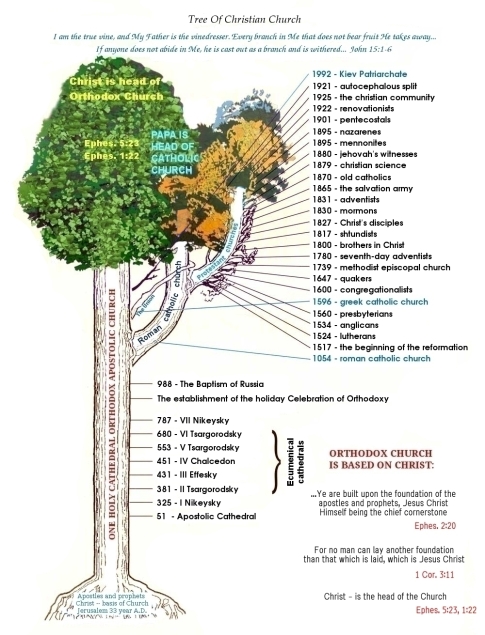
Tree of Christian sects form an Eastern Orthodox point of view.
Tree of Christian sects from an Eastern Orthodox point of view.
Most Christians know very little about there church history. They have no idea about the wide variety of beliefs of the early Christian sects, including the  Ebionites, Marcionites, Arionists, and Gnostics. Most have no idea about the history and development of the multitude of biblical canons or the forging of orthodox Christian theology. Many fundamentalist Christians are lead to believe the following fairy tale, which I will later contrast with the facts about early Christianity.
The Christian Fairy Tale
  • God, the creator of the universe, chose the Jews to be his people.
  • Jews were monotheistic (believed in only 1 god) from the start. Only rebellious Jews ever worshipped other gods.
  • God gave Jews the Hebrew Bible (which contains the exact same books as the Old Testament of the bible of my sect of Christianity) as a guide on how to please Him and live good lives. This included many animal sacrifices.
  • The Jews constantly disobeyed God.
  • The Jews were punished by having their kingdom(s) destroyed and by being scattered throughout the world.
  • Jesus was born around 0 A.D. (Anno Domini, in the year of our Lord) to the virgin Mary. (I will use CE, and BCE)
  • He is both the god of the Old Testament (OT) and is the son of the god of the OT. He is also the Holy Spirit.
  • Around the age of 30 he began his ministry.
  • Around the age of 33 he was sacrificed on the cross. He rose from the dead 3 days later and ascended to heaven.
  • His sacrifice atones those who believe in him for their sins. There is no need for further animal sacrifices or obedience to most OT diet and lifestyle laws other than sex restrictions.
  • True Christians will go to heaven for eternity when they die.
  • All others will burn forever in hell after death.
  • The early Christian church was united and had one perfect set of doctrines.
  • The New Testament (NT) is the perfect word of god that completes the OT.
  • Early Christians had no disagreement about the 27 books of the NT, which were established shortly after 33 CE.
  • The doctrines and canon of [insert name of Christian sect of childhood] have been the doctrines of Christians since the time of Christ.
  • Christianity is confirmed by the Dead Sea Scrolls and other archaeological evidence.
The above picture shows a tree of Christian sects from the point of view of the Eastern Orthodox church. Many other churches teach a similar history of Christianity, claiming that their particular sect is exactly like the original Christian church and all other branches are flawed. Notice that the Easter Orthodox part of the tree has beautiful green leavers while the other sects have ugly brown leaves. Also notice that the base of the tree is Jesus and the apostles in Jerusalem in 33 CE.
Here is a more generic tree of Christian sects from Wikipedia.
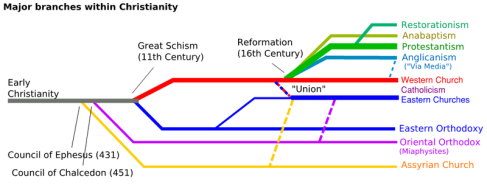
Tree of Christian sects from Wikipedia.

This tree is a little better, because it shows some divisions prior to the Catholic – Eastern Orthodox split. However, it still shows one base known as “Early Christianity”. Wikipedia also notes that “Protestantism in general, and not just Restorationism, claims a direct connection with Early Christianity.”  For example, the Church of Christ is one of many sects that believes they are most similar to the original Christian church.
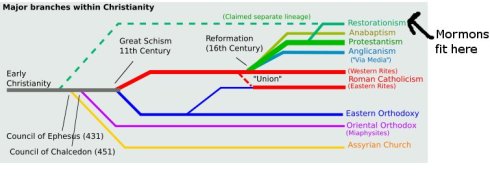
A Mormon blogger to the Wikipedia tree of Christian sects and altered it to show that Mormonism restored original Christianity.

None of the above trees are accepted by scholars (fundamentalist Christian or secular) as fully accurate. The tree of Christian sects below is from the University of California. It more accurately reflects the true nature of the development of Christianity. Most importantly, it represents the multitude of Christian sects that existed prior to the council of Nicea.
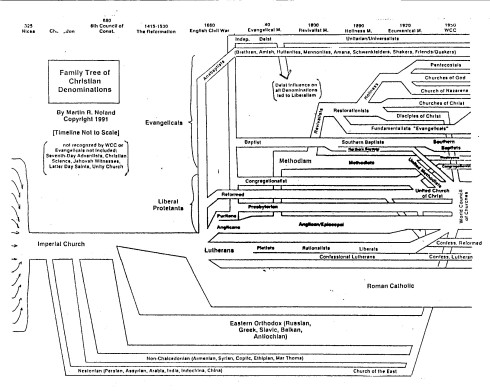
Tree of Christian sects from the University of California.

Notice that the base of the tree is very wide and has many arrows leading to the Imperial Church. These arrows represent the multitude of sects that existed prior to the Council of Nicea in 325 CE.
The following map (also from the University of California) shows many sects that existed at 325 CE, including the Ebionism in Jerusalem, Marcionism in Caesarea, Arianism in Alexandria, Gnosticism in Damascus, and others. The next section of this blog will focus on what some of these early Christian sects believed.
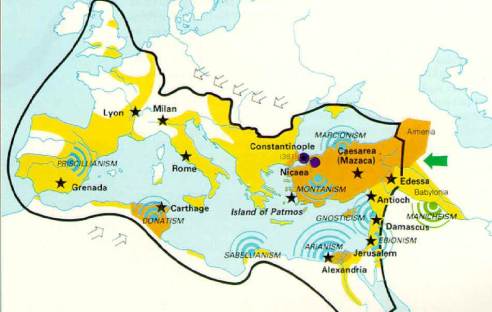
Map displaying Christian sects and their major areas of influence at the time of the Council of Nicea.

Scholarly Christianity
Judaism
  • Ancient Hebrews evolved from the ancient Canaanite Religion. El Elyon was the most high god of manygods.
  • Ancient Hebrews became monolithic. They believed in many gods, but Hebrews should only worship their god named Yahweh.
  • Ancient Hebrews evolved into monotheism around 6th century BCE, believing Yahweh was the only god.
  • Jews lived under the subjugation of many foreign rules, including Romans in the first century.
  • Jews rebelled against Rome in 66 – 73 CE. The Jerusalem Second Temple was destroyed in 70 CE. Masada fell in 73 CE
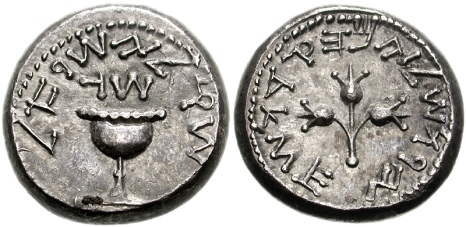
Coins by Jewish rebels in 68 CE proclaim "Jerusalem The Holy."
Coins by Jewish rebels in 68 CE proclaim “Jerusalem The Holy.”
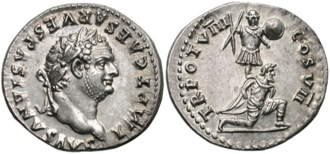
Roman coins around 73 CE show Jewish soldiers kneeling before Romans.
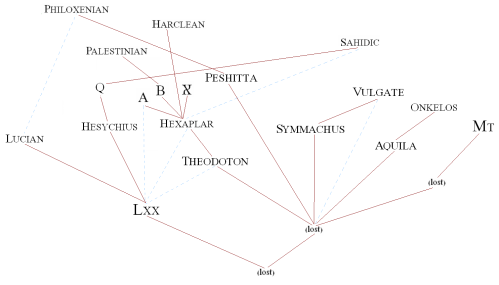

Depiction of the evolution of Old Testament texts. LXX is the Septuagint, MT is the Masoretic Text.


Example of Jewish editing.
  • Deuteronomy 32 (New International Version):8 When the Most High gave the nations their inheritance, when he divided all mankind, he set up boundaries for the peoples according to the number of the sons of Israel.[b] 9 For the Lord’s portion is his people, Jacob his allotted inheritance.
  • b: Masoretic Text; Dead Sea Scrolls (see also Septuagint) sons of God
  • Many scholars believe this passage in the DSS and LXX form supports polytheism. The Most High (Elyon) god divided mankind into nations, giving each son of god their allotment. The “Lord’s” (Jewish God’s) share were the children of Jacob.
Masoretic Text or Septuagint? 
  • The authors of the New Testament (NT) used the Greek Septuagint (LXX) when quoting OT books.
  • Catholics (46 books in OT), Orthodox (51 books), Ethiopians (46 books, or 50 splitting 1 & 2 Kings, etc), and others use the LXX.
  • Protestants use the Hebrew MT and have 39 book in OT.
  • Modern Jews use the Hebrew MT.
  • The Dead Sea Scrolls (DSS – Hebrew) are used by all sides to claim that the Septuagint supports their canons (set of scriptures considered holy).
Jesus Is Not An Important Person During His Time
  • Jesus was not important historically, as he was not mentioned by any contemporary historians, Jewish, Roman, Greek, or otherwise.
  • The general scholarly consensus is that Jesus was a Gallilean Jew born between 7 and 2 BCE. who condemned other Jews in particular of not following the laws or the spirit of the laws.
  • Jesus is believed to have been crucified by the Romans for rebellion against their authority around 30-36 CE.
  • There is a small minority of scholars who claim Jesus never existed. Some also claim Nazareth did not exist in the 1st Century.
  • My opinion is that Jesus was a Rabbi who was crucified by Rome. The supernatural deeds recorded in the bible are merely legend.
There were multiple versions of early Christianity with a variety of beliefs about the nature of Jesus and the relationship with Judaism and the OT. 
  • I will describe Ebionites and Marcionites,  Gnostics, Montanism, Arianism and proto-orthodox Christianity.
  • There were varieties within the above sects (especially Gnostics), and there were other sects not mentioned in this blog.
Ebionites – Very Jewish Christians From Jerusalem
  • Ebionites were very Jewish Christians.
  • They believed in 1 god.
  • They considered themselves Jews and obeyed the OT laws.
  • Only Christian sect recorded by Eusebius as keeping the Sabbath.
  • They believed Jesus was completely human and not divine.
  • They believed Paul was an arch heretic.
  • http://ebionite.org/ – Claim to be modern Ebionites.
  • Ebionites or similar groups such as Nazareans, were possibly the groups chastised by Paul for keeping the OT laws.
  • Matthew 5 was used by Ebionites to show that followers of Jesus should not abandon OT laws.
    • 17 “Do not think that I have come to abolish the Law or the Prophets; I have not come to abolish them but to fulfill them. 18 For truly I tell you, until heaven and earth disappear, not the smallest letter, not the least stroke of a pen, will by any means disappear from the Law until everything is accomplished. 19 Therefore anyone who sets aside one of the least of these commands and teaches others accordingly will be called least in the kingdom of heaven, but whoever practices and teaches these commands will be called great in the kingdom of heaven. 20 For I tell you that unless your righteousness surpasses that of the Pharisees and the teachers of the law, you will certainly not enter the kingdom of heaven.
Marcionites – Very Anti-Jewish Christians
  • Marcionites were Gentiles who claimed Jewish practice was harmful for a relationship with god.
  • They were followers or Marcion, a real person in the 2nd century.
  • They believed in two gods, one Jewish and one Christian.
  • They believed Jesus was completely divine and not human.
  • They rejected the Old Testament as a book inspired by the inferior god of the Jews.
  • They believed Paul was the one true apostle of Christ.
  • Jesus revealed himself to Paul because the other apostles failed to comprehend true Christianity because they were too Jewish.
First Christian Canon Created by Marcion, Who Is Now Considered a Heretic
  • Marcion (a real person considered a heretic by Proto-Orthodox Christianity) created the 1st Christian NT Canon around 144 CE. It contained a version of the gospel of Luke and 10 of the 13 letters of Paul, namely Romans, 1st & 2nd Corinthians, Galatians, Ephesians, Philippians, Colossians, 1st & 2nd Thessalonians, and Philemon.
  • Marion’s canon rejected the OT, Matthew, and John.
  • Proto-orthodox canons were a response to the canon created by Marcion.
Gnostics
  • Very spiritual and many widely varying subsets.
  • Believed Jesus was a spirit and did not suffer, but only appeared to suffer.
  • They believed in salvation through mysterious knowledge.
  • This world is full of ignorance and suffering; salvation comes not by making it better but by escaping it.
  • They had little church structure and taught equality of all members.
  • Coptic Gnostic texts were discovered in Nag Hamadi, Egypt, in 1945.
    • The Coptic Apocalypse of Peter:
    • “He whom you saw on the tree, glad and laughing, this is the living Jesus. But this one into whose hands and feet they drive the nails is his fleshly part, which is the substitute being put to shame, the one who came into being in his likeness. But look at him and me.”
    • Warns against those who “will cleave to the name of a dead man, thinking that they will become pure”.
First Listing Of Four Gospels Is A Response To Gnostics, Against Heresies
  • Around 180 CE, proto-orthodox Christian Bishop Iranaeus wrote Against Heresies to show the errors of gnostics.
  • The first time that 4 and only 4 gospels are listed as divinely inspired occurs in an argument against  Gnostics.
  • “It is not possible that the Gospels can be either more or fewer in number than they are. For, since there are four zones of the world in which we live, and four principal winds, while the Church is scattered throughout all the world, and the pillar and ground of the Church is the Gospel and the spirit of life; it is fitting that she should have four pillars, breathing out immortality on every side, and vivifying men afresh. From which fact, it is evident that the Word, the Artificer of all, He that sits upon the cherubim, and contains all things, He who was manifested to men, has given us the Gospel under four aspects, but bound together by one Spirit.” (Against Heresies, 3:11:8)
  • The reasons listed above to have four and only four gospels are considered humorous by many, including me.
Montanism – Early Pentecostals
  • 2nd Century Christian sect founded by Montanus.
  • Known as New Prophecy by followers, Montanism by critics.
  • Led to Cataphrygian and Phrygian groups that lasted until the 6th Century.
  • Prophetic movement that called on reliance of the Holy Spirit and a conservative personal ethic.
  • Parallels have been drawn to Pentecostals today.
  • Montanus, Prisca and Maximilla spoke via ecstatic visions.
  • Opponents claimed they were possessed by evil spirits.
Arianism – Much of the Nicene Creed is a Response to Their Claim that God and Jesus are Different
  • 3rd Century sect founded by Arius.
  • Arius asserted that the Son of God was a subordinate entity to God the Father.
  • The Son of God did not always exist, but was created by—and is therefore distinct from—God the Father.
  • Based on John 14:28 – …If you loved me, you would be glad that I am going to the Father, for the Father is greater than I.
  • How could Jesus “go to the Father” if he and the “Father” were the same person?
  • How could Jesus and the “Father” be equal if “the Father is greater than I”?
  • Deemed a heretic at Nicea in 325 CE
  • Much of the Nicene Creed was written as a response to Arianism.
Proto-Orthodox Christians – All of the above
  • All of the Above Christians.
  • Jesus was a) Human b)Divine c) All of the Above
  • Jesus is a) God the Father b) God the Son c) God the Holy Spirit d) All of the Above
  • Christians scripture includes a) the OT b) the NT c) All of the Above (but do not have to follow all OT laws)
  • Claimed ancient roots for their religion.
  • Rejected unappealing Jewish practices such as circumcision.
  • Had strong church leadership and hierarchy.
  • Communicated with one another.
Arsenal of the Proto-Orthodox
  • Stressed that they were unified and all the other sects were not unified (similar to Church of Christ , Catholic, Eastern Orthodox and other claims today).
  • Had their own versions of sense & nonsense, truth & error.
  • Claimed apostolic succession, as opposed to Marcion, Montanus, Arius.
  • Started developing creedsin response.
  • Wrote forgeries and falsifications of their opponents views.
  • Charged non-orthodox with reprobate activity.
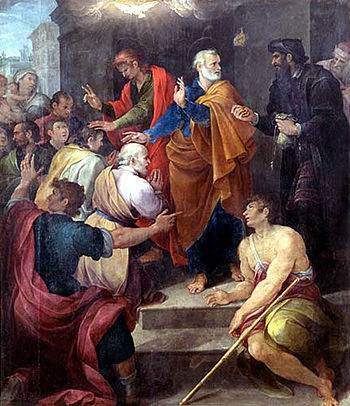
Peter's conflict with Simon Magus by Avanzino Nucci, 1620. Simon is on the right, dressed in black.
Peter’s conflict with Simon Magus by Avanzino Nucci, 1620. Simon is on the right, dressed in black.
Proto-Orthodox Legends of Simon Magus
  • Simon Magus (a magician and new convert) in Acts 8 is chastised for seeking the power to give Holy Spirit to new converts.
  • Little more is said about Simon in the bible, but he is considered the source of heretical views in later writings.
  • Many claims of reprobate activity of non-orthodox Christians, including several involving Simon Magus.

Orthodox Christianity
  • Orthodox Christianity was forged over 3 centuries, culminating in the Council of Nicea in 325 CE.
  • The Proto-Orthodox Christians increased in power and started discussing their own canons and doctrines (partly due to influence of Marcion and the Gnostics).
  • The Roman Emperor Constantine converted to Christianity in 312 CE.
  • Edict of Milan in 313 made Christianity legal.
  • Constantine Ordered the Council of Nicea(present day Iznik, Turkey) in 325 to settle disagreements on Christian doctrine.
  • The Nicene Creed and Constantinople Creed in 381 formalized Christian doctrine.
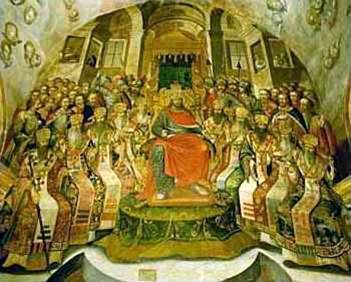
Painting The Council Of Nicea by F. Pavlovskyi, I. Maksimovych, and A. Galik and others at the Gate Church of the Trinity, Kiev, 18th Century.


The Nicene Creed Is A Response To Heresy
We believe in one God,
the Father, 
the Almighty,
maker of heaven and earth,
of all that is, seen and unseen.
We believe in one Lord, Jesus Christ,
the only Son of God,
eternally begotten of the Father,
God from God, Light from Light,
true God from true God,
begotten, not made,
of one Being with the Father.
Through him all things were made.
For us and for our salvation
he came down from heaven:
by the power of the Holy Spirit
he became incarnate from the Virgin Mary,
and was made man.
[The creed lines above claim that Jesus and God are the same, they are one, they are divine, and they are human – all responses to the “heretics”.]
For our sake he was crucified under Pontius Pilate;
he suffered death and was buried.
On the third day he rose again
in accordance with the Scriptures;
he ascended into heaven
and is seated at the right hand of the Father.
He will come again in glory to judge the living and the dead,
and his kingdom will have no end.
[The creed lines in bold above refute the heretical claim by Gnostics and others that Jesus only appeared to die.]
We believe in the Holy Spirit, the Lord, the giver of life,who proceeds from the Father and the Son.
With the Father and the Son he is worshiped and glorified.
He has spoken through the Prophets.
We believe in one holy catholic and apostolic Church.
We acknowledge one baptism for the forgiveness of sins.
We look for the resurrection of the dead,
and the life of the world to come. Amen.
[The creed lines above link the father, son and holy spirit as one. It states there is only one church, not multiple Christian sects.]
The New Testament – Forged Over Centuries
  • The Christian NT was forged over several centuries.
  • The “heretic” Marcion created the first canon. 
  • Lists and canons were created by several early Christians after Marcion.
  • Constantine ordered Eusebius to produce 50 bibles in 331. He had 340 scribes working for him to complete this task. No such bible exists today, but it is believed that this set influenced future canons.
  • The first list of the currently accepted 27 NT books was not until 367 CE in a letter from Athanasius.
  • Many Christians are led to believe that the New Testament was used by the Apostles in 34 CE.
  • Many Books Not In The New Testament Today Were Considered Scripture By Early Chritianities.
  • Many books in the NT today have been edited. Most changes are insignificant, but some are very significant.
  • There are more variations in early Christian manuscripts than there are words in the NT.
  • Today, Christian churches generally agree on the books of the NT.
  • See http://www.ntcanon.org/table.shtml for excellent information on the development of the New Testament.
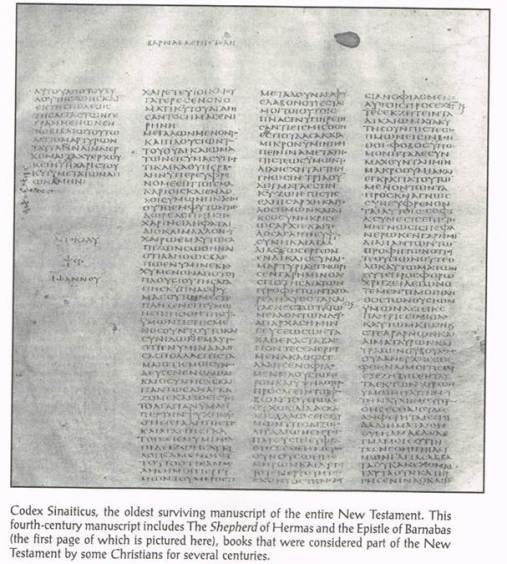
Courtesy of Bart Ehrman.
Courtesy of Bart Ehrman. The Codex Sinaiticus is the oldest collection of the 27 books of the New Testament. It also contains the Shepherd of Hermas and the Epistle of Barnabas. Nothing indicates that these two books are considered of lesser value than the other 27.

Protestants, Catholic, and the Apocrypha
  • Christians still do not agree on books of the OT, and some sects accepts additional books.
  • Jewish leaders had there own synods which developed over centuries into today’s approved MT.
  • Martin Luther did not like some Catholic doctrines, many of which were supported by verses in Maccabees. He got rid of Maccabees by rejecting books in the LXX that were not in the MT in his bible. He published the NT in 1522 and the OT in 1534.
  • Luther also did not believe in the authority of NT books Hebrews, James, Jude and Revelation.
  • The Catholic Church responded by approving the Deuterocanonical books in 1546. These books are now considered equal in authority to all previously canonized books. The vote was 24 yes, 15, no, and 16 abstaining. Only 44% of those present approved this important decision! It is now officially heretical to question the authority of these books!
  • Protestants started putting these books in an apocryphal (doubtful) section, as the 1611 King James Version (KJV) did.
  • Protestants have now removed these books completely, as the official 1895 KJV did.
  • Today’s official KJV is more recent than The Origin of Species!
Christian Canons Today Have Major Differences
Most Americans think in terms of Protestant and Catholic. However, there are many other Christian churches, including Ethiopian, Coptic, and Syrian. The websites below have many lists of accepted texts and can be used to compare the canons of various modern Christian sects.

Absence of evidence is not evidence of absence.

  This is not merely an epistemological maxim ; it is also a logical principle of inference . In other words, the mere absence of evidence ...