Tuesday, 21 November 2017

History of Truth, The Truth about God and Religions


Dr. Adel Elsaie

Source: History of Truth


5.2 Contradictions in The Old Testament

The Story of The Creation

The Flood of Noah

The Ten Commandments

The Golden Calf

Judah or Ephraim

Isaac or Ismael

To See or Not To See

To Rest or Not to Rest

The Lord or Satan 

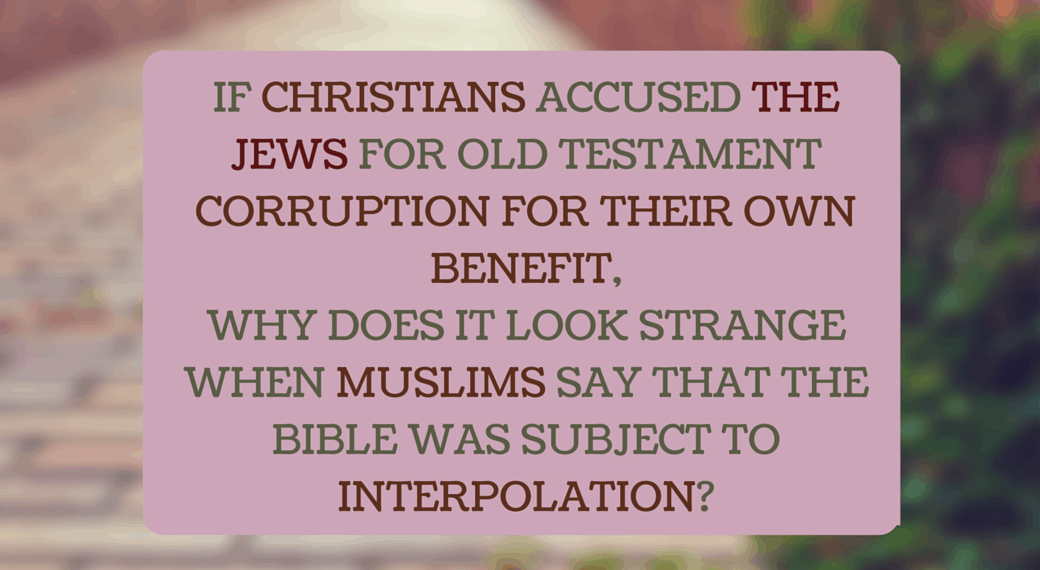
It is not our intention to present all the contradictions in the Old Testament. This would require more than one book devoted to this subject. As such, only samples of the contradiction are presented in this chapter. The Old Testament is full of stories about tribal feud of the people of Israel, and because of that the Old Testament is full of contradictions. Many biblical scholars approach this issue with the conclusion that the whole Old Testament could not be inspired by God. In this case, how can anyone discern the Word of God from the human words? How can then anyone separate the authentic Word of God from those stories? The analysis and criticism of the Old Testament began since the eleventh century. Yet Sunday classes, TV Evangelists, and Jewish rabbis decided that this information could be confusing to the layperson. So they all approach religious preaching from a position of comfort that emphasizes the moral lessons of the Bible rather than introducing confusing issues that may be very hard to explain. Most likely, biblical preachers use the advice of Abraham ibn Ezra when he said “And he who understands will keep silent.”

The Story of The Creation 

The creation event is a fascinating case of two versions of the same story. At the beginning of the Bible, one version of how the world was created is presented. The second chapter of the Bible starts with a different version of creation. And both versions are scientifically inaccurate. In several points they contradict each other. For example, they describe the major events in different order.

1. In Genesis 1:1-26, God created plants on the third day and fish and birds on the fifth day. On the sixth day, He created animals and man.

2. In Genesis 2:7-25, God created man first. Then He created plants. Then, for man to have company, God created animals and birds. And finally, God created woman.

The two stories have different sequences of steps of creation. Biblical scholars noticed that the first version referred to the deity as “God” thirty five times. The second version always refereed to Him by name “Yahweh God” eleven times. The first version never calls Him Yahweh, and the second version never calls Him only God. Therefore, it can be concluded that the first version was written by P, and the second version was written by J. P described the creation in great details to give a sense and a feel of the supremacy of God. It is interesting to note that Genesis 2:1-3 referred to the deity as “God”, after that He was referred to as “Lord God”, which might mean that the first three verses of Genesis 2 should be the end of genesis 1, and thus was part of P. However, in describing the details of the creation in seven days, P had created a theological crisis:

1. If the sequence of the creation is not the same in the two versions, then which one is correct?

2. If P, who holds an omnipotent view of God, wrote the whole first version, then how did P make God rest in the seventh day? Did someone other than P write the seventh day resting story? Was there a fifth source, for example “F”?

3. Why the details of P have major scientific inaccuracies? Maurice Bucaille in his book The Bible, the Quran and Science listed many scientific inaccuracies that show that the P version of creation is inconsistent with what we know now about the Big Bang theory.

Keeping in mind that God cannot contradict Himself, the following points can be concluded:

1. God did not exactly inspire these two different versions.

2. The authentic story from God was edited, interpreted and expanded by at least two writers.

3. The authentic sequence of creation, if any, was changed to conform to the different audience and the readers at the time of compilation.

Now, we can understand why the Islamic religious books are divided into five categories, and the authentic Word of God is kept separate.

The Flood of Noah 

The story of the flood exists in Genesis 6:5 to 8:22. Biblical scholars investigated this part of Genesis and separated the entire story from its two sources J and P. The P part refers to the deity as God, while the J part refers to God by the name Yahweh. The two versions differ in important details of the story:

1. J sated that God regretted that he had made humans, and He was grieved to His Heart, Genesis 6:6. P did not say that.

2. P says that the flood lasted for almost one year (7:11, 7:24, 8:3, and 8:13). J says that it lasted for forty days and forty nights (7:17).

3. P says that Noah sent a raven, while J says it was a dove, Genesis 8:7-8.

4. J has seven pairs of clean animals and one pair of unclean animals. (“Clean” means proper for sacrifice like sheep, “unclean” means not proper for sacrifice like lions.) This is because Noah offers a sacrifice at the end of the story in J. P has one pair of each kind of animal and the sacrifice event was not mentioned.

5. J stated that God smelled the sacrifices of Noah and it pleased Him, Genesis 8:21.

Now, we can understand why the Islamic religious books are divided into five categories, and the authentic Word of God is kept separate.

The Ten Commandments 

The fact that the Ten Commandments are repeated in Exodus 20 and in Deuteronomy 5 almost word for word, with the exception of the fourth commandment raises very intriguing questions. Why? How did it happen? If these are words inspired by God, then why did God repeat Himself in 17 verses or in about half a chapter? Someone may say that God uses repetition for emphasis, why then is the fourth commandment the only difference?

Biblical investigators agree that P wrote the Exodus version and D wrote the Deuteronomy version. The fourth commandment deals with the reason given by God for keeping the Sabbath. The Exodus version, 20:10, by P states that the reason is because God rested on the seventh day. The Deuteronomy version by D gives a very general reason like “And remember that thou wast a servant in the land of Egypt, and Yahweh thy God brought thee out thence through a mighty hand and by stretched out arm.” Deuteronomy 5:15. If P wrote this verse of Exodus, why then did he abandon his perspective of the deity as an Almighty and All-powerful God and made God rest on the seventh day. This part actually conforms to J, because it certainly does not fit the Priestly P. It is fascinating to note that the Exodus version, with God’s resting, is more publicized than the second one. This is probably to present a more potent reason to rest on Saturday. However, in doing that, they give the Almighty human characteristic.

Now, we can understand why the Islamic religious books are divided into five categories, and the authentic Word of God is kept separate.

The Golden Calf 

One of the most intriguing stories of the bible is that of the golden calf. Moses liberated the Israelis from slavery in Egypt. They had seen many miracles, the last of which was the splitting the Red Sea. While Moses was receiving the Ten Commandments on the mountain, Aaron made a golden calf for the people, Exodus 32:4-5. The people said: “these be thy gods, O Israel, which brought thee up out of the land of Egypt.” And Aaron said: “Tomorrow is a feast to the Lord.” The people sacrificed and celebrated wildly. At the same time, God told Moses about the terrible sin that the Israelis were committing, and God said that he would destroy the Israelis and make a great nation from Moses. Moses then asked God to repent of this evil act against the Israelis! The Lord repented and did not destroy the people. Moses came down from the mountain with Joshua, and saw the calf and the condition of the people. He, then, smashed the tablets in anger. The tribe of Levi gathered around Moses and carried out a bloody purge among the people. The story has many questions:

1. Why did the writer of the story portray his people as rebellious at the very time of their freedom and their receiving the covenant?

2. Why did he describe Aaron as the leader of this paganism?

3. Why did Aaron not suffer any punishment?

4. Why did the writer depict a golden calf?

5. Why did the Jews refer to the golden calf (which is singular) as “these are your gods” (plural)? This sentence is exactly the same as that of Jeroboam when he built two temples for the golden calves, 1 king 12:28. Jeroboam was justified in using plural for the calves, but in Exodus they worshiped a singular calf.

6. Why did they say, “which brought thee up out of the land of Egypt.” when the calf was made after they left Egypt?

7. Why did Aaron say, “Tomorrow is a feast to the Lord.” when he allowed worshipping an idol?

8. Why did he picture the Levites as acting in bloody rage?

9. Why was Joshua not included in association with this particular sin?

10.  Is it conceivable that Moses asked God to repent of the evil of His wrath?

The story was written by E from the Northern Kingdom of Israel who used to criticize both the northern and southern religious organizations. Aaron was regarded as a high priest. E could not change the history and the tradition by punishing the high priest. But E chose Aaron because the priests of the family of Aaron had been firmly established in Judah. So he accused Aaron, Moses’ brother, of paganism. In Exodus 4:10-15, when Moses first spoke to God, he said: “I am not a skilled speaker. I have never been able to speak well.” According to the story in the Bible, Moses was reluctant to accept God’s Command, and therefore God said: “I will give you someone to help you. I will use your brother Aaron, from the family of Levi.” If this Word of God did not mean that Aaron was a Prophet, then what does? He was not just a high priest. Aaron was a Prophet in Judaism and Islam. However according to the Old Testament, due to tribal hostilities and wars between the north and the south, Prophet Aaron was accused of paganism, and was demoted from a Prophet to a high priest.

Now, we can understand why the Islamic religious books are divided into five categories, and the authentic Word of God is kept separate.

Judah or Ephraim 

This is a story of birthrights and inheritance issues with Jacob distributing his wealth among his family. E story is in Genesis 48 and J story is in genesis 49. In the E version, Jacob granted Joseph’s sons, Ephraim and Manasseh equal share in everything he owned. Jacob was old and his eyes were weak. When Jacob was blessing Joseph and his sons, Joseph put Ephraim on his left side and Manasseh on his right side. But Jacob crossed his arms, so his right hand was on Ephraim’s head even though Manasseh was firstborn. This did not make Joseph happy. He took his father’s hand and wanted to put it on Manasseh’s head, but Jacob refused and argued that Ephraim would be greater than Manasseh. Why Ephraim? The writer of the E version was from Israel, and king Jeroboam was from the tribe of Ephraim.

Jacob’s first son was Reuben, Simon was the second, Levi was the third, and Judah was the fourth. The J story justifies the superiority of Judah and the formation of the kingdom of Judah. The first son Reuben was excluded from his birthright because he slept with one of his father’s wives and his father found that out. Simon and Levi were also excluded because they planned evil things, killed men, and hurt animals for fun. Therefore the birthright, in the J version, went to Judah who was praised by his father, described as a lion, and was told that his family would be kings.

Now, we can understand why the Islamic religious books are divided into five categories, and the authentic Word of God is kept separate.

Isaac or Ismael 

Christian scholars apply their investigative techniques to biblical stories, and usually defend any evil action of some biblical figures. But when it comes to Ismael, then this is another story. There is no sense here to investigate who wrote the story of Hagar and Ismael. If J wrote that Judah got the birthright, and E claimed that the birthright went to Ephraim, and J and E were from the twelve tribes of Jacob, the son of Isaac, can anyone expect good words about Ismael, the brother of Isaac, from any writer? Ismael was the firstborn, and of course he was denied his birthright as in the above stories. Any reference to Hagar is accompanied with such description as the maid and the Egyptian servant. The entire blessing and the praise went to Isaac. The Angel of the Lord told Hagar that “Ismael would be wild man; his hand will be against everyone and everyone’s hand would be against him, and he shall dwell in the presence of all his brethren,” Genesis 16: 12. Recall that Aaron got much more disrespect when he was accused with paganism in the golden calf story. The honor of ultimate test of obedience, Abraham sacrificing his “only son”, was given to Isaac instead of Ismael, Genesis 22. In fact, it was Ismael who was about to be sacrificed for the sake of God. Ismael knew what would happen to him and he surrendered to the will of God. So the writers of the Bible took the honor and praise from Ismael.

In Genesis 17:20 God said to Hager: “As for Ismael, I have heard thee: Behold, I have blessed him, and will make him fruitful, and will multiply him exceedingly; twelve princes shall he beget, and I will make him a great nation.” This verse states clearly that Ismael is blessed. God also said that his children would form a great nation. This great nation is obviously the Arab nation that started in the Saudi peninsula.

Also, God the Almighty left us with a formidable miracle that no one could take away from Ismael and his children. In Genesis 21:17-20 God’s angel came to help Hagar and the baby Ismael when they were thirsty, and God allowed Hagar to see a well of water. So Hagar went to the well and filled her bag with water. Then she gave water to Ismael to drink. Now, what is this formidable miracle? This referenced well still exists in the Paran desert in Mecca. Since the time of Abraham, that well never dried. Every year millions and millions of Muslims still drink from the well. It is called Zamzam. The Saudis added compressors to the well Zamzam to lift up more and more water. This living miracle has existed for thousands of years. All miracles of the Bible disappeared, but the will of God for praising Ismael still defies time.

Now, we can understand why the Islamic religious books are divided into five categories, and the authentic Word of God is kept separate.

To See or Not To See 

After Jacob wrestled with God, “And Jacob called the name of the place Peniel: for I have seen God face to face, and my life is preserved.” Genesis 32:30.

When Moses beseeched God to see Him, God responded: “You cannot see my face, for no man can see me and live” Exodus 33:20.

E wrote the first verse claiming that Jacob wrestled with God, saw his face and nothing happened to him. P wrote the second verse that denied the action of seeing God by anyone.

1. Which story do you believe?

2. Was E trying to elevate the status of Jacob above Moses?

To Rest or Not to Rest 

 The Jews’ reason to rest on Saturday “For in six days, the Lord made heaven and earth, and on the seventh day he rested, and was refreshed.” Exodus 31:17.

  The Prophet Isaiah says that people can’t imagine what God is like “Hast thou not known? Hast thou not heard, that the everlasting god, the Lord, the Creator of the ends of the earth, fainteth not, neither is weary? There is no searching of his understanding” Isaiah 40:28.

Which verse of the Old Testament fits your perception of God the Almighty?

The Lord or Satan 

David was asked by the Lord to number Israel and Judah:

“And again the anger of the Lord was kindled against Israel, and he moved David against them to say, Go, number Israel and Judah” 2 Samuel 24:1.

Then in 1 Chronicles 21:1, David was provoked by Satan to number Israel:

“And Satan stood up against Israel, and provoked David to number Israel.”

Again, these two verses raise very interesting questions:

1. Are these explanations of the reason for numbering the Jews refer to the same story?

2. Or did God ask David to number Israel and Judah, while Satan provoked David to number Israel alone? And if so, why?

3. Did the two writers have different political interests about the reason for numbering? And if so, could both stories be inspired by God?

The revisers of the Revised Standard Version of the Bible had this to say about the authors of Samuel and Chronicles:

1. Samuel: Author “Unknown”

2. Chronicles: Author “Unknown”, probably collected and edited by Ezra.

Christians fall into a serious dilemma


The Quran says:  Say (O Muslims), 'We believe in God, and what has been revealed to thee, and what was revealed to Abraham, and Ishmael, and Isaac, and Jacob, and the tribes, and what was given to Moses, and Jesus, and the prophets from their Lord,- we will make no distinction between any of them,- and we are unto Him resigned. 3:84

Please Re-read it, and another similar verse of the Quran I quote below:
The Quran says:  We have sent thee inspiration, as We sent it to Noah and the Messengers after him: we sent inspiration to Abraham, Isma'il, Isaac, Jacoband the Tribes, to Jesus, Job, Jonah, Aaron, and Solomon, and to David We gave the Psalms. 4:163
 -------------------

Something is very significant in the above two verses.  Something that negates the entire argument of Christians!

They list names of the recipients of revelation from God, prior to the last prophet, SAW.

Do you see the names of Mark, Mathew, Luke, John or Paul?  They are the authors of most of the books of the New Testament in the bible. Are they not?

The New Testament is the words of Mark, Mathew, Luke, John and Paul, and not the words of Jesus.

Hundreds of gospels were in circulation in the first century AD.   Some of them are still around and can be read online: the gospel of James, the gospel of Thomas and the gospel of Barnabas.  Other gospels were by Peter, Mary Magdeline, and Mary's mother.

Among the gospels that have not survived might have been the gospel of Jesus.

Muslims are commanded to believe in what was given to Jesus.   What did the Christians do to that which was given to the prophet of God, Jesus?  None of the books in the New Testament is written by Jesus?  The bible says Jesus could write. John 8:8, Luke 4,16


So our Christian friends where is the gospel of Jesus Pbuh? When you find it let us know till them stop jumping up and down with hate please!!!

Monday, 20 November 2017

They did not see God


The people assent to the covenant. MosesAaron, Nadab, Abihu, and seventy elders of Israel ascend the mountain and see God. Moses goes on alone and spends forty days on the mountain. (Exodus 24:1-18)

Focal Point

Then Moses and Aaron, Nadab and Abihu, and seventy elders of Israel ascended; and they saw the God of Israel: Under God’s feet there was the likeness of a pavement of sapphire, like the very sky for purity. Yet God did not raise God’s hand against the leaders of the Israelites; they beheld God, and they ate and drank." (Exodus 24:9-11)

Your Guide

Compare the verses "And they saw the God of Israel" (Exodus 24:10) with "God said, ‘You cannot see My face.’" (Exodus 33:20) What aspect of God do you think they saw?

Read the following verses as a compressed narrative: "For man may not see Me and live." (Exodus 33:20); "And they saw the God of Israel." (Exodus 24:10); "Yet God did not raise God’s hand against the leaders of the Israelites." (Exodus 24:11); and "They beheld God, and they ate and drank." (Exodus 24:11) Do you think that they actually did see God and live?

Today we continue to accept that anthropomorphic images of God are meant as metaphors. What are some of the opportunities we have today to see God and live? How do we reconcile these with the teaching that we cannot see God and live?

Although seventy-four people presumably could agree on seeing the pavement below God, they did not have a consensus on what it was like to behold God. Therefore, the pavement was included in the text, but what they saw of God was not. Consider a moment when you believe you "saw God" (literally or metaphorically). How was your vision unique? Did the experience leave you feeling grateful for life or awed that you had survived?

By the Way…

"They saw the God of Israel." They gazed and cast a glance [at God], and therefore they deserved death. However, God didn’t want to mar the rejoicing of the receiving of the Torah, so God waited to carry out the death penalty for Nadab and Abihu until the dedication of the Tabernacle (Leviticus 10:1-2). As for the elders, God waited until the incident mentioned in the verse "The people took to complaining bitterly before Adonai. Adonai heard and was incensed: A fire of Adonai broke out against them, ravaging the outskirts (bik’tzeh) of the camp" (Numbers 11:1), meaning the elders (bak’tzinim) that were in the camp. [The term bik’tzeh hamachaneh ("the outskirts of the camp") is interpreted as "among the officers who were in the camp," that is, the elders.] (Rashi on Exodus 24:10)

Abraham Ibn Ezra explained: They [the seventy-four] saw God in a prophetic vision, as did the prophets Amos in Amos 9:1 and Ezekiel in Ezekiel 1:26. (Nachmanides, quoting Ibn Ezra on Exodus 24:10)

They saw the Kavod of the God of Israel. [This Kavod is the seat of God’s glory or God’s throne.] (Saadiah Gaon)
All this refers to intellectual apprehension and in no way to the eye’s seeing. (Maimonides, The Guide of the Perplexed, I:4)

Bless Thee, O Lord, for the living arc of the sky over me this morning./Bless Thee, O Lord, for the companionship of night mist far above the skyscraper peaks I saw when I woke once during the night./Bless Thee, O Lord, for the miracle of light to my eyes and the mystery of it ever changing./Bless Thee, O Lord, for the laws Thou hast ordained holding fast these tall oblongs of stone and steel, holding fast the planet Earth in its course and farther beyond the cycle of the sun. (Carl Sandburg, "Glass House Canticle" in Harvest Poems, Harcourt, Brace & World, 1960)

If you are in search of the place/of the soul, you are the soul./If you are in search of a morsel/of bread, you are the bread./If you know this secret,/ then you know/that whatever you seek, you are that. (Rumi, a thirteenth-century Persian mystic, quoted in The Power of Prayer around the World, edited by Glenn Mosley and Joanna Hill, Templeton Foundation Press, 2000)

Your Guide

Rashi agrees with the p’shat (most literal) reading of the text: They saw God and therefore died. What is the symbolic difference between seeing God’s Kavod (Saadiah Gaon) and the actual Godhead (Rashi)?
Carl Sandburg notes the ways in which God’s presence can be seen in unexpected places on earth. We strive to recognize the Divine in the world and see God’s glory around us but often overlook God’s presence in our cities and industrial centers. Where do you tend to overlook God’s presence?
If God is not corporeal or contained in a single being, how is seeing the manifestation of God’s work distinct from actually seeing God? Do you agree that human beings "may not see [God] and live"? What aspects of your own life do you think about in connection with this warning?
The poem by Rumi suggests that we can only find that which is already a part of us. Can one who professes to be an agnostic witness the God of Judaism? Must one already believe in God in order to see the Divine?
How can recognizing each manifestation of God in the world change a person’s life?

D’var Torah

There is an inconsistency in our texts and in our general understanding of what it means to see God. On the one hand, we cannot see God and live. On the other hand, we live to see God and recognize the Divine in our loved ones, in strangers, and in the world. How can we reconcile this juxtaposition of contrary ideas?

We must make a distinction between seeing the Divine beauty of the world, a symbol of God’s glory, and the possibility of being stricken down by our audacity to look God in the face as equals.

Seeing God, looking into the eyes and soul of the Creator, understanding and knowing God as we want to know another and be known–these are not possible with God, to whom we are not equal. The seventy-four do not look directly at God but see God from below; they look up at God. The focus of their gaze is on the pavement under God’s throne. They are aware of seeing God, but the center of their attention is on the path that leads to the Eternal. By following that path, we, too, can catch a glimpse of the Eternal God

Jesus’ (Young?) Mother and (Half?) Brothers? The Proto-Gospel of James

Written by Dr. Bart D Erhman

A few days ago lot of readers made comments on the question (thanks to the Roy Moore newsflashes) of whether Mary was a young girl when she got married; and now I have mentioned Jesus’ mother and brothers in Mark’s Gospels.  So let me say a few more things about them.
The earliest non-canonical source that talks about Jesus’ mother (indicating she was a teenager — not something found in the NT) and his brothers (were they really is brothers?) is in the non-canonical Proto-Gospel of James, from some time in the second century.  I thought it might be useful for me to re-post a discussion of the matter from a number of years ago, here:
**************************************************************
The Proto-Gospel of James was very popular in Eastern, Greek-speaking Christianity throughout the Ages, down to modern times; and a version of it was produced – with serious additions and changes – in Latin, that was even more influential in Western Christianity (a book now known as the Gospel of Pseudo-Matthew).   In some times and places, these books were the main source of “information” that people had for knowing about Jesus’ birth and family – more so than the NT Gospels.
The idea that Joseph was an old man and Mary was a young girl?  Comes from the Proto-Gospel (not the NT!).   The view that Jesus was born in a cave?   Proto-Gospel.    The notion that at the nativity there was an ox and a donkey?  Pseudo-Matthew.   And there were lots of other stories familiar to Christians in the Middle Ages not so familiar to people today, all from these books – for example, a spectacular account (in Pseudo-Matthew) of Jesus as an infant, en route to Egypt, helping out his very-hungry mother Mary who was eyeing with longing some fruit at the top of a palm tree, by ordering the tree to bend down and yield its produce to her.  It does, and Jesus blesses the tree and guarantees that one of its branches will be taken to Paradise.
The Proto-Gospel was also responsible for the popularity of one particular view of Jesus’ brothers.

So, when I taught at Rutgers, probably ¾ or so of my students were Roman Catholic.  It ain’t that way here in the South.  Here in the South, with my Baptist, non-denominational, Bible-church, and so on evangelical students (the vast majority of them), the historical approach to the NT can be shocking and dismaying.   Students here often get upset when they hear about contradictions in the NT and historical errors, and so on.   At Rutgers, that wasn’t a problem.  (These students were not, as a rule, committed to the infallibility of the Bible.)  The ONE problem that arose, virtually every class I taught, was one I had never expected before getting into this business.  It was when I mentioned something about Jesus’ “brothers.”   Students got really upset when I told them that Jesus probably really did have brothers.   This was a big issue for them.
Why?  Because in the Roman Catholic tradition, Jesus’ mother not only *conceived* him and remained a virgin.   And she not only gave birth to him and yet still was a virgin (hymen intact).   She was *always* a virgin, to her dying day.   The “perpetual virginity of Mary” is a major teaching of the church, and my Rutgers students all knew it.
But what about the people in the NT who are called Jesus’ “brothers”?  If Jesus’ mother never had children, well, who are they?
In the Catholic tradition (usually) they are not simply people close to Jesus (brothers in a spiritual sense, as in “brothers and sisters, we are gathered here today….”).   There are in fact two leading options for who these “brothers” were (James, Joses, Simon, and Jude; sisters are mentioned as well; this is in Mark 6; they are mentioned but not named  as well in John 7).  And the first finds its first support in the Proto-Gospel.
Some of you noticed in the passages that I have quoted that Joseph refers to his “sons.”   In other passages of the book Joseph is explicitly said to be a (very) old widower who is given guardianship over the young virgin girl (12 year old!) Mary.   These sons, then, are obviously Joseph’s children from his previous marriage.  They are, in effect, half-step-brothers of Jesus.  (“Step” because Joseph is not actually Jesus’ father) (which means Jesus isn’t related to these brothers by blood, but that’s just a further oddity).
This view is still held by some Catholics today, but it was roundly and robustly condemned by no less an authority than Jerome in the early fifth century.   And for a very solid reason.   Jerome was a major advocate of an ascetic lifestyle.  A Christian should not, should DECIDEDLY NOT, indulge in the pleasures of the flesh.  No rich foods, no good wine, and no sex.  Preferably, no sex at all.
For this way of life, the Virgin Mary of course came to play an important role.   The mother of the Son of God never had sex, and she was especially blessed of God.  So if you too want to be especially blessed of God….     But for Jerome it was not enough that Mary never had sex.  It was important that Jesus’ adoptive father, Joseph, ALSO never had sex.  And that meant that the so-called brothers of Jesus could not be sons of Joseph from his previous marriage.
Who were they then?
Jerome was a highly learned man, one of the great scholars of Christian antiquity.  And among other things, he was one of the few people in the Latin (Western) church who could actually read Greek.   Jerome insisted that the Greek word for “brother” actually could and often did mean “cousin.”   Jesus’ brothers then were not Joseph’s sons.  They Jesus’ cousins.  Why?  Because Joseph like Mary was a virgin his entire life.  And you should be too!!!
It was precisely because Jerome condemned the Proto-Gospel of James for advancing the view that Joseph had children from a previous marriage that it was virtually dis-used in Western Christianity.  We don’t have any complete manuscripts of it in Latin.  The manuscripts are all in Eastern languages (esp. Greek).  It was only when someone – about 500 years after the Proto-Gospel was first written – in the early 7th century created his own version, in Latin (Pseudo-Matthew) that the great legends of this great book came again to be disseminated in the West.

Saturday, 18 November 2017

when Christians ask...

Christians keep bringing up the same old argument, that if Allah Swt revealed the Torah why don’t we believe in the Torah and follow it? There are many reason why we don’t follow the Torah which you have. Firstly, the Torah was given to Moses Pbuh, which was to be followed by the children of Israel. It was a guidance for the children of Israel only. the Torah was entrusted to the rabbis and doctors of law as mentioned in Surah 5:44, but unfortunately, they could not preserve it.  throughout time the Jews became hard hearted their faith wasn’t as strong and committed as their forefathers were. They started to distort and change the words of God, writing words which were not from God as mentioned in Surah 2:27 and 2:79. For breaching their covenant which they made with God Almighty they have been cursed as found in Surah 5:13 Secondly we have not been commanded to follow the Torah, yes we are to believe in the Torah which “was” revealed by Allah Swt to Moses Pbuh.

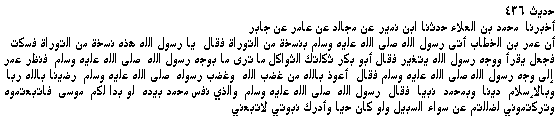
We also have explicit Hadith telling  us Torah has been changed/corrupted

The Bani Israel wrote a book, they followed it and left the Torah. (This hadith was reported in Tabarani’s Al Mu’jam Al Awsat and was authenticated by
Sheikh Nasr Al Deen Al Albani in his Silsila Al Ahaadeeth Al Saheeha , hadith no. 2832.)

The Prophet peace be upon him said…
The Bani Israel as a long time passed and their hearts became hardened, they invented a book from themselves. It took over their hearts and their tongues.
(This hadith was reported in Al Bayhaqi’s
Shu’b Al Eemaan, Volume 2, no.439. Sheikh Nasr Al Deen Al Albani has authenticated this hadith in his Silsila Al Ahaadeeth Al Saheeha , hadith no. 2694.)


This should be sufficient prove, that the Torah which Christians and Jews read is not the original Torah given to Moses Pbuh

Now let’s go little deeper, when Christians tell us why don’t we follow the Torah which they have, what exactly do they mean?  The irony  is, many Christians don’t even know what “TORAH” means.  The word Torah means  "to guide/teach" (cf. Lev 10:11). The meaning of the word is therefore "teaching", "doctrine", or "instruction" or commonly known as the Law.

Now if the word “Torah” means teaching or instruction, then Muslims don’t have a problem with that let me elaborate. There are 613 Laws in the “TORAH” 613 instructions and rules, take for instance

Not to commit sodomy with one's father (Lev. 18:7)
Not to commit incest with one's father's wife (Lev. 18:8)
Not to commit sodomy with one's father's brother (Lev. 18:14)
Not to commit sodomy with a male (Lev. 18:22)
Not to do wrong in buying or selling (Lev. 25:14)
Not to borrow on interest (Deut. 23:20)
That one who possesses evidence shall testify in Court (Lev. 5:1)
Not to steal personal property (Lev. 19:11)
Not to defraud (Lev. 19:13) etc..

Th above Laws are not a problem for Muslims. When you say TORAH, you mean LAW and INSTRUCTIONS. Why then do you expect us to believe in the 5 books of the Pentateuch, when there is only 613 Laws which make up the TORAH. Those laws also come with instructions. Why should we believe in the stories found within the Law? Those stories found in, Genesis, Exodus, Leviticus, Numbers and Deuteronomy are meaningless since the Torah doesn’t mean stories why should we accept them. Think about it, the 5 books of the Pentateuch, speak of the creation and fall of man, how people fought each other, how kingdom and empire were built. How man defied God etc. within all those stories are the Law of God (Torah). Some laws were specifically for the Jewish Sabbatical and Jubilee Years others where for the Jewish court and judicial procedure. But many are still applicable for modern times, which Muslims wont have a problem with. Take for instance Not to slay an innocent person (Ex. 20:13) Not to defraud (Lev. 19:13) Not to turn one's attention to idolatry (Lev. 19:4)  To destroy idolatry and its appurtenances (Deut. 12:2-3) etc..


Next time Christians tells you why don’t you follow the Torah, since it’s a revelation from your God. Correct them on what the Torah means.  Torah does not mean the 5 books of the Pentateuch, i.e. the creation story, biographies of Prophets etc..  rather it means Laws, Instructions and teaching. Another interesting point is, Joshua on many occasions refers to the Torah as the “Law of Moses” even the New Testament, refers the Torah as the “Law of Moses”.  


When we say the Torah is corrupted we mean the “Law/Instructions/Teachings” have been corrupted. Also, why are there 613 laws, why not 650 why stop at 613? Was this divinely inspired or another handy work of the rabbis? Funny enough we have good reason to believe this was made up by a rabbi.

The first report that the Torah contains 613 commandments dates to the third century CE, when Rabbi Simlai mentioned this concept in a sermon that is recorded in the Babylonian Talmud, Makkot 23b. The Talmud states: “Rabbi Simlai gave as a sermon [darash Rabi Simlai]: 613 commandments were communicated to Moses – 365 negative commands, corresponding to the number of solar days [in a year], and 248 positive commands, corresponding to the number of the members [bones covered with flesh] of a man’s body.” It thus appears that Rabbi Simlai invented the number 613 because it fit his sermon: A person should observe the Torah with all his body parts (248) every day (365). The two numbers add up to 613.

As far as we know, no one thought there were 613 biblical commandments before Rabbi Simlai offered his sermon. In fact, 150 years before Rabbi Simlai, ben Azzai is quoted as saying that there were three hundred biblical commands. (Sifrei Deuteronomy 76) E. E. Urbach wrote: “In the Tannaitic sources this number [613] is unknown.” (The Sages: Their Concepts and Beliefs (Cambridge, MA: Harvard University Press, 1987).

Ibn Ezra (1089–1167) recognized that if one counts all of the divine commandments recorded in the Bible, the number would be well over a thousand; and that if only the commandments relevant to his day were numbered, the total would be less than three hundred. He wrote in his Yesod Moreh 2: “Some sages enumerate 613 mitzvot [divine commandments] in diverse ways By “diverse ways,” ibn Ezra meant that rabbis differed in what they included in the 613 “biblical commandments.” The most famous catalogue is that of Maimonides, discussed below, who included beliefs in his list. In contrast, Bachya ibn Pakuda (eleventh century) considered that only practical duties and not beliefs should be included, so he had a different list of 613 commands. Ibn Pakuda’s list appears in Sefer Torat Chovot Halevavot (Jerusalem: Feldheim, 1984)…but the truth is that there is no end of the number of mitzvot…and if we were to count only the root principles…the number of mitzvot would not reach 613.”


So we can see from the above information, this 613 Law was made up by Rabbi Simlai. throughout time rabbis have been playing with the Law of Moses, thus the Torah is not prestige as it was delivered. 

Friday, 17 November 2017

The Lost Torah


The Lost Torah

This article is a refutation to those who claim the Torah has not been tampered with. This bold claim Christians make, that the Torah is exactly the same “word for word” from the time of Moses will be analysed. Let’s start off with what the Jewish sources have to say before we completely destroys this nonsense made by Christians.

The Midrash (Devarim Rabba 9:9) tells us:

Before his death, Moses wrote 13 Torah Scrolls. Twelve of these were distributed to each of the 12 Tribes. The 13th was placed in the Ark of the Covenant (along with the Tablets). If anyone would come and attempt to rewrite or falsify the Torah, the one in the Ark would "testify" against him.
Similarly, an authentic "proof text" was always kept in the Holy Temple in Jerusalem, against which all other scrolls were checked. Following the destruction of the Second Temple in 70 CE, the Sages would periodically perform global checks to guard against any scribal errors.

“Take this Book of the Law and place it beside the ark of the covenant of the Lord your God. There it will remain as a witness against you. 27 For I know how rebellious and stiff-necked you are. If you have been rebellious against the Lord while I am still alive and with you, how much more will you rebel after I die!28 Assemble before me all the elders of your tribes and all your officials, so that I can speak these words in their hearing and call the heavens and the earth to testify against them. 29 For I know that after my death you are sure to become utterly corrupt and to turn from the way I have commanded you. (Deuteronomy 31:26-29)

From the above statements we read that, Moses not only wrote “13 scrolls” he also had one put in the Ark of the Covenant. The “Torah scroll” which was put in the Ark of the Covenant, was a proof test that would verify if the Torah which was in the hand of that individual was the exact same as the one put in the “Ark of the Covenant”.

Here’s the problem, where is the Ark of the Covenant now? How is one supposed to verify if he has the original Torah which Moses commanded to be placed in the “Ark of the Covenant” What about those other “12 scrolls” given to the 12 tribes of Israel, where are they?  Why was the “Torah scrolls” placed in the Ark of the Covenant in the first place, so they can be protected from any tampering. What was the point of placing the Torah Scrolls in the Ark of the Covenant when the object itself is missing, how absurd!

Isn’t it interesting how Moses said, after he leaves, the Jews would turn to corruption and disobey all which he has commanded them. “For I know that after my death you are sure to become utterly corrupt and to turn from the way I have commanded you.” If Moses is a Prophet of God, then surely his saying about the Jews would come to terms. That’s a sign of a false Prophet according to the same “Torah” in dispute.

"When a prophet speaks in the name of the LORD, if the thing does not come about or come true, that is the thing which the LORD has not spoken. The prophet has spoken it presumptuously; you shall not be afraid of him. (Deuteronomy 18:22)

There’s also another problem added to this mess. According Exodus 25:16, the Two Tablets with the 10 commandments were placed in the Ark of the Covenant. Again how does one verify the 10 commandments which is written in Exodus 20 is the same as written on the “Two Tablets” placed in the Ark of the Covenant, when the Ark itself is missing? The idea that the Torah which is read by millions of Jews and Christian as being the same as what was written by Moses is totally absurd.

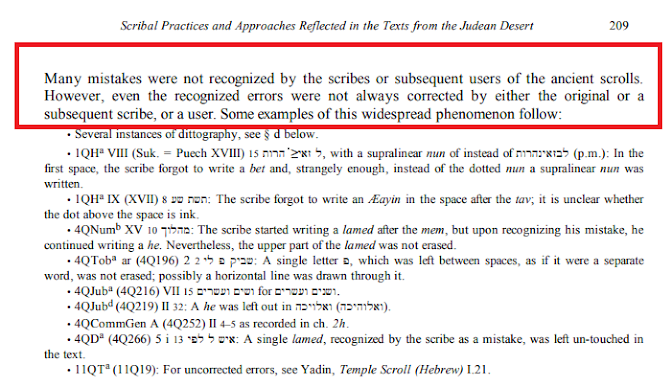
It’s ludicrous to make such a bold claim when you have no manuscripts which go back to the time of Moses. If Moses supposed to have written those “Torah scrolls” roughly around 3500 years ago, and the earliest of manuscripts which we have under our possession dates to around 200BC, (that is the “DSS scrolls”) how many years gap is there between the time of Moses and the DSS scrolls? Nearly 1200 years!  So you now have a 1200 year missing gap between the time of Moses and the earliest manuscripts, how then could you claim you have the original Torah which Moses had written?

The tradition of preserving the Torah could not have been possible with the Jews, since history tells us during their exile they had nothing at hand. We also have many versions of the Torah at our hands, such as the DSS, Samaritan Torah, Masoretic Torah, Septuagint Torah (copied from Hebrew manuscripts into Greek). All of those versions differ each other one way or another. Here’s a small sample of what I mean by differ.


He will be a wild donkey of a man; his hand will be against everyone and everyone's hand against him, and he will live in hostility toward all his brothers."(Genesis 16:12 Masoretic text)

Compare this to the Samaritan Torah

He will be a FRUITFUL MAN; his hand will be with everyone and everyone's hand will be with him, and he will live among all his brothers."(Genesis 16:12 Samaritan text) 

Notice the Significant difference between the two, especially when it comes to the nature of Ismael Pbuh. The Masoretic Torah seems to make a derogatory statement towards the Prophet of God Ishmael Pbuh. Whereas the Samaritan Torah gives us a more honest and accurate image of Ishmael Pbuh, which  also fits with the promise God made about him in the Book of Genesis.

And as for Ishmael, I have heard thee: Behold, I have blessed him, and will make him fruitful, and will multiply him exceedingly; twelve princes shall he beget, and I will make him a great nation. (Genesis 17:20)

Ask yourself this question, did the scribes of the Masorectic text make such changes in order to conceal the true identity and nature of Ishmael Pbuh? Unless the Masoretes who received the Hebrew mancripts were already corruptedBut what did the Masoretes themselves believe?  Did they believe they were perfectly preserving the ancient text?  Did they even think they had received a perfect text to begin with?
History says “no” . . .
Early rabbinic sources, from around 200 CE, mention several passages of Scripture in which the conclusion is inevitable that the ancient reading must have differed from that of the present text. . . . Rabbi Simon ben Pazzi (3rd century) calls these readings “emendations of the Scribes” (tikkune Soferim; Midrash Genesis Rabbah xlix. 7), assuming that the Scribes actually made the changes. This view was adopted by the later Midrash and by the majority of Masoretes.


Note that the matter of changing texts was known even in the time of the Talmud. Therefore, according to the Halacha, what is to be done when we do not know the precise text of the Torah?

In Tractate Soferim 6:4 it is said: “Rabbi Shimon ben Lakish said: Three scrolls of the Torah were found in the Temple court: The Maon [instead ofMaonah] scroll, the Zaatutei [instead of Naarei] scroll, and the He [instead ofHoo] scroll…so they retained the reading of the two [i.e., the majority] and abandoned that of the one [i.e. the exception].” The decision was according to the majority of the scrolls, based on “after the multitude to sway” (Exodus 23:2).
With no surprise the Masoretic text, written around the (10th or 11th) century the first full codex is taken from corrupted sources imagine that. There are many more such differences throughout the individual versions of the Torah. I’ll add a few more so you can see for yourself the Torah has been tampered with just as predicted in Deuteronomy 31.


(How Old was Lamech when he had his son?)


When Lamech had lived 182 years, he had a son.
(Genesis 5:28 Masoretic Torah)

When Lamech had lived 188 years, he had a son.
(Genesis 5:28 Septuagint Torah) 

When Lamech had lived 53 years, he had a son.
(Genesis 5:28 Samaritan Torah)

----------------------------

(How long did Lamech live?)

Altogether, Lamech lived a total of 777 years, and then he died.
(Genesis 5:31 Masoretic text)

Altogether, Lamech lived a total of 753 years, and then he died.
(Genesis 5:31 Septuagint Torah) 

Altogether, Lamech lived a total of 653 years, and then he died.
(Genesis 5:31 Samaritan text)

-------------------------------------

And when you have crossed the Jordan, set up these stones on MOUNT GERIZIM, as I command you today, and coat them with plaster........ (Deuteronomy 27:4 Samaritan text)


                                                       Compare to 


And when you have crossed the Jordan, set up these stones on MOUNT EBAL, as I command you today, and coat them with plaster. (Deuteronomy 27:4 Masoretic text)


--------------------------------------


But Zipporah took a flint knife, cut off her son's foreskin and touched Moses' feet with it. "Surely you are a bridegroom of blood to me," she said. (Exodus 4:25 Masoretic Torah )

                                                        Compare to

But seeboorah took a flint, and she CIRCUMCISED HER BLOCKED HEART and she brought herself to his feet and she said you are a bridegroom of blood to me," (Exodus 4:25 Samaritan Torah )

-----------------------------------------

Below  we see Direct commandments have been added and subtracted 

"You shall not covet your neighbor's house. You shall not covet your neighbor's wife, or his male or female servant, his ox or donkey, or anything that belongs to your neighbor."( Exodus 20:17 Masoretic Torah)


                                                    ------------ Extended Version ----------------


Thou shalt not covet thy neighbour's house, and not thou shalt not covet thy neighbour's wife, nor his field, nor his manservant, nor his maidservant, nor his ox, nor his ass, nor any thing that [is] thy neighbour's. And when it so happens that LORD God brings you to the land of Caanan, which you are coming to posses, you shall set-up there for you great stones and plaster them with plaster and you write on the stones all words of this law. And it becomes for you that across the Jordan you shall raise these stones, which I command you today, in mountain Grizim. And you build there the altar to the LORD God of you. Altar of stones. Not you shall wave on them iron. With whole stones you shall build the altar to LORD God of you. And you bring on it ascend offerings to LORD God of you, and you sacrifice peace offerings, and you eat there and you rejoice before the face of the LORD God of you. The mountain this is across the Jordan behind the way of the rising of the sun, in the land of Caanan who is dwelling in the desert before the Galgal, beside Alvin-Mara, before Sechem (Exodus 20:17 Samaritan Torah)


We can see from all those above versions, that Torah was not preserved as Christians claim. The original “13 scrolls” which was written by Moses is missing and no longer with us. Another thing to add to all this is, when Moses wrote “13 scrolls” did he only write 13 individual scrolls the entire time or more? Here’s another portion from the Midra
sh which states:

- A Torah Scroll is disqualified if even a single letter is added.

- A Torah Scroll is disqualified if even a single letter is deleted.

Ask yourself from the evidence which I’ve provided, how many “letters and words” have been added to the “Torah” can you honestly say those  added words and paragraphs didn’t change a single meaning to what was being said?  The Midrash goes as far as saying “anything additional added to the Torah writings should be scraped” the problem is before we think of scrapping anything, we first have to establish which came from the “Original 13 Scrolls” written by Moses. And the answer it you can’t.


·         Interestingly The Aleppo Codex (c. 920 CE) and Leningrad Codex (c. 1008 CE) were the oldest Hebrew language manuscripts of the Tanakh. If they are the oldest full codex Bible in our possession, what about during the time of Jesus what were they using? Without a doubt they were using scrolls copied throughout centuries going back to 200BC. This is also acknowledged by a Christian apologist by the name of “Sam Shamoun” famous for his hatred towards Islam.

We also have another issue to deal with, and that is the Nash Papyrus, “A false impression has been created among general readers that the OT has been transmitted through the ages exactly word for word, and character for character." Such is hardly the case; even the Ten Commandments differ in two versions.' See for instance Wurthwein's analysis of the Nash Papyrus [Wurthwein, p. 34]. (THE HISTORY OF THE QURANIC TEXT From Revelation to Compilation A Comparative Study with the Old and New Testaments MUHAMMAD MUSTAFA AL-AZAMI)

Another question raised by Christians is, was the Torah corrupted before or “AFTER” the advent of Islam? One Christian apologist by the name of Alex Kerimli called it the “conspiracy theory” let’s answer them using their own Bible.

The idea that he Torah was corrupted after the advent of Islam is nonsensical. It’s like saying ”was the Torah revealed to Adam and the Gospel to Moses”. However let’s show how the Torah was corrupted by Jesus himself whom Christians follow.


What would you say if we told you that Jesus himself altered the text?  Hard to believe right, well we have evidence from the New Testament where Jesus altered the text. If we go to the Book of Luke on chapter 4 verse 16 &17 it reads:

And he came to Nazareth, where he had been brought up: and, as his custom was, he went into the synagogue on the sabbath day, and stood up to read. And there was delivered unto him the book of the prophet Isaiah. And when he had opened the book, he found the place where it was written, (Luke 4:16-17)

Here we read Jesus went inside a synagogue on a Sabbath day, stood up and read from the scroll of Isaiah. The next few verses tell us what Jesus read:

The Spirit of the Lord is upon me, because he hath anointed me to preach the gospel to the poor; he hath sent me to heal the brokenhearted, to preach deliverance to the captives, and recovering of sight to the blind, to set at liberty them that are bruised, (Luke 4:18)

Jesus read a verse from the Book of Isaiah chapter 61 verse 1. It would seem without doubt he read from the ancient scrolls, which would have been preserved by the orthodox rabbis. Just to be on the safe side let’s compare Jesus’s reading with the Hebrew Bible, and see if they really line up word for word.

The Spirit of the Lord GOD is on Me, because the LORD has anointed Me to bring good news to the poor. He has sent Me to heal the brokenhearted, to proclaim liberty to the captives, and freedom to the prisoners; to proclaim the year of the LORD's favor, and the day of our God's vengeance; to comfort all who mourn (Isaiah 61:1)


If you compare the two passages side by side you’ll notice one thing added and one thing removed. Jesus added “and recovery of sight to the blind” and removed “and the day of our God’s vengeance.” Luke tells us,  Luke 4:16-17 He came to Nazareth, where He had been brought up. As usual, He entered the synagogue on the Sabbath day and stood up to read. (17) The scroll of the prophet Isaiah was given to Him, and unrolling the scroll, He found the place where it was written: We’re not really given the option of saying that Jesus was roughly paraphrasing because He actually took the scroll and turned to the passage, implying that he read it. When he quit, he rolled up the scroll, gave it back to the attendant, and sat down (v. 20). Of course He could have turned to it and then simply looked up and spoke from memory. I’m sure He had most, if not all, of the Scriptures memorized at this point in His life. However, if we say that, there are two problems. One is that we are making an unnatural assumption. Jesus took the book, opened to the right page and then didn’t read it? That doesn’t seem right.

Second, we’d be saying that Jesus’ memory did not stand up to the test and He misquoted the Scriptures! 
 In case you’re wondering, these differences are reflected in the Greek and Hebrew texts as well so it’s not a modern translational error.

Now you have two options to choose from. Could it be the scroll Jesus was given to read was corrupted, or that Jesus himself corrupted the text? It seem more likely from the New Testament, that Jesus of the Bible altered and added his own word to scriptures. Which means he went against the command of Yahweh, as found in Deuteronomy 4:2


If the Septuagint was written before the time of Jesus, followed by the Masoretic after the advent of Islam and they both differ in many places what does that tell you. It’s pretty clear Jesus changed the words from the scroll which he was reading from. Unless the scroll which Jesus was reading from was different from the Septuagint which creates a bigger problem and proving the fact the Torah was changed before the advent of Islam.


Also just for the record Luke 4:18-19 says that Jesus read from the scroll of Isaiah, but the text given was not on any scroll of Isaiah. As Robert J. Karris writes in 'The New Jerome Bible Commentary' (section 43:59) 'As the analysis of verses 18-19 will make clear, this Isaiah text is not to be found on a synagogue scroll. It is an artistic text, woven from Isa 61:1-2 and Isa 58:6.' Luke quotes from the Septuagint version of Isaiah and quotes Isaiah 61:1 a,b,d, Isaiah 58:6 d and Isaiah 61:2 a. Luke mixed together two different chapters from Isaiah.

Now if Christians believe all scriptures are God breathed and inspired then was Moses speaking the truth about Jews turning to Corruption! How about the Torah being distorted by false scribes, I'll leave that to you.

---------------------

Christians keep bringing up the same old argument, that if Allah Swt revealed the Torah why don’t we believe in the Torah and follow it? There are many reason why we don’t follow the Torah which you have. Firstly, the Torah was given to Moses Pbuh, which was to be followed by the children of Israel. It was a guidance for the children of Israel only. the Torah was entrusted to the rabbis and doctors of law as mentioned in Surah 5:44, but unfortunately, they could not preserve it.  throughout time the Jews became hard hearted their faith wasn’t as strong and committed as their forefathers were. They started to distort and change the words of God, writing words which were not from God as mentioned in Surah 2:27 and 2:79 for breaching their covenant which they made with God Almighty, they have been cursed as found in Surah 5:13. Secondly we have not been commanded to follow the Torah, yes we are to believe in the Torah which “was” revealed by Allah Swt to Moses Pbuh. We also have  Hadith  which  explicitly tells us Torah has been changed/corrupted

The Bani Israel wrote a book, they followed it and left the Torah. (This hadith was reported in Tabarani’s Al Mu’jam Al Awsat and was authenticated by
Sheikh Nasr Al Deen Al Albani in his Silsila Al Ahaadeeth Al Saheeha , hadith no. 2832.)

The Prophet peace be upon him said…
The Bani Israel as a long time passed and their hearts became hardened, they invented a book from themselves. It took over their hearts and their tongues.
(This hadith was reported in Al Bayhaqi’s
Shu’b Al Eemaan, Volume 2, no.439. Sheikh Nasr Al Deen Al Albani has authenticated this hadith in his Silsila Al Ahaadeeth Al Saheeha , hadith no. 2694.)


This should be sufficient prove, that the Torah which Christians and Jews read is not the original Torah given to Moses Pbuh

Now let’s go little deeper, when Christians tells us why don’t we follow the Torah which they have, what exactly do they mean?  What’s ironic is, many Christians don’t even know what “TORAH” means.  The word Torah means  "to guide/teach" (cf. Lev 10:11). The meaning of the word is therefore "teaching", "doctrine", or "instruction" or commonly known as the Law.

Now if the word “Torah” means teaching or instruction Muslims don’t have a problem with that, let me elaborate. There are 613 Laws in the “TORAH” 613 instructions and rules, take for instance

Not to commit sodomy with one's father (Lev. 18:7)
Not to commit incest with one's father's wife (Lev. 18:8)
Not to commit sodomy with one's father's brother (Lev. 18:14)
Not to commit sodomy with a male (Lev. 18:22)
Not to do wrong in buying or selling (Lev. 25:14)
Not to borrow on interest (Deut. 23:20)
That one who possesses evidence shall testify in Court (Lev. 5:1)
Not to steal personal property (Lev. 19:11)
Not to defraud (Lev. 19:13) etc..

Th above Laws are not a problem for Muslims. When you say TORAH, you mean LAW and INSTRUCTIONS. Why then do you expect us to believe in the 5 books of the Pentateuch, when there is only 613 Laws which make up the TORAH. Those laws also come with instructions. Why should we believe in the stories found within the Law? Those stories found in, Genesis, Exodus, Leviticus, Numbers and Deuteronomy are meaningless since the Torah doesn’t mean stories why should we accept them. Think about it, the 5 books of the Pentateuch, speak of the creation and fall of man, how people fought each other, how kingdom and empire were built. How man defied God etc. within all those stories are the Law of God (Torah). Some laws were specifically for the Jewish Sabbatical and Jubilee Years others where for the Jewish court and judicial procedure. But many are still applicable for modern times, which Muslims wont have a problem with. Take for instance Not to slay an innocent person (Ex. 20:13) Not to defraud (Lev. 19:13) Not to turn one's attention to idolatry (Lev. 19:4)  To destroy idolatry and its appurtenances (Deut. 12:2-3) etc..


Next time Christians tells you why don’t you follow the Torah, since it’s a revelation from your God. Correct them on what the Torah means.  Torah does not mean the 5 books of the Pentateuch, i.e. the creation story, biographies of Prophets etc..  rather it means Laws, Instructions and teaching. Another interesting point is, Joshua on many occasions refers to the Torah as the “Law of Moses” even the New Testament, refers the Torah as the “Law of Moses”.  

Yahweh testifying the Jews forgot the TORAH "Law, instruction, teachings" of God

My people are destroyed for lack of knowledge; because you have rejected knowledge, I reject you from being a priest to me. And since you have "FORGOTTEN THE LAW OF YOUR GOD", I also will forget your children. (Hosea 4:6)

Here the word Law in Hebrew is "Torah תּוֹרַ֣ת,” thus the Jewish rabbis are being accused of forgetting the Torah i.e. Law, Instruction, teachings. The question is did they not have the Book of Moses with them? Christians claim this book was always with the Jews so what happened? 

Case closed!
"that most of the nation completely forgot Torah and the commandments" (Numbers 15:22 Rambam)

"and in 55 years the Torah was forgotten.” (2 Kings 22: 8 Radak)


When we say the Torah is corrupted we mean the “Law/Instructions/Teachings” have been corrupted. Also, why are there 613 laws, why not 650 why stop at 613? Was this divinely inspired or another handy work of the rabbis? Funny enough we have good reason to believe this was made up by a rabbi.

The first report that the Torah contains 613 commandments dates to the third century CE, when Rabbi Simlai mentioned this concept in a sermon that is recorded in the Babylonian Talmud, Makkot 23b. The Talmud states: “Rabbi Simlai gave as a sermon [darash Rabi Simlai]: 613 commandments were communicated to Moses – 365 negative commands, corresponding to the number of solar days [in a year], and 248 positive commands, corresponding to the number of the members [bones covered with flesh] of a man’s body.” It thus appears that Rabbi Simlai invented the number 613 because it fit his sermon: A person should observe the Torah with all his body parts (248) every day (365). The two numbers add up to 613.

As far as we know, no one thought there were 613 biblical commandments before Rabbi Simlai offered his sermon. In fact, 150 years before Rabbi Simlai, ben Azzai is quoted as saying that there were three hundred biblical commands. (Sifrei Deuteronomy 76) E. E. Urbach wrote: “In the Tannaitic sources this number [613] is unknown.” (The Sages: Their Concepts and Beliefs (Cambridge, MA: Harvard University Press, 1987).

Ibn Ezra (1089–1167) recognized that if one counts all of the divine commandments recorded in the Bible, the number would be well over a thousand; and that if only the commandments relevant to his day were numbered, the total would be less than three hundred. He wrote in his Yesod Moreh 2: “Some sages enumerate 613 mitzvot [divine commandments] in diverse ways By “diverse ways,” ibn Ezra meant that rabbis differed in what they included in the 613 “biblical commandments.” The most famous catalogue is that of Maimonides, discussed below, who included beliefs in his list. In contrast, Bachya ibn Pakuda (eleventh century) considered that only practical duties and not beliefs should be included, so he had a different list of 613 commands. Ibn Pakuda’s list appears in Sefer Torat Chovot Halevavot (Jerusalem: Feldheim, 1984)…but the truth is that there is no end of the number of mitzvot…and if we were to count only the root principles…the number of mitzvot would not reach 613.”


So we can see from the above information, this 613 Law was made up by Rabbi Simlai. throughout time rabbis have been playing with the Law of Moses, thus the Torah is not prestige as it was delivered. 

-------------------


The Ark of the Covenant goes missing and the Bible is silent of its whereabouts? yet the Bible has no problem telling us how many soldiers the Israelite's had and killed e.g. Joshua 20, or Rachel stealing her fathers idols and hiding them inside the camels saddle,  how ironic.


if one of the most Sacred object can disappear what makes you say the Torah could not be altered by the Jews? what’s alarming to know is this very Ark of the Covenant contained relics of Moses and Aaron, and even the most beloved to Jews the “Torah & Tablets".


If the Torah, the Tablets, the rod of Aaron alongside the Ark of the Covenant can go missing, what reason do you have the Torah which you currently have could not be altered?


So Moses the servant of the LORD died there, in the land of Moab, at the command of the LORD. He buried him in the valley in the land of Moab, near Beth-peor; and no one knows his burial place to this day. (Deuteronomy 34:5-6 Masoretic Torah)

According to the Masoretic Torah, Moses of the Bible was buried by Yahweh in the land of Moab. The verse goes on to say no one knows where Moses was buried till this day. This tells us the text was written much later i.e. long after Moses.

Here's where it gets  interesting. We have a text which pre dates the Masoretic Torah by roughly a thousand years. It's the DSS text. Here's what the DSS says

So Moses the servant of the LORD died in the land of Moab, according to the word of the Lord . And they (Israelites) buried him in the valley in the land of Moab, opposite Beth-peor; but no one knows of his burial place to this day. (Deuteronomy 34:5-6 DSS Torah)


Did you catch the problem? The Masoretic Torah which postdates the DSS states Yahweh buried Moses. However the DSS which predates the Masoretic states "they" i.e. the Israelites buried Moses in the land of Moab. The other problem is, if the Israelites buried Moses in Moab, then surely they would know they location to where the exact place is. The text on both manuscripts states "no one knows till this day", again indicating the author wrote much later.  If for arguments sake the author wrote a thousand years after Moses, then yes he wouldn't know where the exact buried location would be unless they had a strong oral tradition which we know they didn't. It's possible the people who participated in burying Moses orally told people the location, which eventually faded away from the lips and memory of people. Whatever the case we see the earliest manuscript i.e. the DSS proves tampering took place at best.
Ezra changed the Torah script

It is taught in a baraita (Tosefta 4:5):Rabbi Yosei says: Ezra was suitable, given his greatness, for the Torah to be given by him to the Jewish people, had Moses not come first and received the Torah already. With regard to Moses the verse states: “And Moses went up to God” (Exodus 19:3), and with regard to Ezra the verse states: “This Ezra went up from Babylon and he was a ready scribe in the Torah of Moses, which the Lord, the God of Israel, had given” (Ezra 7:6). Just as the going up stated here, with regard to Moses, is for the Torah, which he received from God and transmitted to the Jewish people, so too, the going up stated there,with regard to Ezra, is for the Torah, as he taught Torah to the Jewish people and was suitable to have originally merited to give it. The baraita continues:With regard to Moses the verse states: “And the Lord commanded me at that time to teach you statutes and ordinances” (Deuteronomy 4:14), andwith regard to Ezra the verse states: “For Ezra had set his heart to seek the Torah of the Lord his God and to do it and to teach in Israel statutes and ordinances” (Ezra 7:10). And even though the Torah was not given literallyby him, the script of the Torah was changed by him, as it is stated:


“And the writing of the letter [hannishtevan] was written in the Aramaic script, and set forth in the Aramaic tongue” (Ezra 4:7). The term “hannishtevan” is similar to the word nishtana, meaning changed, alluding to the fact that the script had been changed. And it is written with regard to the writing on the wall of Belshazzar’s palace: 


( Talmud Sanhedrin 22a )


As a penalty for the sin they have committed, they must bring to the LORD a female lamb or goat from the flock as a sin offering; and the priest shall make atonement for them for their sin. (Leviticus 5:6 Masoretic Torah)

Compare the Masoretic with the DSS

and he shall bring his trespass offering to Yahweh for his sin which he has sinned, a female from the flock, a lamb or a goat, for a sin offering; and the priest shall make atonement for him concerning his sin which he has sinned, and he shall be forgiven. (Leviticus 5:6 DSS Torah)

Interesting after making an offering to Yahweh and the priest making an atonement for that person their sins are forgiven, as found in the DSS. This is absent from the Masoretic text how comes?

---------------------------------------------


Deliberate scribal change confirmed by rabbis

For thus said the LORD of Hosts—He who sent me after glory—concerning the nations that have taken you as spoil: “Whoever touches you touches the pupil of his own eye. (Zachariah 2:12)
---------------

The original wording in Zechariah 2:12 has God saying “whoever touches you (Israel) touches the apple of my eye,” meaning pocking a finger in God’s eye, which suggests that God has an eye and can be harmed. It was replaced to “his eye,” saying whoever touches Israel has done such a grievous harm as if he hit the nation in its eye.

Deliberate scribal change, thus the text was altered.

A number of rabbinic texts claim that the uncorrected wording was actually

“Whoever touches you touches the pupil of My [= God’s!] eye.”
Midrash Tanhuma [3] calls this “a scribal correction [made] by the Men of the Great Assembly” (שהוא תיקון סופרים אנשי כנסת הגדולה). Writing in the Jewish Study Bible, Ehud Ben Zvi paraphrases this rabbinic comment:

“The original text read, ‘the pupil of My own eye,’ and was changed by the soferim (scribes) so as to avoid the obvious anthropomorphism.”

Attempting to explain this apparently brazen attitude to sacred text from religious leaders, the 20th-century scholar of rabbinics, Saul Lieberman, argued that some rabbis justified their emendations based on the Talmudic saying:

Rabbi Hiyya bar Abba said in the name of Rabbi Yohanan: “It is better that one letter be removed from the Torah than that the Divine name be publicly profaned.”[4]

reference
3] Beshalah 16.
[4] Hellenism in Jewish Palestine (New York, 1962), p. 35, quoting b. Yevamot 79a.

Such attempts to rewrite history and “clean up” the work of an earlier rabbi are not so rare.  See e.g. my Rashbam’s Commentary on Leviticus and Numbers: An Annotated Translation, pp. 260-261, where I argue that Rashbam’s commentary to Num 22:1 was altered for religious ideological reasons.  And see more generally Marc Shapiro’s recent book, Changing the Immutable: How Orthodox Judaism Rewrites its History, concerning the phenomenon in contemporary times.


--------------------------


another easy and simple t way to prove the current "Torah" Christians and Jews read has been corrupted.

All you do is ask the Christian, " if you believe the "Torah" you read is not corrupted then show us where Jesus is mentioned as the Messiah, and that he will be beaten, crucified and killed by the Jews, and on the third day resurrect. Go a step further and cite the following passage from Luke.

He said to them, "This is what I told you while I was still with you: Everything must be fulfilled that is written about me in the Law of Moses, the Prophets and the Psalms." Then he opened their minds to understand the Scriptures, And said unto them, Thus it is written, and thus it behoved Christ to suffer, and to rise from the dead the third day: (Luke 24:44-46)

Now if you say the "Torah" has not been corrupted show in which Torah book is such information found? Name the chapter and verse. If you can't then admit your either your Jesus lied of the Torah which he was referring to is missing or corrupted and all those parts which mention about him was taken out.


You can't have the cake and eat it.


Rabbi Shimon said to him: Is it possible that the Torah scroll was missing a single letter? But it is written that God instructed Moses: “Take this Torah scroll and put it by the side of the Ark of the Covenant” (Deuteronomy 31:26), indicating that the Torah was complete as is and that nothing further would be added to it. (Talmud Menachot 30a:7)


If nothing was added after the Torah was placed inside the Ark (Talmud Bava Batra 14b:3), how did chapter 31:26 all the way till the end of Deuteronomy chapter 34:12 make its way to the Torah when it was safely locked inside the Ark? Who opened the Ark and added all those chapters?


More broken glass for them to chew on


Discrepancy

Cain made love to his wife, and she became pregnant and gave birth to Enoch. Cain was then building a city, and he named it after his son Enoch. (Genesis 4:17)

According to Genesis the first book of the Pentateuch, Cain was the father of Enoch. However, if we turn to the New Testament which was written roughly 1600 years later, Luke tell us in his genealogy; Enoch was the son of Jared?

the son of Methuselah, the son of Enoch,
the son of Jared, the son of Mahalalel,
the son of Kenan (Luke 3:37)

Seems like the sources Luke was reliant on were not aware of the Old Testament's discrepancy.  Luke's sources ignored Genesis 4:17 and instead took what Genesis 5:18 said.

When Jared was 162 years old, he became the father of Enoch. (Genesis 5:18)

Did you catch the joke? Genesis 4:17 explicitly states Cain was the father of Enoch, yet five chapters later, Jared becomes the father of Enoch not Cain? This is a blatant discrepancy within the Bible. Now just for the records, Genesis 5 omits Cain and his son.

Do not be fooled by Christians when they tell you there were two different Enoch's. Genesis 4:18 confirms there was one Enoch alongside the same names found in Luke 3:36-37

To Enoch was born Irad. And Irad begot Mehujael, and Mehujael begot Methushael, and Methushael begot Lamech. (Genesis 4:18)

Once again we ask, why did Luke omit cain as the father and why does Genesis 4 and 5 contradict? Well it gets worse. According to Jude 1:14, Enoch was the seventh from Adam

And Enoch also, the seventh from Adam, prophesied of these, saying, Behold, the Lord comes with ten thousands of his saints (Jude 1:14)

However, if we read the genealogy from Luke and Genesis 5, Enoch is sixth from Adam not seventh.

the son of Methuselah, the son of Enoch,
the son of Jared, the son of Mahalalel,
the son of Kenan, 38 the son of Enosh,
the son of Seth, the son of Adam,
the son of God. (Luke 3:37-38)

Adam's son was :  Seth (1) Enosh (2) Kenan (3) Mahalalel (4) Jared (5) Enoch (6)

Again we see a problem with the transmission of information.


--------------------


Amazing! the earliest fragments of the Tanack discovered inside the Qumran caves (DSS fragments) make no mention of Samson. We have manuscripts of the book of judges, but the story of samson is nowhere to be found as though it was never written. Text prior to Samsons and after is written , yet the story of samson which is found in the current "Masoretic, Septuagint" bible, is nowhere to be found in the DSS fragments, how strange?  Nor is the book of Esther found. Not a single fragment from the book of Esther was discovered. Scholars believe those stories were later written and added as part of the current Tanack.
Talk about later corruption, adding and omitting. Christians claim their book is the word of God and no addition or omission took place, this is a blatant lie. Prove us wrong by showing the story of samson and the book of Esther from the earliest fragments, so we know they have some credibility as part of your bible. If not scrap those books from your canon alongside many passages from other different books


------------------------


According to Exodus, Moses went up Mount Sinai where he received the tablets, the Torah and commandments. Did you catch the problem?

Moses received the "TORAH" alongside the tablets and commandments. Yet the Jews claim Moses wrote the Torah found in the Bible? If that the case, what did he receive in mount Sinai? The verse is clear, Moses received the Torah. Where exactly is this Torah?


"The LORD said to Moses, “Come up to Me on the mountain and wait there, and I will give you the stone tablets with the Torah (תּוֹרָה)and commandments which I have inscribed to instruct them.” (Exodus 24:12)

Nowhere in the 5 books known as the "Torah" do we find anywhere written where Moses wrote them. bear in mind Exodus, Leviticus, Numbers and Deuteronomy are stories and events of Moses and the children of Israel.  Ask yourself this question how do you know Genesis was written by Moses? Where exactly does it say Moses wrote Genesis or any of the books? It's all through tradition. Learned Jews know perfectly well the Pentateuch was not written by Moses. 

Also, notice the text says, God has written them to teach them. this would refer to the oral law which Christians reject.  Rashi a giant Jewish scholar writes in his commentary

את לחת האבן והתורה והמצוה אשר כתבתי להורתם [AND I WILL GIVE THEE] THE TABLETS OF STONE, AND THE LAW, AND THE COMMANDMENT WHICH I HAVE WRITTEN TO TEACH THEM — All the six hundred and thirteen commandments are implicitly contained in the Ten Commandments and may therefore be regarded as having been written on the tablets. Rabbi Saadia specified in the אזהרות which he has composed those commandments which may be associated with each of the Ten Commandments. (Rashi commentary on Exodus 24:12)


Now this might be a lot for Christians to swallow, however looking at it from a neutral stance shows the Torah is not the 5 books found in the Bible known as the Pentateuch.


--------------


preserved yea right!
If you ever forget the LORD your God and follow other gods and worship and bow down to them, I testify against you today that you will surely be destroyed. (Deuteronomy 8:19 Masoretic Torah)
There is a variant reading of the above statement.
And If you forget the LORD your God and walk after other gods and serve them and worship to them, I call the heavens and the earth as witnesses against you today that you will surely perish. (Deuteronomy 8:19 DSS Torah)
Notice how the DSS Torah states Yahweh will use the heavens and earth as witnesses against those who worship a false god. This is very interesting since Christians brag, Yahweh doesn't depend on anything as he only swears by himself. seems like the DSS opened a new can of worms.

--------------------


Since it is established that they have altered and changed (their scriptures), our Prophet Muḥammad, may God bless him and grant him peace, told us: ‘When the People of the Book narrate something, neither confirm them, nor deny them. Rather, “Say: We believe in that which has been sent down to us and sent down to you; our God and your God is One, to Him we surrender”.’21 It is a known fact that they have not changed everything that came down to them, but rather, only part of it, specifically that which would be detrimental for them if it remained, such as the glad tidings regarding Muḥammad and similar things. And it is due to this that he, peace be upon him, said: ‘Neither confirm them,’ for by changing some of it they have become unreliable transgressors. And he, may God bless him, said: ‘Nor deny them,’ due to the possibility that what they report to you is among the things they have not changed. He further said: ‘Say: We believe in that which has been sent down to us and sent down to you,’ because the totality of what has been sent down to them [in its original form] is true, namely the Torah, the Gospel sent down to Jesus, and other books that were sent down to the prophets. The changes occurred over a long period of time after the revelation. The controversy concerns only that which they possess at the moment, due to the length of time involved and its transmission from book to book and from language to language. 22 (Muslim Exegesis of the Bible in Medieval Cairo Najm al-Dīn al-Ṭūfī’s (d. 716/1316) Commentary on the Christian Scriptures P. 248)

Footnote

21) Q 29:46. See Bukhārī, Ṣaḥīḥ, “Shahādāt” 30, “Tafsīr sūrat al-Baqara” 11, “al-Iʿtiṣām bi-alKitāb” 26, “Tawḥīd” 51; Abū Dāwūd, Sunan, “ʿIlm” 2; Aḥmad b. Ḥanbal, Musnad, 4/136.

22 The same ḥadīth is also cited and commented on in his Intiṣārāt (vol. I, pp. 231–232; vol. II, p. 751) and Ḥallāl (f. 18b).

------------


Then the children of Dan set up for themselves the carved image; and Jonathan the son of Gershom, the son of Manasseh, and his sons were priests to the tribe of Dan until the day of the captivity of the land. (Judges 18:30 KJV)


There the Danites set up for themselves the idol, and Jonathan son of Gershom, the son of Moses, and his sons were priests for the tribe of Dan until the time of the captivity of the land. (Judges 18:30 NIV)


Did you notice the difference between the two?  The KJV says  Manasseh whereas the NIV says Moses. Why two different names? According to Rashi and JPS an altering took place.


Rashi commentary

Ben Menasheh. In deference to Moshe, the letter "nun" was included, thus altering the name. It is scripturally suspended to indicate that he was actually not Menasheh, but Moshe.10Bava Basra 109b.


JPS commentary

Heb. º0äùðî with º0ð suspended, indicating an earlier reading “Moses”; cf. Exod. 2.22.


Why was the name Moses changed to Maneesha? Because the idea of Moses's son becoming a pagan was not acceptable in the eyes of the Jews so the scribes changed the name thus, altering the text


The sons of Moses: Gershom and Eliezer. (1 Chronicle 23:15)

-------------------


Rejoice, O ye nations, with his people: for he will avenge the blood of his servants, and will render vengeance to his adversaries, and will be merciful unto his land, and to his people. (Deuteronomy 32:43 Masoretic version)
the text below is taken from the Septuagint and DSS
Rejoice, ye heavens, with him, and let all the angels of God worship him; rejoice ye Gentiles, with his people, and let all the sons of God strengthen themselves in him; for he will avenge the blood of his sons, and he will render vengeance, and recompense justice to his enemies, and will reward them that hate him; and the Lord shall purge the land of his people. (Deuteronomy 32:43 Septuagint/DSS)

notice the deference between the Masoretic and Septuagint/DSS. the Masoretic has the shorter version, also DSS version (4QDeut) including Septuagint of "Deuteronomy 32:43 has 'let all God’s angels worship him' while the Masoretic text does not."

Is this corruption of the DSS/ LXX for adding it or of the Masoretic for lacking it? And if the DSS/ LXX is corrupt, then how did the Masoretic which was written later get it correct?


-------------------------------


One event triple contradictions. Who made the golden calf? Aaron, fire or Israelite's?

” He [Aaron] took this from their hand, and fashioned it with a graving tool and made it into a molten calf.” (Exodus 32:4)

So I told them, 'Whoever has any gold jewelry, take it off.' Then they gave me the gold, and I threw it into the fire, and out came this calf!" (Exodus 32:24)

“At that time they [the Israelites] made a calf and brought a sacrifice to the idol, and were rejoicing in the works of their hands.” (Acts 7:41)
Interestingly, Exodus 32:24 claims the golden calf came out the fire miraculously !


---------------------------------


Interesting the bible seems to portray the Hebrews the slaves of Egypt, they went through centuries of hardship, persecution through tyrannical rulers. However, they still were able to enjoin the luxury or wearing gold?
And Aharon said to them, Break off the golden earrings, which are in the ears of your wives, of your sons, and of your daughters, and bring them to me. (Exodus 32:2)
Seems odd for a nation who were in constant persecution and slavery able to afford gold for their family, wives, sons, and daughters? also notice "wives" was being use in plural, so, they also had more than one wife on top of being persecuted.
are we missing something form the story guys?


---------------------------


And there went a man of the house of Levi, and took to wife a daughter of Levi.And the woman conceived, andbore a son: and when she saw that he was a goodly child, she hid him three months. And when she could not longer hide him, she took for him a box made of papyrus, and daubed it with slime and with pitch, and put the child in it; and she laid it in the rushes by the River’s brink. (Exodus 2:1-3)
Indeed, a very strange peculiar way to address his father, mother during their introduction, even himself as a matter of fact.

"And there went a man of the house of Levi and took to wife a daughter of Levi. And the woman conceived, and bore a son (v1)"

Considering Moses being the author makes no sense he would start off by introducing his father as "a man" and his mother as "daughter of Levi the woman", and himself
as "the son"? even the proceeding verses are strange as he refers to his mother as "she" considering he was the author i.e. his own autobiography?

The very first verse makes it clear Moses was not the author of Exodus.


------------------------

These are the names of the sons of Israel who went to Egypt with Jacob, each with his
family: Reuben, Simeon, Levi, and Judah; Issachar, Zebulun, and Benjamin; (Exodus 1:1-3 Masoretic Torah)
Compare with the DSS
1 Now these are the names of the sons of Israel, who came into Egypt (every man and his household came with Jacob their father): [..] 3 Issachar, Zebulun, Joseph and Benjamin, (Exodus 1:1, 1:3 DSS 4Q13 fragment)
Notice how "Joseph is mentioned as one of the members who went to Egypt with Jacob his father? Joseph was already in Egypt as the vizier or Prime Minister. Though the DSS fragment has verse 2 missing, this still doesn't explain why Joseph was mentioned as part of the 75 members who came to Egypt with Jacob?


----------------------


Whatever Yahweh pleased, that he has done,in heaven and in earth, to do as he does,there is none like Yah, there is none like Yahweh,there is none who acts as king of the gods (Psalm 135:6 4Q92 DSS)
No mention of Jesus or his son? Interestingly, the additional text "to do as he does,there is none like Yah, there is none like Yahweh, there is none who acts as king of the gods" is missing from both LXX and Masoretic?

What does that tell you?

--------------

The words of Qarāfī, who says: ‘If (the Christians) say, “how do you (Muslims) hold onto these scriptures [i.e. the Bible] when you consider them to be unauthentic?” we reply that the prophethood of our Prophet, peace be upon him, is proven by miracles and has no need for these books. Yet, we point to what they hold as proof of his prophethood, peace be upon him, only in order to force the ahl al-kitāb, who believe in their authenticity, to accept the argument (ilzām)’ (Qarāfī, Ajwiba, p. 463).

Muslim Exegesis of the Bible in Medieval Cairo Najm al-Dīn al-Ṭūfī’s (d. 716/1316) Page 350 

-----------


Since it is established that they have altered and changed (their scriptures), our Prophet Muḥammad, may God bless him and grant him peace, told us: ‘When the People of the Book narrate something, neither confirm them, nor deny them. Rather, “Say: We believe in that which has been sent down to us and sent down to you; our God and your God is One, to Him we surrender”.’21 It is a known fact that they have not changed everything that came down to them, but rather, only part of it, specifically that which would be detrimental for them if it remained, such as the glad tidings regarding Muḥammad and similar things. And it is due to this that he, peace be upon him, said: ‘Neither confirm them,’ for by changing some of it they have become unreliable transgressors. And he, may God bless him, said: ‘Nor deny them,’ due to the possibility that what they report to you is among the things they have not changed. He further said: ‘Say: We believe in that which has been sent down to us and sent down to you,’ because the totality of what has been sent down to them [in its original form] is true, namely the Torah, the Gospel sent down to Jesus, and other books that were sent down to the prophets. The changes occurred over a long period of time after the revelation. The controversy concerns only that which they possess at the moment, due to the length of time involved and its transmission from book to book and from language to language. 22 (Muslim Exegesis of the Bible in Medieval Cairo Najm al-Dīn al-Ṭūfī’s (d.716/1316) Commentary on the Christian Scriptures P. 248)


Footnote


21) Q 29:46. See Bukhārī, Ṣaḥīḥ, “Shahādāt” 30, “Tafsīr sūrat al-Baqara” 11, “al-Iʿtiṣām bi-alKitāb” 26, “Tawḥīd” 51; Abū Dāwūd, Sunan, “ʿIlm” 2; Aḥmad b. Ḥanbal, Musnad, 4/136.


22 The same ḥadīth is also cited and commented on in his Intiṣārāt (vol. I, pp. 231–232; vol. II, p. 751) and Ḥallāl (f. 18b).

Septuagint Torah in trouble! (corrupted)
Phylacteries and Mezuzoth may only be written in square Hebrew script. Permission was also given to write scrolls of the Law in Greek characters but not in those of any other foreign tongue. The ancient Greek script has gone out of use, been corrupted and become obsolete. Hence, at the present day, all three religious articles,—Scroll of the Law, Tephillin and Mezuzah,—are only written in the square Hebrew script. Care must be taken in writing that no letter shall adhere to any other letter; for any letter which is not completely surrounded on all four sides by a blank space of parchment has been improperly written. Any letter that cannot be read by a child of ordinary intelligence—not particularly bright or dull—is improperly written. Thus a Yod must not be like a Vav nor a Vav like a Yod, nor a Koph like a Beth, nor a Beth like a Koph, nor a Daleth like a Resh, nor a Resh like a Daleth, etc., so that the reader may be able to read fluently.
(Mishneh Torah, Tefillin, Mezuzah and the Torah Scroll 1:19משנה תורה, הלכות תפילין ומזוזה וספר תורהThe Mishneh Torah by Maimonides. trans. by Moses Hyamson, 1937-1949)

Ezra changed the "Torah" script
Ezra 7:10. And even though the Torah was not given literally by him, the script of the Torah was changed by him, as it is stated: “And the writing of the letter [hannishtevan] was written in the Aramaic script, and set forth in the Aramaic tongue” Ezra 4:7.
(Talmud Sanhedrin 21b)

------

 "It is better that a single law be uprooted than that the whole Torah be forgotten" (Talmud Temurah 14b)


They said in response to the question of how Rav Dimi could propose writing down the halakha in a letter: Perhaps with regard to a new matter it is different, i.e., it might be permitted to write down new material so that it not be forgotten. One proof for this suggestion is that Rabbi Yoḥanan and Reish Lakish would read from a scroll of aggada, containing the words of the Sages, on Shabbat. And they did so because they taught as follows: Since one cannot remember the Oral Law without writing it down, it is permitted to violate the halakha, as derived from the verse: “It is time to work for the Lord; they have made void your Torah” (Psalms 119:126). They said it is better to uproot a single halakha of the Torah, i.e., the prohibition of writing down the Oral Torah, and thereby ensure that the Torah is not forgotten from the Jewish people entirely. (Talmud Temurah 14b)


Rav Yehuda says that Rav says: Just before the time when Moses, our teacher, left this world and went to the Garden of Eden, he said to Joshua: Ask from me all the cases of uncertainty in matters of halakha that you have, so that I can clarify them for you. Joshua said to him: My teacher, did I ever leave you for even one moment and go to another place? Didn’t you write this about me in the Torah: “But his minister, Joshua, son of Nun, a young man, did not depart out of the tent” (Exodus 33:11)? If I would have had any case of uncertainty I would have asked you earlier. Immediately after he said this, Joshua’s strength weakened, and three hundred halakhot were forgotten by him, and seven hundred cases of uncertainty emerged before him, and the entire Jewish people arose to kill him, as he was unable to teach them the forgotten halakhot. (Talmud Temurah 16a)


The Gemara returns to the matter itself. Rav Yehuda says that Shmuel says: Three thousand halakhot were forgotten during the days of mourning for Moses. The Jewish people said to Joshua: Ask for guidance from Heaven so that you can reacquire the forgotten halakhot. Joshua said to them: “It is not in heaven” (Deuteronomy 30:12). Once the Torah was given on Sinai, the Sages of each generation must determine the halakha. No new halakhot may be added or subtracted by heavenly instruction or through prophecy. (Talmud Temurah 16a)


------------

The prophet Ezekiel contradicts the words of the Torah

“Rav Judah said in Rav’s name: In truth, that man, Channaniah the son of Chezkiah by name, is to be remembered for good; but for him, the  book of Ezekiel would have been hidden, for its words contradicted the Torah. What did he do? Three hundred barrels of oil were taken up to him and he sat in an upper chamber and reconciled them.”(Tractate Shabbat 13b.) b. Menahot 45a, b. Hagiga 13a


Therefore they had to reconcile the contradictions between the various books. But so strange are their deductions that we wonder why they had to take three hundred barrels of oil up to Channaniah the son of Chezkiah. Using the way Chazal chose to reconcile the contradictions and discrepancies, all are reconciled through a wave of the hand — so a small candle should have sufficed Channaniah the son of Chezkiah

 ---------------------

What was the length of time that the Israelites lived in Egypt?

Masoretic Torah (Egypt only) 430 years.

Samaritan Torah both (Egypt & Canaan) 430 years.

1 Kings 6:1 (Egypt only) 480 years

LXX 1 Kings 6:1 (Egypt only 440 years


In The Antiquity of the Jews (1830, 166; Book 8.3.1) Josephus says the exodus occurred 592 years before the Temple of Solomon was built which is about 960 BC.

What a mess!

Rashi commentary

This was one of the passages which they altered for king Ptolemy (Mekhilta d'Rabbi Yishmael 12:40; Megillah 9a).

---------


Immediately after he said this, Joshua’s strength weakened, and three hundred halakhot were forgotten by him, and seven hundred cases of uncertainty emerged before him, and the entire Jewish people arose to kill him, as he was unable to teach them the forgotten halakhot. (Talmud Temurah 16a) Joshua could not have been a Prophet


It is taught in a baraita: One thousand and seven hundred a fortiori inferences, and verbal analogies, and minutiae of the scribes were forgotten during the days of mourning for Moses. (Talmud Temurah 16a)


-----------------

Deuteronomy 18:15 the Prophet to come will change the law so listen to him

Come and hear “To him you shall listen” (Deut 18:15), even if he says to you: Transgress one of the mitzvot of Torah, for example Elijah at mount Carmel, listen to him in everything according to its time! its different, as its written (TO HIM YOU SHALL LISTEN) (Talmud Yevamot 90b)


Talmud/Deut 18 Prophet: TO HIM YOU SHALL LISTEN = OBEY What The Prophet says (His positive Mitzva) = Making any changes to the Law, incl. "OVERRIDING A PROHIBITION" = (Basically, making what was Haram for them Halal) [Beautiful Verse from The Quran about this] Now, Read The Quran - Ch. 7 (Al-Baqara) v. 157:


more aboration sanctioned by rabbis. Rabbis can and do abrogate/suspend laws already as per Deuteronomy 17:8-12...

They no longer carry out the various punishments in the Tanakh such as the marriage of the raped women to their rapists, execution for breaking the Sabbath, etc.


---------

Until now the book of Jubilees was recognised as apocrypha by the Jews because it was not written in Hebrew, but in Ethiopian hence, it's part of the Ethiopian cannon. Interestingly, manuscripts of the book of Jubilees were discovered in the Qumran caves written in Hebrew,

indicating that Jubilees was widely used at Qumran, a book not considered apocrypha. The book of Jubilees presents as God speaking to Moses in the first person. The pronouns in the book of Jubilees is strikingly different than the Masoretic Torah which is by consensus uses by the majority Jews.

Here's the interesting part. If you read from chapter one regarding Moses when he went up Mount Sinai. God tells him regarding a future prophecy of what will become of the children of Israel. Here are a few lines of what God said regarding these "chosen people"

And they will eat and be satisfied, and they will turn to strange gods, to (gods) which cannot deliver them from aught of their tribulation: 10

"and this witness shall be heard for a witness against them. For they will forget all My commandments, (even) all that I command them, and they will walk after the Gentiles, 11

And they will make to themselves high places and groves and graven images, and they will worship, each his own (graven image), so as to go astray, and they will sacrifice their children to demons, and to all the works of the error of their hearts. 15

and they will persecute those who seek the law, and they will abrogate and change everything so as to work evil before My eyes. 17

(Book of Jubilees 1:10,11,15,17)

This type of harsh language towards the Israelites is not found in the Masoretic text. Not only did God say the Jews will turn to paganism he also prophecies’ something very interesting. Read verse 17 very carefully.

"and they will persecute those who seek the law, and they will abrogate and change everything so as to work evil before My eyes."

They will abrogate and change the law, the Hebrew word"תורה" is used thus, the law will be changed. Verse 19 again emphasis how the Jews will forget the Torah. This book was written by Jew’s thousands of years ago, and it claims to predict what the Jews would do. Imagine a book confirming the outcome of its people. Jews without a doubt have no reason to reject this book. Again, the only reason they kept it out the cannon was because it was not written in Hebrew, nor did they have access to any manuscripts until now.

This book indeed exposes the Jews for lying about their book being perfectly preserved.  Question is, why is all this crucial information missing from the Masoretic? It seems Jeremiah 8:8 after reading the historical book of jubilees makes perfect sense.

“How do you say: “We are wise, and the Torah of the Lord is with us? when, in fact, the false pen of the scribes has made it into a lie?” (Jeremiah 8:8)

Jeremiah uses the same word תורה Torah as being distorted/changed/corrupted as found in the book of Jubilees. You decide!


According to God question.org the Book of Jubilees was written around the 2nd century?

"The Book of Jubilees, sometimes called the “Lesser Genesis,” was probably written in the 2nd century BC and records an account of the biblical history of the world from the creation to Moses." (https://www.gotquestions.org/book-of-Jubilees.html)

The author further goes on to say only a few fragments exist in Greek and Latin, but no in its entirety.

"There are some fragments existing today in Greek and Latin, but nowhere near a complete book in either language." (https://www.gotquestions.org/book-of-Jubilees.html)

The author does say some scholars "believe" the book of Jubilees was written in "Hebrew"

"The only complete version of the Book of Jubilees is written in Ethiopian, though most scholars believe that it was originally written in Hebrew."(https://www.gotquestions.org/book-of-Jubilees.html)

To be frank, the author had no knowledge what he wrote. One thing he was good at is, deceiving the readers into believing what he wrote was true. 

The Book of Jubilee was discovered in the Qumran caves. The book of Jubilee dates back 100 BC possibly earlier. The Book of Jubilee was found in the Hebrew text. Thus, got question.org got it all wrong

As a result, general reference works such as the Oxford Annotated Bible and the Mercer Bible Dictionary conclude the work can be dated to 160–150 BC. (VanderKam (1989, 2001), pp. 17–21.) this makes the book of Jubilee an inspired book used roughly 160 years before Christianity not 2nd century BC as the author claims.  Watch out for these deceptive sheep hunters.

--------


Emmanuel Tov Professor of Bible Studies in the Department of Bible at the Hebrew University of Jerusalem.


The baraita now considers the authors of the biblical books: And who wrote the books of the Bible? Moses wrote his own book, i.e., the Torah, and the portion of Balaam in the Torah, and the book of Job. Joshua wrote his own book and eight verses in the Torah, which describe the death of Moses. Samuel wrote his own book, the book of Judges, and the book of Ruth. David wrote the book of Psalms by means of ten elders of previous generations, assembling a collection that included compositions of others along with his own. He included psalms authored by Adam the first man, by Melchizedek king of Salem, and by Abraham, and by Moses, and by Heman, and by Jeduthun, and by Asaph, and by the three sons of Korah. (Talmud Bava Batra 15b- 15a:)


Professor Emanuel Tov writes the Masoretes received corrupted text. The text the Masoretes were trying to standardise were already full of errors and corruption. They have the audacity to say the OT was never corrupted. (TEXTUAL CRITICISM OF THE HEBREW BIBLE pp, 9)


---------------------


SCRIBAL PRACTICES AND APPROACHES REFLECTED IN THE TEXTS FOUND IN THE JUDEAN DESER pp. 209 (Emanuel Tov)

Note that the matter of changing texts was known even in the time of the Talmud. Therefore, according to the Halacha, what is to be done when we do not know the precise text of the Torah?

In Tractate Soferim 6:4 it is said: “Rabbi Shimon ben Lakish said: Three scrolls of the Torah were found in the Temple court: The Maon [instead ofMaonah] scroll, the Zaatutei [instead of Naarei] scroll, and the He [instead ofHoo] scroll…so they retained the reading of the two [i.e., the majority] and abandoned that of the one [i.e. the exception].” The decision was according to the majority of the scrolls, based on “after the multitude to sway” (Exodus 23:2).


Professor of Jewish Studies Barry Levy, in his book: "Fixing Gods Torah", p. 4


Dss,

Samaritan,

LXX,

Masoretic, (which recention? Aleppo codex, Lenningrad codex. Codex Sassoon 1053 which predates the Lenningrad codex. Aaron ben Moses ben Asher 930 CE family of the masorete)

The Ashkar-Gilson Manuscript      

Ketef Hinnom Scrolls 600BC,

Silver scrolls,

Nash papyrus 150BC

Shapira or Moses scrolls

Aquila text  

Theodotion text 

Lucian text

Aquila (flourished 2nd century AD) was a scholar who in about AD 140 completed a literal translation into Greek of the Old Testament; it replaced the Septuagint (q.v.) among Jews and was used by the Church Fathers Origen in the 3rd century and St. Jerome in the 4th and 5th centuries. St. Epiphanius (c. 315—403) preserved in his writings the popular Christian tradition that Aquila was a relative of the Roman emperor Hadrian, who employed him in rebuilding Jerusalem. There he was converted to Christianity, but, on being reproved for practicing pagan astrology, he returned to Judaism.


Theodotion was a Hellenistic Jewish scholar, perhaps working in Ephesus, who in c. 150 CE translated the Hebrew Bible into Greek.

---------------------

Emmanuel Tov

Jacob Neusner

Geza Vermas

Dr Noam Mizrahi

Reinhard Muller/  Juha Pakkala/  Bas ter Haar Romeny (EVIDENCE OF EDITING Growth and Change of Texts in the Hebrew Bible)

Joshua  A. Berman (Inconsistency in the Torah Ancient Literary Convention and the Limits of Source Criticism)

Joel S Baden

C Dennis Mckinsey

Rolf Rendtorff (The PROBLEM of the PROCESS of TRANSMISSION in the PENTATEUCH)

Michael S. Heiser

PETER ENNS

John F. Brug (Textual Criticism of the Old Testament)

John barton

Peter schafer

Philip w comfort

Ellis R. Brotzman and

Eric J. Tully ( Old Testament textual criticism)

ROBERT REZETKO Hebrew, Biblical and Jewish Studies)

B Barry Levy

James Tabor

Rabbi Lee Weissman

-------------------


Imagine the "scholars in the early church" concluded the rabbis of the first and second century changed the Masoretic text where "Jesus the Messiah" was mentioned. This book accuses rabbi Akiva as the culprit Incredible😜 (REBOOTING THE BIBLE S. Douglas Woodward pp. 214)


According to the Rabbi Yosef Mizrchi, King David added to the Torah. He changed a Torah permissible act.


The Qumran Scrolls of the Book of Judges: Literary Formation, Textual Criticism, and Historical Linguistics pp. 63  (ROBERT REZETKO)


Fixing God's Torah [B. BARRY. LEVY] pp.134


Deuteronomy 4:2 : You shall not add or subtract to the command does not mean rabbinic laws cannot be added protect the bible laws


------------

Textual Criticism of the Bible: Revised Edition pp.87


--------------------

The Book That Changed: Narratives of Ezran Authorship as Late Antique Biblical Criticism [Rebecca Scharbach Wollenber]

Rabbi Akiva, one of the greatest sages of the Talmud, interpreted Deuteronomy 10:20 "You shall fear the Lord your God" to mean "you shall fear both the Lord your God and the Torah scholars". Rashi comments


Jewish corruption of the Old Testament

This section shall highlight some of the corruptions made by the Jews in the Old Testament and how early Christians accused the Jews of corruption.

Justin Martyr

The first example is Justin Martyr(an early church father who died at about 150 AD) says in his dialogue with Trypho, a Jew:

Chap. LXXII. — Passages Have Been Removed by the Jews from Esdras and Jeremiah.

And I said, “I shall do as you please. From the statements, then, which Esdras made in reference to the law of the passover, they have taken away the following: ‘And Esdras said to the people, This passover is our Saviour and our refuge. And if you have understood, and your heart has taken it in, that we shall humble Him on a standard, and….. thereafter hope in Him, then this place shall not be forsaken for ever, says the God of hosts. But if you will not believe Him, and will not listen to His declaration, you shall be a laughing-stock to the nations.’…… And again, from the sayings of the same Jeremiah these have been cut out: ‘The Lord God remembered His dead people of Israel who lay in the graves; and He descended to preach to them His own salvation.

So Justin Martyr here is explicitly accusing the Jews of corrupting the Old Testament by hiding some verses talking about salvation. But is it that easy that verses are removed from the Bible?
Jewish corruption of the Old Testament

John Chrysostom

Let’s see what John Chrysostom (church father who lived in the fourth century) says in his Homilies on Gospel Matthew when he came to the verse quoting the Old Testament” which was spoken by the prophets, He shall be called a Nazarene.”:

And what manner of prophet said this? Be not curious, nor overbusy. For many of the prophetic writings have been lost; and this one may see from the history of the Chronicles. For being negligent, and continually falling into ungodliness, some they suffered to perish, others they themselves burnt up  and cut to pieces. The latter fact Jeremiah relates; the former, he who composed the fourth book of Kings, saying, that after a long time the book of Deuteronomy was hardly found, buried somewhere and lost. But if, when there was no barbarian there, they so betrayed their books, much 56 more when the barbarians had overrun them. For as to the fact, that the prophet had foretold it, the apostles themselves in many places call Him a Nazarene. ”

So simply John Chrysostom is not just accusing the Jews of being negligent who are not caring for their books, but also of destroying their own books. If these are accusations made by Christians, who are supposed to share the Jews their belief in the Old Testament, how could Muslims trust the Jews and consider that they were really honest and followed God’s commandment to keep Hi s books, not to add or remove or replace?

Adam Clarke

Not only that, we can see another interesting account by Adam Clarke, a Christian commentator where he shows another intentional corruption made by the Jews against the Samaritans. He said in his commentary on Deu 27:4 –

“Set up these stones – in Mount Ebal – So the present Hebrew text , but the  Samaritan has Mount Gerizim. Dr. Kennicott has largely defended the reading of the Samaritan in his second dissertation on the present state of the Hebrew text , and Dr. Parry has defended the Hebrew against the Samaritan. Many still think Dr. Kennicott’s arguments unanswerable, and have no doubt that the Jews have here corrupted the text through their enmity to the Samaritans. “

So here again Adam Clarke didn’t just accuse the Jews for corrupting the manuscripts due to their hostility with Christians only, but also they did the same with Samaritans, and with Muslims when they changed the name ofAbraham’s offered son to Isaac.

These may be just some examples of what I have seen from Christian writings, and for sure if we dug more through various books, we may find more issues showing other issues. Actually if we went through early and medieval Muslim writings, we may find many quotes from Jewish and Christian writings talking about Prophet Muhammad in a very explicit way which are not present in the Bible. But if the Jews are actually proven to behave  the way described above, then I tend to believe Muslim scholars, especially that this is against both Christian and Jewish beliefs

---------

Justin Martyr affirms the Qur'anic claim that the Bible was corrupted

Much to the consternation of Christians, Muslims insist that the texts of their scripture, the Bible, have undergone changes, alterations, or in other words, corruption. The Muslims' insistence is based on several Qur'anic passages that seem to testify to the fact that they, the Jews (and Christians), have manhandled the scriptures that they were given:

"So woe to those who write the "scripture" with their own hands, then say, "This is from Allah," in order to exchange it for a small price. Woe to them for what their hands have written and woe to them for what they earn." [Quran 2:79]

"Of those who are Jews (there are those who) alter words from their places and say: We have heard and we disobey and: Hear, may you not be made to hear! and: Raina, distorting (the word) with their tongues and taunting about religion; and if they had said (instead): We have heard and we obey, and hearken, and unzurna it would have been better for them and more upright; but Allah has cursed them on account of their unbelief, so they do not believe but a little." [4:46]

While the Qur'an's preservation is ensured by Allah, for He says that He Himself would see to its preservation, in 15:9 ("Indeed, it is We who sent down the Quran and indeed, We will be its guardian."), the preservation of previous scriptures were entrusted to the people that received them [Qur'an 5:44], but, unfortunately, they failed to live up to their responsibility:

"“But because of their breach of their covenant, We cursed them, and made their hearts grow hard; they change the words from their (right) places and forget a good part of the message that was sent them, nor wilt thou cease to find them- barring a few – ever bent on (new) deceits: but forgive them, and overlook (their misdeeds): for Allah loveth those who are kind.” [Qur'an 5, verse 13]

It is rather quite surprising that the Christians would be surprised by the Qur'anic charge since it is by no means a unique accusation. Hundreds of years before the revelation of the Qur'an, major Christian Church Fathers* actually testified to the Jewish corruption of scripture. One such Church Father or patristic personality was Justin Martyr, who, in his dialogue with Trypho, indicts the Jews of corrupting the Old Testament:

"from the ninety-fifth (ninety-sixth) Psalm they have taken away this short saying of the words of David: ‘From the wood.’ For when the passage said, ‘Tell ye among the nations, the Lord hath reigned from the wood,’ they have left, ‘Tell ye among the nations, the Lord hath reigned.'" [1]

In the book, i.e., Justin Martyr's 'The First Apology', the above quotation comes under the chapter "[THE WORDS] "FROM THE WOOD" HAVE BEEN CUT OUT OF PS [PSALM] XCVI." According to Justin Martyr, then, the Jews, driven by theological purposes, had tampered with the text of Psalm 96 and removed words from their original text. Writing on Justin Martyr's testimony concerning the corruption of the Bible at the hands of the Jews, professor emeritus and former chair of the Humanities Department at Wilbur Wright College, Dr. Sheldon W. Liebman writes:

"Justin Martyr went so far as to accuse the Jews of corrupting their Bible (i.e., rewriting it) "so as to obscure the scriptures' plain prophetic testimony to Jesus as the Christ." [2]

Lest we are accused of misreading Justin Martyr, the scholarly appraisal of Sheldon Liebman above reinforces our point.

Christians should not be too surprised by the Qur'an when it disavows their scriptures for having been corrupted, because this allegation is by no means unique to the Qur'an. Around 400 years before the Qur'an even came to the scene, this charge was made by their own "Holy Spirit-inspired" Church Fathers, such as Justin Martyr.

Notes:

* According to Catholic.com, Church Fathers are "...so called because of their leadership in the early Church, especially in defending, expounding, and developing Catholic doctrines. For the first two centuries, most of these men were bishops, although in later years certain priests and deacons were also recognized as Fathers."

[1] Justin Martyr (2007). The First Apology. In Alexander Roberts, James Donaldson & Arthur Cleveland Coxe (eds), The Ante-Nicene Fathers, Volume 1: The Apostolic Fathers with Justin Martyr and Irenaeus. New York: CosmoClassics. p. 235

[2] Liebman, S. W. (2018). The Great Betrayal: Christians and Jews in the First Four Centuries. Eugene, Oregon: Wipf & Stock. p. 384

----------------------------------

The Bible has been Corrupted


The Quran says that the current Torah, Psalms and Gospel (the New Testament) have been  corrupted. Numerous passages of the Quran refer to man’s distortion and alterations of the previous books of revelations from Allah. These passages in the Quran note that the received books by the People of the Book, The Jews and the Christians, do not conform to the original revelations that were given to Moses, David and Jesus.


Can ye (o ye men of Faith) entertain the hope that they will believe in you?- Seeing that a party of them heard the Word of Allah, and perverted it knowingly after they understood it… Then woe to those who write the Book with their own hands, and then say:"This is from Allah," to traffic with it for miserable price!- Woe to them for what their hands do write, and for the gain they make thereby. (Quran 2:75,79) 


There is among them a section who distort the Book with their tongues: (As they read) you would think it is a part of the Book, but it is no part of the Book; and they say, "That is from Allah," but it is not from Allah: It is they who tell a lie against Allah, and (well) they know it! (Quran 3:78) 


But because of their breach of their covenant, We cursed them, and made their hearts grow hard; they change the words from their (right) places and forget a good part of the message that was sent them, nor wilt thou cease to find them- barring a few - ever bent on (new) deceits: but forgive them, and overlook (their misdeeds): for Allah loveth those who are kind. From those, too, who call themselves Christians, We did take a covenant, but they forgot a good part of the message that was sent them: so we estranged them, with enmity and hatred between the one and the other, to the day of judgment. And soon will Allah show them what it is they have done. (Quran 5:13-14) 


No just estimate of Allah do they make when they say: "Nothing doth Allah send down to man (by way of revelation)" Say: "Who then sent down the Book which Moses brought?- a light and guidance to man: But ye make it into (separate) sheets for show, while ye conceal much (of its contents): therein were ye taught that which ye knew not- neither ye nor your fathers." Say: "Allah (sent it down)": Then leave them to plunge in vain discourse and trifling. (Quran 6:91) 


But those who wronged among them changed [the words] to a statement other than that which had been said to them. So We sent upon them a punishment from the sky for the wrong that they were doing. [Quran 7:162]


Among the Jews are those who distort words from their [proper] usages and say, "We hear and disobey" and "Hear but be not heard" and "Ra'ina," twisting their tongues and defaming the religion. And if they had said [instead], "We hear and obey" and "Wait for us [to understand]," it would have been better for them and more suitable. But Allah has cursed them for their disbelief, so they believe not, except for a few.[quran 4:46]

And [mention, O Muhammad], when Allah took a covenant from those who were given the Scripture, [saying], "You must make it clear to the people and not conceal it." But they threw it away behind their backs and exchanged it for a small price. And wretched is that which they purchased. [Quran 3:187]

O People of the Scripture, there has come to you Our Messenger making clear to you much of what you used to conceal of the Scripture and overlooking much. There has come to you from Allah a light and a clear Book.[Quran 5:15]


Indeed, those who conceal what We sent down of clear proofs and guidance after We made it clear for the people in the Scripture - those are cursed by Allah and cursed by those who curse[Quran 2:159]


Indeed, they who conceal what Allah has sent down of the Book and exchange it for a small price - those consume not into their bellies except the Fire. And Allah will not speak to them on the Day of Resurrection, nor will He purify them. And they will have a painful punishment.[Quran 2:174]


Where Hadith Says Bible is corrupted :


 The Hadith (sayings and actions of Prophet Muhammad in Islam) as well point out to Biblical Corruption. Consider these hadith: 


Narrated Abu Huraira: The people of the Scripture (Jews) used to recite the Torah in Hebrew and they used to explain it in Arabic to the Muslims. On that Allah's Apostle said, "Do not believe the people of the Scripture or disbelieve them, but say:-- "We believe in Allah and what is revealed to us." (2.136) (Bukhari Volume 6, Book 60, Number 12) 


Narrated Ubaidullah: Ibn 'Abbas said, "Why do you ask the people of the scripture about anything while your Book (Quran) which has been revealed to Allah's Apostle is newer and the latest? You read it pure, undistorted and unchanged, and Allah has told you that the people of the scripture (Jews and Christians) changed their scripture and distorted it, and wrote the scripture with their own hands and said, 'It is from Allah,' to sell it for a little gain. Does not the knowledge which has come to you prevent you from asking them about anything? No, by Allah, we have never seen any man from them asking you regarding what has been revealed to you!" (Bukhari Volume 9, Book 92, Number 461)


Narrated 'Ubaidullah bin 'Abdullah: 'Abdullah bin 'Abbas said, "O the group of Muslims! How can you ask the people of the Scriptures about anything while your Book which Allah has revealed to your Prophet contains the most recent news from Allah and is pure and not distorted? Allah has told you that the people of the Scriptures have changed some of Allah's Books and distorted it and wrote something with their own hands and said, 'This is from Allah, so as to have a minor gain for it. Won't the knowledge that has come to you stop you from asking them? No, by Allah, we have never seen a man from them asking you about that (the Book Al-Qur'an ) which has been revealed to you. (Bukhari Volume 9, Book 93, Number 614)


What Scholars of Bible says : 


The gospels are not eyewitness accounts


-Allen D. Callahan, Associate Professor of New Testament, Harvard Divinity School


Some scholars say so many revisions occurred in the 100 years following Jesus' death that no one can be absolutely sure of the accuracy or authenticity of the Gospels, especially of the words the authors attributed to Jesus himself.
-Jeffery L. Sheler, [2] 


and WHAT MORE BIBLE ITSELF SPEAK ABOUT CORRUPTION : 

" 'How can you say, "We are wise, for we have the law of the LORD," when actually the lying pen of the scribes has handled it falsely? (Jeremiah 8:8 New International Version) 


Which Part of Bible is corrupted : 

Anypart which says:[my personal view]

GOD have Son.
God turned in to man.
God sent his son to die for us.
Salvation by Jesus Blood.
Every things which makes a human Equal to God. 


Verse 4:136 of the Holy Quran:

"O you who have believed, believe in Allah and His Messenger and the Book that He sent down upon His Messenger and the Scripture which He sent down before. And whoever disbelieves in Allah, His angels, His books, His messengers, and the Last Day has certainly gone far astray."


----------------------------------

Those who follow the Messenger, the unlettered prophet, whom they find written in what they have of the Torah and the Gospel… [Al A’raaf 157]


----------------


note in "what they have of the Torah and Gospel" i.e. what was available to them at their time. also notice "Injeel, Gospel" singular is mentioned. we find from the verse, the entire original  Torah was not with the Jews at that time.  This is also mentioned by Allah Swt

They have no true respect of God when they say, "God has not sent anything to a mortal being." (Muhammad), tell them, "Who revealed the Book containing a light and guidance for the people which Moses brought? You wrote down only some parts of the original on paper and hid much, even after having learnt from it, that which neither you nor your fathers knew." Tell them, "God has (revealed the Quran)," and then leave them alone to pursue their useless investigations. (Surah 6:91)

Notice how the Jews wrote some parts of the original Torah and hid the rest from men. In honest they Jews played a serious deceptive part in concealing the truth, but eventually they were exposed.

--------------

According to Dean Burgon, a renowned Bible defender of the last century, the codices Vaticanus and Sinaiticus are among “the most corrupt copies in existence.” Burgon wrote, “I am able to demonstrate that every one of them singly is in a high degree corrupt, and is condemned upon evidence older than itself”. Although these two codices may be “earliest” they are by no means “most reliable.”


John William Burgon’s The Revision Revised [Collingswood NJ: The Bible For Today, 1981 reprint], 548 pp).


-------------


The Talmud what it is and what is says, Jacob Neusner pp.171 


-----------------------------------------------------------------------------------------


According to the Talmud the cherubim stood up miraculously expanding its wings?


The outspread wings of the cherubim were 20 cubits across: one wing 5 cubits long touching one wall of the House, and the other wing 5 cubits long touching the wing of the other cherub; [2 Chronicles 3:11]

 And concerning their bodies, our Sages said, (Yoma 21a), that they stood miraculously, [i.e., they did not occupy space]. But according to the simple explanation of the matter, it appears to me that their bodies protruded from them like a bird which spreads its wings, that its body protrudes outside its wings, [Rashi commentary]

--------------------------------

Joshua the son of Nun, married a prostitute called Rahab. this prostitute is one of the Great ancestor of Jesus.
-----------------
Eight prophets, who were also priests, descended from Rahab the prostitute, and they are: Neriah; his son Baruch; Seraiah; Mahseiah; Jeremiah; his father, Hilkiah; Jeremiah’s cousin Hanamel; and Hanamel’s father, Shallum. Rabbi Yehuda said: So too, Huldah the prophetess was a descendant of Rahab the prostitute, (Talmud Megillah 14b)
For Rahab (the prostitute)converted and married Joshua, and therefore Huldah descended from both Joshua and Rahab. (Talmud Megillah Daf 14b)
---------------
According to the genealogy of Jesus found in Matthew, Rahab the Prostitute is one of his great ancestor. Salmon the father of Boaz, whose mother was Rahab, Boaz the father of Obed, whose mother was Ruth, Obed the father of Jesse, (Matthew 1:5)
do Christians accept their god coming from the lineage of a "whore, prostitute"

10, 20 or 40 commandments on the tablets?


All rabbinic opinions (on halakhah at least) are from God according to the talmud


--------------------------

According to Zohar Satan wrestled with Jacob.

Against Apion book 1:8 says tanack had 22 books josephus says there are only 22 books


Torah unknown during the time of King David


----------


The idea that the Torah developed over time is confirmed by evidence in the Bible itself. The Book of Kings, which was completed during the Babylonian exile (see its final verses), never uses the term “Torah” in reference to our Five Books of Moses, though it does in reference to Deuteronomy (see 2 Kings 14:6 and Deuteronomy 24:16), implying that some form of Deuteronomy is the “Torah” for the author of Kings.


In contrast, the Book of Chronicles, several centuries later, unlike Kings uses the term Torah many times in reference to the Torah as we more or less know it—including what is called the Priestly material (P—large parts of Leviticus, Numbers and smaller sections of Genesis and Exodus, and a snippet at the end of Deuteronomy). This seems to suggest that the earlier author of Kings did not have our Torah, or consider it authoritative, while the later author of Chronicles did.


Other evidence from comparing Kings and Chronicles substantiates this. 2 Chronicles 6 and 1 Kings 8 both record Solomon’s prayer upon inaugurating the Temple. Both texts refer back to God’s message to his father David, that his descendants must follow God, but they do so using different language:


רַק אִם יִשְׁמְרוּ בָנֶיךָ אֶת דַּרְכָּם לָלֶכֶת בְּתוֹרָתִי כַּאֲשֶׁר הָלַכְתָּ לְפָנָי.

if only your children will look to their way and walk in the path of My Torah as you have walked before Me. (2 Chronicles) 6:16


compare with


ַק אִם יִשְׁמְרוּ בָנֶיךָ אֶת דַּרְכָּם לָלֶכֶת לְפָנַי כַּאֲשֶׁר הָלַכְתָּ לְפָנָי

if only your descendants will look to their way and walk before Me as you have walked before Me. (1 Kings 8:25)


If the author of Kings had the Torah, why did he not frame his comment, like Chronicles, using the term “Torah”? The evidence seems to strongly imply (note—I am not using the word “prove”)—that the earlier author of Kings did not know the Torah as we have it, while the later author of Chronicles did.


 -----------------

Kitabul Muqaddas

العهد الجديد new testament (al ahed aljaded)

العهد القديم   old testament (al ahed alqadeem )


Some rabbis were worthy enough for the divine presence to rest on them as it did on Moses. Other rabbis were worthy enough for the sun to stand still for them as it did for Joshua. Placing rabbis on the level of prophets.


----------

God sits on  Abrahams right Side


"Say, ‘Who was it who sent down the Scripture, which Moses brought as a light and a guide to people, which you made into separate sheets, showing some but hiding many?" [Surah 6:91]


Moses Pbuh will have to follow the Messenger Pbuh

The following is the hadith from Sunan of al-Darimi.


Muhammad Ibn al-`Ala' told us that Ibn Numayr reported from Mujalid from Ibn `Aamir from Jabir that `Umar Ibn al-Khattab brought a copy of the Torah to the Prophet, peace be upon him, and said: "O Apostle of God, this is a copy of the Torah."  But [the Prophet] kept silent. Then `Umar started reading and the face of the Prophet kept changing. So, Abu Bakr interrupted him violently: "Don't you see the face of the Prophet?" `Umar looked at the Prophet's face and said "May God preserve me from His anger and from the anger of his Apostle, peace be upon him, we accepted God as Lord and Islam as religion and Muhammad as prophet." Then the Prophet, peace be upon him, said: "By the One Who owns Muhammad's soul, if Moses, peace be upon him, appeared to you and you followed him and left me, you would go astray from the right path and if he were alive and reached [the time of] my prophethood he would have followed me. "

Comments

This states clearly the the religion as well as the scripture give to Moses(P) is abrogated after the advent of Qur'an. The clearly shows Muslim's position vis-a-vis of the previous scripures, i.e., the Torah, Zabur or Injil, and that the Muslims do not have to follow it. It would be worthwhile to add that this refutes some of the Christian missionary claims that the Qur'an points to the "superiority" of the Bible. If that was the case then why would Prophet Moses(P) need to abandon the revelation given to him by God for the Qur'an?

It is clear that Islam is the final religion and whoever does not accept Islam would be a loser on the Last Day.


-----------------


Jesus according to Matthew said “The scribes and Pharisees sit in Moses’ seat. so do and observe whatever they tell you" [Matthew 23:1-3] The Talmud states "be more careful in [the observance of] the words of the Scribes than in the words of the Torah" [ Talmud Eruvin 21b]


---------


the Gospel that the Qurʾān confirms is not the Gospel as Christians recognized it in the Qurʾān’s own day" The Bible In Arabic pp.74 (Sidney H. Griffith)


---------------------------       


Jeremiah 8:8


"'How can you say, "We are wise, for we have the law of the LORD," when actually the lying pen of the scribes has handled it falsely?


Read the context of Jeremiah 8

Start from verse 4 as the verses before talks about a completely different subject,


Jeremiah verse 4 tells us


4 “Say to them, ‘This is what the Lord says:


The verses from 4 onwards tell us how Jerusalem  turned away and how the wicked people don't repent etc..

However when u get to verse 8  The Lord says something very interesting lets read


8 “How can you say, ‘We are    wise, and the law of the Lord is with us’? But behold, the lying pen of the scribes has made it into a lie.


So The Lord is confirming the law has been corrupted!!

Isn't that enough  proof, Or u want more??


http://www.scielo.org.za/scielo.php?script=sci_arttext&pid=S1015-87582018000200009#:~:text=According%20to%20Jeremiah%208%3A8,%22%20or%20%22lying%20pen%22.


Commentary confirms the Torah was corrupted by false priests!!


Clarke's Commentary on the Bible


The pen of the scribes is in vain - The deceitful pen of the scribes. They have written falsely, though they had the truth before them. It is too bold an assertion to say that "the Jews have never falsified the sacred oracles;" they have done it again and again. They have written falsities when they knew they were such.


Barnes' Notes on the Bible


The law of the Lord - The "Torah," or written law, the possession of which made the priests and prophets so boastfully exclaim, "We are wise."


Lo, certainly ... - Rather, Verily, lo! the lying pen "of the scribes" hath made it - the Law - into a lie. The mention of "scribes" in this place is a crucial point in the argument whether or not the Pentateuch or Torah is the old law-book of the Jews, or a fabrication which gradually grew up, but was not received as authoritative until after the return from the captivity. It is not until the time of Josiah 2 Chronicles 34:13 that "scribes" are mentioned except as political officers; here, however, they are students of the Torah. The Torah must have existed in writing before there could have been an order of men whose special business it was to study it; and therefore to explain this verse by saying that perhaps the scribes were writers of false prophecies written in imitation of the true, is to lose the whole gist of the passage. What the scribes turned into a lie was that Law of which they had just boasted that they were the possessors. Moreover, the scribes undeniably became possessed of preponderating influence during the exile: and on the return from Babylon were powerful enough to prevent the restoration of the kingly office. That there should be along with the priests and Levites men who devoted themselves to the study of the written Law, and who in the time of Josiah had acquired such influence as to be recognized as a distinct class - is just what we should expect from the rapid progress of learning, which began with Elisha's active management of the schools of the prophets, and culminated in the days of Hezekiah. Jeremiah's whole argument depends upon the fact that there were in his days men who claimed to be "wise" or "learned" men because of their study of the Pentateuch, and is entirely inconsistent with the assumptions that Jeremiah wrote the book of Deuteronomy, and that Ezra wrote parts of Exodus and the whole of Leviticus.


Berean Study Bible


From <https://biblehub.com/jeremiah/8-8.htm>


the lying pen of the scribes

The "pen" (עֵט, et) symbolizes the authority and influence of the scribes, who were responsible for copying and interpreting the Scriptures. The term "lying" (שֶׁקֶר, sheker) indicates falsehood and deceit. Historically, scribes held significant power in shaping religious understanding, and their corruption led to widespread deception. This critique underscores the responsibility of religious leaders to faithfully transmit God’s word.


Now this is not what Jeremiah is saying from his own mouth, its what God has instructed him to say!!


God is aware the scribes have corrupted the law.


Just a few more passages to expose the bible


[Jer. 6:10] Behold, the word of the Lord is unto them a reproach, they have no delight in it. From the least of them even unto the greatest of them, every one is given to covetousness, and FROM THE PROPHET EVENT UNTO THE PRIEST, EVERY ONE DEALS FALSELY.


[Jer 14:14] The prophets prophesy lies in my name: I sent them not neither have I commanded them, neither spoke unto them.


[Jer. 23:36] And the burden of the Lord shall you mention no more. For you have perverted the words of the living God.


[Jer. 23:31] They use their tongues and say, "HE SAYS".


WAKE UP!!!!!!!


שֶׁקֶר sheqer, sheh'-ker an untruth without a cause, deceit(-ful), false liar, lie, lying


---------------

These are the words which Moses spake unto all Israel beyond the Jordan in the wilderness, in the Arabah over against Suph, between Paran, and Tophel, and Laban, and Hazeroth, and Di-zahab (Deuteronomy 1:1)

We know from Numbers 20:12 Moses was told he would never cross to Jordan. So, this is someone who is already situated in promised land of Canaan,  "THESE ARE THE WORDS THAT MOSES SPOKE

BACK WHEN HE WAS IN THE OTHER SIDE OF JORDEN" proves Moses could not have written this.


How could this be the writing of Moses if a passage contradicts his own location of stay?


---------
"Irenaeus, for instance, suggested: During the captivity of the people under Nebuchadnezzar the Scriptures had been ruined by corruption" The Book That Changed: Narratives of Ezran Authorship as Late Antique Biblical Criticism [Rebecca Scharbach Wollenber] pp.148


According to Talmud Shabbat 89a, Moses hid the torah and God called him a fabricator.


Rebbi Eleazar ben Rebbi Simeon said: I told the Samaritan scribes: You falsified your Torah and did not gain anything, because you cause to be written in your Torah “near the terebinths of guidance, Sichem An additional word which is not original.” [Jerusalem Talmud Sotah 7:3:4]


I told the Samaritan scribes: You falsified your Torah


One of the earliest attestations to Muslim belief in the corruption of the pre-quranic scriptures appears in a letter allegedly written by the caliph ʿUmar ibn ʿAbd al-ʿAzīz (r. 717-720) to the Roman emperor Leo III preserved only in Armenian by the 8th-cent. chronicler Łewond.


Note: the rabbis confirm Moses received the entire Torah on Mount Sinai


WITHOUT PAEDOPHILES THERE IS NO CHRISTIAN MESSIAH.

    If a person you are having a dialogue with lacks basic knowledge of the subject in question, then you know it’s not worth the time or ...