taken from The Quran and Bible Blog
A Quiet Place in Cyberspace Dedicated to the Search for Truth and Salvation
بِسْمِ اللهِ الرَّحْمٰنِ الرَّحِيْم
…Those who argue over it are full of doubts, they have no definite knowledge to follow, only guesses and assumptions; but it is for certain they did not kill him… (4:157)
Contention 2: There is no eyewitness testimony or reliable independent source to the event
Now that we’ve reviewed some of the problems with the gospel accounts of the crucifixion (which can be viewed here). We’re now going to explore the sources outside of Christendom that is used to substantiate the crucifixion story. For analysis purposes, we will spit our sources into two categories of Roman and Jewish. It should be noted that it’s unlikely that any of these sources actually read the Gospels however two consistent issues we’re going to see among them all is timing and as the ayat of Surah An Nisa says only guesses and assumptions. Christians often argue that it’s a historical fact that Jesus was crucified by even the most skeptical scholars.
The first thing to understand is that history at its most basic level is a game of probabilities. Historians use the “historical method” to look through all historical materials, assess them and then produce what they think is the most likely sequence of events. According to the historical method, one rejects any supernatural events (for example they also say he didn’t rise from the dead in three days). It’s not that ‘supernatural’ options such as resurrection or being taken up to the heavens are not possible but because they’re miracles they’re by the word’s definition the least likely event to happen according to the historical method. A historian’s reasoning is Jesus is probably not alive now as no one has been recorded living over 2,000 years. It’s highly improbable (or impossible) for a human to live that long so one must assume he must’ve died at some point and the crucifixion seems to be the most likely cause.
However, to claim that all scholars agree on the crucifixion is simply untrue. Now granted that the circle of scholars of this persuasion is small in number but that doesn’t discount the fact that they exist. Some scholars who have questioned Jesus’s existence and so by definition deny the crucifixion event are:
Richard Carrier, Robert M. Price, Bruno Bauer, Arthur Drews, Tom Harpur, George .A. Wells, and Earl Doherty.
The good news for us is scholarship is not a democracy. While no doubt it helps to have numbers, a position relies on its merits and how well it can be defended by those who adhere to it. So with that being said, the question remains what other sources do we have for the crucifixion in general? This may surprise readers but not that much:
Now that we’ve reviewed some of the problems with the gospel accounts of the crucifixion (which can be viewed here). We’re now going to explore the sources outside of Christendom that is used to substantiate the crucifixion story. For analysis purposes, we will spit our sources into two categories of Roman and Jewish. It should be noted that it’s unlikely that any of these sources actually read the Gospels however two consistent issues we’re going to see among them all is timing and as the ayat of Surah An Nisa says only guesses and assumptions. Christians often argue that it’s a historical fact that Jesus was crucified by even the most skeptical scholars.
The first thing to understand is that history at its most basic level is a game of probabilities. Historians use the “historical method” to look through all historical materials, assess them and then produce what they think is the most likely sequence of events. According to the historical method, one rejects any supernatural events (for example they also say he didn’t rise from the dead in three days). It’s not that ‘supernatural’ options such as resurrection or being taken up to the heavens are not possible but because they’re miracles they’re by the word’s definition the least likely event to happen according to the historical method. A historian’s reasoning is Jesus is probably not alive now as no one has been recorded living over 2,000 years. It’s highly improbable (or impossible) for a human to live that long so one must assume he must’ve died at some point and the crucifixion seems to be the most likely cause.
However, to claim that all scholars agree on the crucifixion is simply untrue. Now granted that the circle of scholars of this persuasion is small in number but that doesn’t discount the fact that they exist. Some scholars who have questioned Jesus’s existence and so by definition deny the crucifixion event are:
Richard Carrier, Robert M. Price, Bruno Bauer, Arthur Drews, Tom Harpur, George .A. Wells, and Earl Doherty.
The good news for us is scholarship is not a democracy. While no doubt it helps to have numbers, a position relies on its merits and how well it can be defended by those who adhere to it. So with that being said, the question remains what other sources do we have for the crucifixion in general? This may surprise readers but not that much:
“Reliable knowledge of Jesus, his life and teaching, is limited. The years of his adolescence and young manhood are shrouded in silence, and his active ministry of not over two or three years is treated only briefly in the Gospels. There are only four short accounts of Jesus’ ministry, and these record what people thought of his as well as what he did and taught. Beyond the narrative of his teachings and actions nothing is known of his personality, physical appearance, or bearing that might account for the remarkable charismatic power which he held over his disciples and the masses who at one time followed him.” [1]
The simple truth is that we are far removed from the beginnings of Christianity. We do not have any contemporary historical sources for Jesus, and we can only loosely reconstruct anything about his biography from unknown Greek sources (different from the Aramaic spoken in the region he preached) that date to decades after his life, and of the handful of these sources that we do possess, many historians and NT scholars doubt their historical reliability:
“However desirable it might be to have available records of Jesus’ words and deeds that were made during his lifetime, we must acknowledge that we have none. The primary sources of our knowledge of Jesus, therefore, are the gospels: the Books of Matthew, Mark, Luke and John. But as the title “gospel” (good news), implies, and as the opening word of Mark makes explicit, they are not objective reports but propaganda.” [2]
Due to these problems, we really only have a few kernels of information about the historical Jesus, whose core biography has now been lost.
Jewish Sources
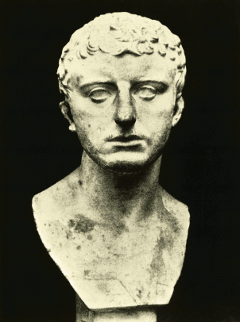
1. Josephus
“About this time there lived Jesus, a wise man, if indeed one ought to call him a man. For he was one who wrought surprising feats and was a teacher of such people as accept the truth gladly. He won over many Jews and many of the Greeks. He was the Messiah. When Pilate, upon hearing him accused by men of the highest standing among us, had condemned him to be crucified, those who had in the first place come to love [him] did not cease. On the third day he appeared to them restored to life. For the prophets of God had prophesied these and myriads of other marvellous [things] about him. And the tribe of the Christians, so called after him, has still up to now, not disappeared.” [3]
This passage is known as the “Testimonium Flavianum” and is probably the most popular (and most contested) reference quoted for proof of the crucifixion outside of the Bible. As a bit of background about the man, Flavius Josephus was a Jewish historian, born in Judea in the 1st century. What makes Josephus special was that he acted as governor for Galilee and even states he lived in Cana, which is the city the gospels say Jesus performed his first miracle [4] [5]. In the early days of the first Jewish Revolt against Rome (66–70 C.E.), Josephus was a commander in Galilee but through a series of events surrendered and became a prisoner of war. He then made a ‘prophecy’ that his captor, Vespasian, the commander on the Roman side he was fighting, would become emperor, and when this happened, Vespasian being amused freed him.
In the 70s and 90s CE Josephus’s finished his two major works, “The History of The Jewish War” and “The Antiquities of the Jews”. The testimonium appears at first to be a slam dunk about the historicity of the Crucifixion. It states who encouraged his killing (the Jews), who sentenced him to die (Pilate) and how they did it (by crucifixion). The reality is though as Prof. Raymond Brown notes, that since the 16th century this text’s authenticity has been questioned and a number of authorities who rejected the text as an outright fabrication including Batiffol, Birdsall, Burkitt, Conzelmann, Hahn, L. Hermann, Lagrange, Norden and Zeitlin. [6]
Before continuing the first thing from a Muslim perspective is the man was a traitor (more on this in a bit) and claimed prophethood which is more than enough to disqualify him due to being a liar. However, since we are doing historical analysis, the concern about this passage is the obvious Christian undertones. The church father Origen states in Against Celsus, 1.47 and in his Commentary on Matthew 10:17 that Josephus did not believe Jesus was the Messiah. In fact, a few years after writing “the Antiquities”, which is itself a book devoted to the defense of Judaism and discussing it with non-Jews, Josephus wrote “Against Apion” to defend Judaism as the true religion against a critic. Furthermore, in his Autobiography, he brags about being a Pharisee. So, there’s really no debate that Josephus was not a Christian when he wrote the Antiquities, so we can say almost for certain he didn’t write: “if it be lawful to call him a man”,“ He was [the] Christ” and “he appeared to them alive again the third day; as the divine prophets had foretold these and ten thousand other wonderful things concerning him.”
Also, some common sense is in order if Josephus thought Jesus was the Messiah it’s safe to assume he would’ve added more about him than a brief passing note in another person’s story which was only a paragraph long.
To understand these issues we first have to look at how Josephus’s work reached us today. Josephus admits that he betrayed the Jews during the revolt against the Romans and this is for the most part how he’s remembered by them. He was not a respected historian and his writings got to us by Christians scribes in the Middle Ages, not Jews. So this explains the Christian themes in the passage.
Most scholars think that even though the ‘Testimonium Flavianum’ is not completely authentic some of it is (aka a ‘partial-interpolation’.) John Meier who argued that the passage is a ‘partial interpolation’ removed any parts he perceived as Christian in the passage and came out with the following:
In the 70s and 90s CE Josephus’s finished his two major works, “The History of The Jewish War” and “The Antiquities of the Jews”. The testimonium appears at first to be a slam dunk about the historicity of the Crucifixion. It states who encouraged his killing (the Jews), who sentenced him to die (Pilate) and how they did it (by crucifixion). The reality is though as Prof. Raymond Brown notes, that since the 16th century this text’s authenticity has been questioned and a number of authorities who rejected the text as an outright fabrication including Batiffol, Birdsall, Burkitt, Conzelmann, Hahn, L. Hermann, Lagrange, Norden and Zeitlin. [6]
Before continuing the first thing from a Muslim perspective is the man was a traitor (more on this in a bit) and claimed prophethood which is more than enough to disqualify him due to being a liar. However, since we are doing historical analysis, the concern about this passage is the obvious Christian undertones. The church father Origen states in Against Celsus, 1.47 and in his Commentary on Matthew 10:17 that Josephus did not believe Jesus was the Messiah. In fact, a few years after writing “the Antiquities”, which is itself a book devoted to the defense of Judaism and discussing it with non-Jews, Josephus wrote “Against Apion” to defend Judaism as the true religion against a critic. Furthermore, in his Autobiography, he brags about being a Pharisee. So, there’s really no debate that Josephus was not a Christian when he wrote the Antiquities, so we can say almost for certain he didn’t write: “if it be lawful to call him a man”,“ He was [the] Christ” and “he appeared to them alive again the third day; as the divine prophets had foretold these and ten thousand other wonderful things concerning him.”
Also, some common sense is in order if Josephus thought Jesus was the Messiah it’s safe to assume he would’ve added more about him than a brief passing note in another person’s story which was only a paragraph long.
To understand these issues we first have to look at how Josephus’s work reached us today. Josephus admits that he betrayed the Jews during the revolt against the Romans and this is for the most part how he’s remembered by them. He was not a respected historian and his writings got to us by Christians scribes in the Middle Ages, not Jews. So this explains the Christian themes in the passage.
Most scholars think that even though the ‘Testimonium Flavianum’ is not completely authentic some of it is (aka a ‘partial-interpolation’.) John Meier who argued that the passage is a ‘partial interpolation’ removed any parts he perceived as Christian in the passage and came out with the following:
“Now there was about this time Jesus, a wise man; for he was a doer of wonderful works, a teacher of such men as receive the truth with pleasure. He drew over to him both many of the Jews and many of the Gentiles. And when Pilate, at the suggestion of the principal men amongst us, had condemned him to the cross, those that loved him at the first did not forsake him. And the tribe of Christians, so named from him, are not extinct at this day.”
The argument is essentially that this is the original passage and that a later Christian author ‘touched it up a bit’ so that readers knew that Josephus is talking about thee, Jesus. This position has been criticized because:
The argument is essentially that this is the original passage and that a later Christian author ‘touched it up a bit’ so that readers knew that Josephus is talking about thee, Jesus. This position has been criticized because:
1. They have no evidence for how they came to this conclusion
2. The text is not easy to separate grammar wise and they have no evidence to what parts they chose to delete
3. The text exists in all known manuscripts indicating there was no redaction to the text. (However, it should be noted there is no manuscript of Antiquities of the Jews 18-20 before the eleventh century (i.e. over a thousand-year gap from its writing) [7]
2. The text is not easy to separate grammar wise and they have no evidence to what parts they chose to delete
3. The text exists in all known manuscripts indicating there was no redaction to the text. (However, it should be noted there is no manuscript of Antiquities of the Jews 18-20 before the eleventh century (i.e. over a thousand-year gap from its writing) [7]

TESTIMONIUM FLAVIANUM FROM CODEX AMBROSIANUS (MEDIOLANENSIS) F. 128 SUPERIOR, THE OLDEST EXTANT MANUSCRIPT WRITTEN IN THE 11TH CENTURY.
Another problem regarding this text’s chain is that no writer before the 4th century makes a reference to it. For example, Origen when defending Christianity in his debate against the pagan writer Celsus quotes a variety of sources including Josephus but doesn’t use the testimonium. Some have argued that he might have known about it by stating that Josephus: “did not believe Jesus was the Christ” but there’s no evidence to state that this is from the testimonium. One can easily argue that he is simply saying: “Josephus wasn’t a Christian,” which is a paraphrase for “Josephus was a Pharisaic Jew” as his autobiography says.
The simplest answer to explain as to why Origen didn’t quote the testimonium is because this paragraph had not yet been written. It was absent from early copies of the works of Josephus and did not appear in Origen’s third-century version.
The simplest answer to explain as to why Origen didn’t quote the testimonium is because this paragraph had not yet been written. It was absent from early copies of the works of Josephus and did not appear in Origen’s third-century version.
Another point used to prove that the testimonium is a ‘partial interpolation’ in an Arabic translation of Josephus discovered in 1971 by Professor Shlomo Pines of the Hebrew University in Jerusalem. An Arab bishop by the name of Agapius of Hierapolis wrote of world history from creation until his time in 941 CE. In this work, he quotes an Arabic translation, of the Testimonium without the most obvious Christian add-ons. (See chart for comparison)
So the argument is that the obvious Christian references don’t apply with the Bishop’s version and this shows that Josephus wrote about the crucifixion.
So the argument is that the obvious Christian references don’t apply with the Bishop’s version and this shows that Josephus wrote about the crucifixion.
| Agapius of Hierapolis | Eusebius of Caesarea |
| Similarly Josephus the Hebrew. For he says in the treatises that he has written on the governance of the Jews: At this time there was a wise man who was called Jesus. And his conduct was good, and [he] was known to be virtuous. And many people from among the Jews and the other nations became his disciples. Pilate condemned him to be crucified and to die. And those who had become his disciples did not abandon his discipleship. They reported that he had appeared to them three days after his crucifixion and that he was alive; accordingly he was perhaps the Messiah concerning whom the prophets have recounted wonders. | About this time there lived Jesus, a wise man, if indeed one ought to call him a man. For he was one who wrought surprising feats and was a teacher of such people as accept the truth gladly. He won over many Jews and many of the Greeks. He was the Messiah. When Pilate, upon hearing him accused by men of the highest standing among us, had condemned him to be crucified, those who had in the first place come to love [him] did not cease. On the third day he appeared to them restored to life. For the prophets of God had prophesied these and myriads of other marvellous [things] about him. And the tribe of the Christians, so called after him, has still up to now, not disappeared. |
Well, Alice Whealey one of the top Josephan scholars refutes the argument that the Arabic comes from a manuscript of Josephus independent of the other manuscripts. She proves that it actually derives from the Church Father Eusebius’s work. [8] So this Arabic version is just a translation of Theophilus of Edessa’s version which used Eusebius’s version
Even Pines himself notes:
Even Pines himself notes:
“Agapius’ Arabic text of the Testimonium is in all probability translated from a Syriac version of the Greek original. It is highly probable that in the course of these translations, and also as a result of scribal errors, some alterations, not due to a deliberate attempt at distortion, were introduced into the text.” [9]
Which now brings us to the most important point. If the text was not penned by Josephus then who?
One opinion is that it was an anonymous scribe between Origen and Eusebius due to the linguistic parallels that Gary J. Goldberg noted between the Testimonium and Luke. [10] He finds nineteen unique correspondences between Luke’s Emmaus creedal account and the Testimonium, and all nineteen are in exactly the same order (with order and word variations only within each). He does note some narrative differences (which are expected due to the contexts being different and as a result of author embellishment), and there is a twentieth correspondence out of order (identifying Jesus as “the Christ”). But otherwise, the coincidences here are difficult to explain. He also shows that the Testimonium contains vocabulary and phrasing that is particularly Christian ( especially Lukan) and not Josephan in writing style. He concluded that this means either a Christian wrote it or Josephus copied from a Christian source. However, these features are so peculiar it’s unlikely Josephus would rewrite a Christian creedal statement into his history book.
Another scholarly view is the Church Father Eusebius is the scribe who penned (whether completely or partially) this text as Ken Olson of the Center For Hellenic Studies in Harvard notes:
One opinion is that it was an anonymous scribe between Origen and Eusebius due to the linguistic parallels that Gary J. Goldberg noted between the Testimonium and Luke. [10] He finds nineteen unique correspondences between Luke’s Emmaus creedal account and the Testimonium, and all nineteen are in exactly the same order (with order and word variations only within each). He does note some narrative differences (which are expected due to the contexts being different and as a result of author embellishment), and there is a twentieth correspondence out of order (identifying Jesus as “the Christ”). But otherwise, the coincidences here are difficult to explain. He also shows that the Testimonium contains vocabulary and phrasing that is particularly Christian ( especially Lukan) and not Josephan in writing style. He concluded that this means either a Christian wrote it or Josephus copied from a Christian source. However, these features are so peculiar it’s unlikely Josephus would rewrite a Christian creedal statement into his history book.
Another scholarly view is the Church Father Eusebius is the scribe who penned (whether completely or partially) this text as Ken Olson of the Center For Hellenic Studies in Harvard notes:
“Both the language and the content have close parallels in the work of Eusebius of Caesarea, who is the first author to show any knowledge of the text. Eusebius quotes the Testimonium in three of his extant works: the Demonstration of the Gospel 3.5.106, the Ecclesiastical History 1.11.8, and the Theophany 5.44. The most likely hypothesis is that Eusebius either composed the entire text or rewrote it so thoroughly that it is now impossible to recover a Josephan original.” [11]
Olson says that in all in arguments for a partial Josephus text Eusebius is an exception to each case. Quoting Van Voorst [12] who sums up all the arguments of the passage’s authenticity Olson gives the following counters for Eusebius being the exception.
1. The passage calls Jesus a “wise man,” which while complimentary is not what one might expect a Christian interpolation to say, because the label was not at all a common Christian one.
Eusebius calls Jesus (identified as “our Savior and Lord”) a wise man (sophos anēr) in the Prophetic Eclogues (PG 22, 1129), which shows he has no issue using it for Jesus. In the context of the Testimonium, Eusebius is responding to claims made by the pagan philosopher Porphyry, Hecate and the oracles of Apollo that Jesus was a “wise man” who had mistakenly been taken to be a god by the Christians (I know). The Christian response to this was to allow that the oracles may have spoken the truth about Jesus being a “wise man”, but to insist that he was far more than that. [13] [14] (How this counters their argument I’ll never know)
1. The passage calls Jesus a “wise man,” which while complimentary is not what one might expect a Christian interpolation to say, because the label was not at all a common Christian one.
Eusebius calls Jesus (identified as “our Savior and Lord”) a wise man (sophos anēr) in the Prophetic Eclogues (PG 22, 1129), which shows he has no issue using it for Jesus. In the context of the Testimonium, Eusebius is responding to claims made by the pagan philosopher Porphyry, Hecate and the oracles of Apollo that Jesus was a “wise man” who had mistakenly been taken to be a god by the Christians (I know). The Christian response to this was to allow that the oracles may have spoken the truth about Jesus being a “wise man”, but to insist that he was far more than that. [13] [14] (How this counters their argument I’ll never know)
2. That Jesus is said to have been a “worker of amazing deeds” (paradoxōn ergōn poiētēs) may be a positive statement, but the wording is not likely to come from a Christian. The phrase “amazing deeds” is itself ambiguous; it can also be translated “startling/controversial deeds,” and the whole sentence can be read to mean simply that Jesus had a reputation as a wonder-worker.
In Josephus’s writings, the words“worker of amazing deeds” (paradoxōn ergōn poiētēs) is found only in the Testimonium but occurs several times in Eusebius writings to describe Jesus or God. The claim that the phrase is “ambiguous” is more of a problem of interpretation. The phrase “worker of amazing deeds” might sound ambiguous to modern interpreters who imagine it coming from the Jew Josephus. But no one would find the phrase ambiguous when Eusebius applies it to the Logos of God [15] or to God Himself. [16] The same argument applies to those scholars who edit out the most obviously Christian parts of the Testimonium and find the remainder “too restrained” to be the work of a Christian but because Eusebius describes Jesus like this in his other works shows that it’s not “too restrained”.
3. According to the passage, Jesus was a teacher of people who accept the truth with pleasure.” Christian writers generally avoid a positive use of the word “pleasure” (hēdonē), with its connotation of Hedonism.
Eusebius praises Christian Martyrs who received death with pleasure[17] [18] and describes the happy state of the righteous in the afterlife who rejoice in pleasure in the divine presence in his commentary on Psalm 67 [19]. Furthermore, the term “teacher of human beings” (didaskalos anthrōpōn) is not found in Josephus’ works outside the Testimonium but is used to describe Jesus in Eusebius’ Demonstratio [20]. The theme that Jesus was sent into the world to teach the truth about the One God to all human beings willing to receive it is the central point in Eusebius’ theology of the incarnation. [21]
Eusebius believed that “Christ, the Logos” taught the knowledge of God and to worship Him alone, to the Hebrew nation before Moses. Later, through Moses and the prophets, the Logos had also taught their descendants the Jews about God, but his teaching was in the form of symbols in the Torah, which most of them were only able to in the worldly sense instead of the spiritual one. Finally, as “the prophets foretold”, Christ became incarnate as the man Jesus to re-teach the earlier true religion to all nations. [22]
4. The statement that Jesus won over “both Jews and Greeks” represents a misunderstanding perhaps found among non-Christians like Lucian. However, anyone remotely familiar with the Gospel tradition knows that Jesus did not win over “many Greeks” to his movement, even though “Greeks” here means Gentiles.
This argument assumes that all ancient Christians read the Gospels the way modern historical critics do. Christians had the habit of increasing Jesus’ message and contact with Gentiles. [23] For example, in the Demonstratio, Eusebius says that Jesus brought crowds of both Jews and Gentiles under his power can be established from the witness of his disciples and apart from it [24], that he freed all who came to him from the polytheistic error, [25] and that he revealed the power of his divinity to all equally whether Greeks or Jews. [26] In retelling the story of King Abgar in the Ecclesiastical History, Eusebius says that Jesus miracles became so well known that crowds from faraway foreign lands came to him seeking healing. [27]
5. The sentence “Those who had first loved him did not cease [doing so]” is characteristically Josephan in style, and points to the continuance of Christianity after the death of its founder. It implies that the love of Jesus’ followers for him, not Jesus’ resurrection appearances to them, was the basis for Christianity’s continuance.
To state the passage is “in Josephus’s writing style” is entirely conjecture. Most commentators have stated that not explaining what his followers stopped doing and leaving on to guess it is not Josephus’s writing style. As for the argumnent, that it makes the love of Jesus not the Ressurection appearances the reason for his followers continuing this based on a misreading of the text. The passage explicitly says Jesus’ resurrection appearance is the reason for his followers not ceasing in their “love” (or “adherence”). This is a Eusebian type of argument. Eusebius says elsewhere that one of the major reasons for the Resurrection is Christ’s desire to give his followers visual proof of life after death so that they would continue and spread his teaching. [28]
6. Calling Christians a “tribe” (phylon) would also be unusual for a Christian scribe; a follower of a missionizing faith would be uncomfortable with the more narrow particularistic implications of the word.
Van Voorst himself notes: “the exception that proves the rule is Eusebius, Ecclesiastical History 3.3.3, “the Christian tribe.”[29] Eusebius uses ethnic terms (including genos, laos and ethnos) and concepts in describing Christianity. [30]
So two different conclusions emerge either:
A. Eusebius forged the testimonium [31]
or
B. Eusebius made a scribal note that made its way into the main text [32]
Olson argues well, that the six arguments against Christians writing the passage doesn’t work with Eusebius. Even if one doesn’t agree that Eusebius wrote it, this still doesn’t change the fact that these arguments are based on what Christians would or would not have written instead of analyzing what they did write. With that being said for argument’s sake let’s say that Josephus really did write the Testimonium, it still doesn’t prove anything for the crucifixion. All it shows is that by 93 CE— some sixty or more years after the alleged event—a Jewish historian heard some information about Jesus. The question is where would Josephus have gotten this information? He obviously would’ve heard stories about Jesus that were being passed around by Christians. There is nothing whatsoever to suggest that Josephus did any kind of primary research into the life of Jesus by examining Roman records of some kind because quite simply there weren’t any.
In Josephus’s writings, the words“worker of amazing deeds” (paradoxōn ergōn poiētēs) is found only in the Testimonium but occurs several times in Eusebius writings to describe Jesus or God. The claim that the phrase is “ambiguous” is more of a problem of interpretation. The phrase “worker of amazing deeds” might sound ambiguous to modern interpreters who imagine it coming from the Jew Josephus. But no one would find the phrase ambiguous when Eusebius applies it to the Logos of God [15] or to God Himself. [16] The same argument applies to those scholars who edit out the most obviously Christian parts of the Testimonium and find the remainder “too restrained” to be the work of a Christian but because Eusebius describes Jesus like this in his other works shows that it’s not “too restrained”.
3. According to the passage, Jesus was a teacher of people who accept the truth with pleasure.” Christian writers generally avoid a positive use of the word “pleasure” (hēdonē), with its connotation of Hedonism.
Eusebius praises Christian Martyrs who received death with pleasure[17] [18] and describes the happy state of the righteous in the afterlife who rejoice in pleasure in the divine presence in his commentary on Psalm 67 [19]. Furthermore, the term “teacher of human beings” (didaskalos anthrōpōn) is not found in Josephus’ works outside the Testimonium but is used to describe Jesus in Eusebius’ Demonstratio [20]. The theme that Jesus was sent into the world to teach the truth about the One God to all human beings willing to receive it is the central point in Eusebius’ theology of the incarnation. [21]
Eusebius believed that “Christ, the Logos” taught the knowledge of God and to worship Him alone, to the Hebrew nation before Moses. Later, through Moses and the prophets, the Logos had also taught their descendants the Jews about God, but his teaching was in the form of symbols in the Torah, which most of them were only able to in the worldly sense instead of the spiritual one. Finally, as “the prophets foretold”, Christ became incarnate as the man Jesus to re-teach the earlier true religion to all nations. [22]
4. The statement that Jesus won over “both Jews and Greeks” represents a misunderstanding perhaps found among non-Christians like Lucian. However, anyone remotely familiar with the Gospel tradition knows that Jesus did not win over “many Greeks” to his movement, even though “Greeks” here means Gentiles.
This argument assumes that all ancient Christians read the Gospels the way modern historical critics do. Christians had the habit of increasing Jesus’ message and contact with Gentiles. [23] For example, in the Demonstratio, Eusebius says that Jesus brought crowds of both Jews and Gentiles under his power can be established from the witness of his disciples and apart from it [24], that he freed all who came to him from the polytheistic error, [25] and that he revealed the power of his divinity to all equally whether Greeks or Jews. [26] In retelling the story of King Abgar in the Ecclesiastical History, Eusebius says that Jesus miracles became so well known that crowds from faraway foreign lands came to him seeking healing. [27]
5. The sentence “Those who had first loved him did not cease [doing so]” is characteristically Josephan in style, and points to the continuance of Christianity after the death of its founder. It implies that the love of Jesus’ followers for him, not Jesus’ resurrection appearances to them, was the basis for Christianity’s continuance.
To state the passage is “in Josephus’s writing style” is entirely conjecture. Most commentators have stated that not explaining what his followers stopped doing and leaving on to guess it is not Josephus’s writing style. As for the argumnent, that it makes the love of Jesus not the Ressurection appearances the reason for his followers continuing this based on a misreading of the text. The passage explicitly says Jesus’ resurrection appearance is the reason for his followers not ceasing in their “love” (or “adherence”). This is a Eusebian type of argument. Eusebius says elsewhere that one of the major reasons for the Resurrection is Christ’s desire to give his followers visual proof of life after death so that they would continue and spread his teaching. [28]
6. Calling Christians a “tribe” (phylon) would also be unusual for a Christian scribe; a follower of a missionizing faith would be uncomfortable with the more narrow particularistic implications of the word.
Van Voorst himself notes: “the exception that proves the rule is Eusebius, Ecclesiastical History 3.3.3, “the Christian tribe.”[29] Eusebius uses ethnic terms (including genos, laos and ethnos) and concepts in describing Christianity. [30]
So two different conclusions emerge either:
A. Eusebius forged the testimonium [31]
or
B. Eusebius made a scribal note that made its way into the main text [32]
Olson argues well, that the six arguments against Christians writing the passage doesn’t work with Eusebius. Even if one doesn’t agree that Eusebius wrote it, this still doesn’t change the fact that these arguments are based on what Christians would or would not have written instead of analyzing what they did write. With that being said for argument’s sake let’s say that Josephus really did write the Testimonium, it still doesn’t prove anything for the crucifixion. All it shows is that by 93 CE— some sixty or more years after the alleged event—a Jewish historian heard some information about Jesus. The question is where would Josephus have gotten this information? He obviously would’ve heard stories about Jesus that were being passed around by Christians. There is nothing whatsoever to suggest that Josephus did any kind of primary research into the life of Jesus by examining Roman records of some kind because quite simply there weren’t any.
2. The Talmud
It is taught: On the eve of Passover they hung Yeshu and the crier went forth for forty days beforehand declaring that “[Yeshu] is going to be stoned for practicing witchcraft, for enticing and leading Israel astray. Anyone who knows something to clear him should come forth and exonerate him.” But no one had anything exonerating for him and they hung him on the eve of Passover. Ulla said: Would one think that we should look for exonerating evidence for him? He was an enticer and God said (Deuteronomy 13:9) “Show him no pity or compassion, and do not shield him.” Yeshu was different because he was close to the government. It is taught: Yeshu had five disciples – Matai, Nekai, Netzer, Buni, and Todah. They brought Matai [before the judges]. He said to them: Will Matai be killed? It is written (Psalm 42:2) “When [=Matai] shall (I) come and appear before G-d.” They said to him: Yes, Matai will be killed as it is written (Psalm 41:5) “When [=Matai] shall (he) die and his name perish.” They brought Nekai. He said to them: Will Nekai be killed? It is written (Exodus 23:7) “The innocent [=Naki] and the righteous you shall not slay.” They said to him: Yes, Nekai will be killed as it is written (Psalm 10:8) “In secret places he slay the innocent [=Naki].” They brought Netzer. He said to them: Will Netzer be killed? It is written (Isaiah 11:1) “A branch [=Netzer] shall spring up from his roots.” They said to him: Yes, Netzer will be killed as it is written (Isaiah 14:19) “You are cast forth out of your grave like an abominable branch [=Netzer].” They brought Buni. He said to them: Will Buni be killed? It is written (Exodus 4:22) “My son [=Beni], my firstborn, Israel.” They said to him: Yes, Buni will be killed as it is written (Exodus 4:23) “Behold, I slay your son [=Bincha] your firstborn.” They brought Todah. He said to them: Will Todah be killed? It is written (Psalm 100:1) “A Psalm for thanksgiving [=Todah].” They said to him: Yes, Todah will be killed as it is written (Psalm 50:23) “Whoever sacrifices thanksgiving [=Todah] honors me.” [33]
It is taught: For all others liable for the death penalty [except for the enticer to idolatry] we do not hide witnesses. How do they deal with [the enticer]? They light a lamp for him in the inner chamber and place witnesses in the outer chamber so that they can see and hear him while he cannot see or hear them. One says to him “Tell me again what you said to me in private” and he tells him. He says “How can we forsake our G-d in heaven and worship idolatry?” If he repents, good. If he says “This is our obligation and what we must do” the witnesses who hear him from outside bring him to the court and stone him. And so they did to Ben Stada in Lud and hung him on the eve of Passover. [34]
The Talmud is a collection of writings ranging from legal disputes, anecdotes, folklore, customs, and sayings from early Judaism. The main part of the Talmud is what is known as the Mishnah, which are stories of early rabbis along with their various teachings on Jewish law based on long circulated oral traditions. However most of the Talmud is a pair of commentaries from 4th century Palestine and 5th century Babylon by later rabbis about the Mishnah called the Gemara.
Now for those of you who were paying attention, you may have noticed that this work was put together long after the days Jesus would’ve been crucified (again 300 and 400 years later). So this alone is enough to disqualify them as eyewitness evidence but let’s examine the passages because there are some other peculiarities about them.
There are no explicit references about Jesus in the Mishnah, it’s supposed to be ‘implied’ that he’s the one being referred to as a man named “Yesu Ben (son of) Panthera.” Panthera is supposed to be the name given to a Roman soldier who Mary, is alleged to have fornicated with. Some scholars view this tradition as subtle attack on Jesus being born as the “son of a virgin.” In Greek, the word for virgin is “parthenos”, which is supposed to be close in spelling to “Panthera”. Also in the Talmud, this Yesu is accused of being a sorcerer who learned magic in Egypt. The connection is supposed to be made is in a gospel narrative Jesus is said to have fled with his family to Egypt soon after he was born. Finally, this Yesu is said to have been hanged on the eve of the Passover.
All these references have some issues, first this Yesu is said to be a student of Rabbi Yehoshua Ben Perachiah and lived during the time of John Hyrcanus
“…When John [Hyrcanus] the king killed the rabbis, R. Yehoshua Ben Perachiah [and Yeshu] went to Alexandria of Egypt…” [35]
Which means he was born over a century before Jesus.
The next point to notice is the passage says: “the crier went forth for forty days beforehand declaring that “[Yeshu] is going to be stoned for practicing witchcraft, for enticing and leading Israel astray.”and “…the witnesses who hear him from outside bring him to the court and stone him. And so they did to Ben Stada in Lud and hung him on the eve of Passover.”
None of this has any parallel in any Christian gospels who said Jesus was tried quickly and was crucified at a place called Golgotha (not Lud). To make things even more confusing the standard rabbinic understanding of these passages is that they’re referring to at least two different people.
Also this Ben Stada was stoned to death by a Jewish court and not crucified by the Roman government. The Synoptic Gospels also say that Jesus was executed on Passover itself [36] [37] [38] and not the eve of Passover (though in fairness John does contradict the Synoptics on this) And finally, the disciples mentioned are not the right number or names except maybe one of them.
Now for those of you who were paying attention, you may have noticed that this work was put together long after the days Jesus would’ve been crucified (again 300 and 400 years later). So this alone is enough to disqualify them as eyewitness evidence but let’s examine the passages because there are some other peculiarities about them.
There are no explicit references about Jesus in the Mishnah, it’s supposed to be ‘implied’ that he’s the one being referred to as a man named “Yesu Ben (son of) Panthera.” Panthera is supposed to be the name given to a Roman soldier who Mary, is alleged to have fornicated with. Some scholars view this tradition as subtle attack on Jesus being born as the “son of a virgin.” In Greek, the word for virgin is “parthenos”, which is supposed to be close in spelling to “Panthera”. Also in the Talmud, this Yesu is accused of being a sorcerer who learned magic in Egypt. The connection is supposed to be made is in a gospel narrative Jesus is said to have fled with his family to Egypt soon after he was born. Finally, this Yesu is said to have been hanged on the eve of the Passover.
All these references have some issues, first this Yesu is said to be a student of Rabbi Yehoshua Ben Perachiah and lived during the time of John Hyrcanus
“…When John [Hyrcanus] the king killed the rabbis, R. Yehoshua Ben Perachiah [and Yeshu] went to Alexandria of Egypt…” [35]
Which means he was born over a century before Jesus.
The next point to notice is the passage says: “the crier went forth for forty days beforehand declaring that “[Yeshu] is going to be stoned for practicing witchcraft, for enticing and leading Israel astray.”and “…the witnesses who hear him from outside bring him to the court and stone him. And so they did to Ben Stada in Lud and hung him on the eve of Passover.”
None of this has any parallel in any Christian gospels who said Jesus was tried quickly and was crucified at a place called Golgotha (not Lud). To make things even more confusing the standard rabbinic understanding of these passages is that they’re referring to at least two different people.
Also this Ben Stada was stoned to death by a Jewish court and not crucified by the Roman government. The Synoptic Gospels also say that Jesus was executed on Passover itself [36] [37] [38] and not the eve of Passover (though in fairness John does contradict the Synoptics on this) And finally, the disciples mentioned are not the right number or names except maybe one of them.
| Ben Pandira | Ben Stada | Jesus the Messiah |
| Lived approx. 80 BCE | Lived approx. 100 CE | Preached around 6-27 CE |
| Student of Rabbi Yehoshua Ben Perachiah | N/A | No known teachers |
| Escaped persecution by fleeing to Egypt and, upon return, became an idolater | Brought witchcraft from Egypt | In one account family fled to Egypt |
| N/A | Mother was Miriam the hairdresser, also known as Stada | No recording of Mary being a hairdresser. This may however be a play on being a fornicator |
| Father was named Pandira | N/A | Had no father |
| N/A | Step-father was Pappos Ben Yehudah | Step-father was Joseph |
| Executed on the day before Passover | Executed on the day before Passover in Lud for idolatry | The Synoptics say he was executed before Passover. John says he was executed on Passover |
| Had close contact with government officials | N/A | Recorded to preach to tax collectors |
| Had five disciples who were also executed. | N/A | Had twelve disciples who were not executed with him |
| N/A | Trial was 40 days long | Trial was 1 day |
So what’s going on here?
Rabbi Morris Goldstein, in his book, Jesus in the Jewish Tradition, argues against Jesus being in the various references in the Talmud. Basically, the passages originally referred to different people named Yeshu Ben Stada, and Yeshu Ben Pandira, none of whom were Jesus. Over time, different generations of talmudic rabbis melded the passages together with added phrases and details. This theory is modified by some scholars, such as Joseph Klausner and John P. Meier, who believe that some of the later additions were meant to refer to Jesus, while the original basic text did not. I personally favor the latter opinion as Peter Schäfer’s ‘Jesus in the Talmud’ makes a convincing argument that these references definitely later on in Judaism’s history were meant to be shots at Jesus the Messiah. However whatever the case may be because of this uncertainty of who’s being talked about, combined with the Talmud’s late writing this is enough to disqualify it as proof for the crucifixion.
Rabbi Morris Goldstein, in his book, Jesus in the Jewish Tradition, argues against Jesus being in the various references in the Talmud. Basically, the passages originally referred to different people named Yeshu Ben Stada, and Yeshu Ben Pandira, none of whom were Jesus. Over time, different generations of talmudic rabbis melded the passages together with added phrases and details. This theory is modified by some scholars, such as Joseph Klausner and John P. Meier, who believe that some of the later additions were meant to refer to Jesus, while the original basic text did not. I personally favor the latter opinion as Peter Schäfer’s ‘Jesus in the Talmud’ makes a convincing argument that these references definitely later on in Judaism’s history were meant to be shots at Jesus the Messiah. However whatever the case may be because of this uncertainty of who’s being talked about, combined with the Talmud’s late writing this is enough to disqualify it as proof for the crucifixion.
Roman Sources

3. Cornelius Tacitus
“Nero looked around for a scapegoat, and inflicted the most fiendish tortures on a group of persons already hated for their crimes. This was the sect known as Christians. Their founder, one Christus, had been put to death by the procurator, Pontius Pilate in the reign of Tiberius. [40]
Cornelius Tacitus was a Roman aristocrat and historian born about 55-57CE. His father was a wealthy man who belonged to the second tier of the Roman elite, the equestrian order (think kinda like their version of knights).
Rome itself was still suffering from a big fire that had destroyed the city in 64 CE. And to make matters worse, a civil war known as the Year of the Four Emperors in 69 C.E. had broken out, ending with Vespasian becoming emperor (who you may have remembered that Josephus had “prophesied” about him doing so in his entry).
Tacitus became quaestor in 81 or 82CE, and after this, he was admitted to the Senate. His two major books— the Histories (100–110 CE) and the Annals (115 CE) — go through the reign of Tiberius, Claudius, Nero, and those of the Year of the Four Emperors.
Rome itself was still suffering from a big fire that had destroyed the city in 64 CE. And to make matters worse, a civil war known as the Year of the Four Emperors in 69 C.E. had broken out, ending with Vespasian becoming emperor (who you may have remembered that Josephus had “prophesied” about him doing so in his entry).
Tacitus became quaestor in 81 or 82CE, and after this, he was admitted to the Senate. His two major books— the Histories (100–110 CE) and the Annals (115 CE) — go through the reign of Tiberius, Claudius, Nero, and those of the Year of the Four Emperors.

CHRESTIANS OF CHRIST. BOOK XV OF TACITUS’S ANNALS IS PRESERVED IN THE 11TH–12TH-CENTURY CODEX MEDICEUS II, A COLLECTION OF MEDIEVAL MANUSCRIPTS NOW HOUSED IN THE BIBLIOTECA MEDICEA LAURENZIANA IN FLORENCE, ITALY, ALONG WITH OTHER MANUSCRIPTS AND BOOKS THAT BELONGED TO THE MEDICI FAMILY. HIGHLIGHTED ABOVE IS THE LATIN TEXT READING “… WHOM THE CROWD CALLED ‘CHRESTIANS.’ THE FOUNDER OF THIS NAME, CHRIST, HAD BEEN EXECUTED IN THE REIGN OF TIBERIUS BY THE PROCURATOR PONTIUS PILATE …” PHOTO: CODEX MEDICEUS 68 II, FOL. 38R, THE BIBLIOTECA MEDICEA LAURENZIANA, FLORENCE, ITALY.
So our first issue is like Josephus, Tacitus himself is not an eyewitness to the Crucifixion. He himself was born approx. 25 years after the event, and his work Annals that mentions the passage of Jesus’s crucifixion was written about 115CE which leaves us a gap of about 85 years. So now is that question of how did Tacitus get his information? Theissen and Merz in “The Historical Jesus: A Comprehensive Guide’, give us three possibilities:
- From government records.
- From Christians (either directly or through his friend Pliny the Younger when some Christians were being rounded up in 110 CE.)
- From earlier historians (Pliny the Elder would in that event be the most likely one, but there were many to choose from)
Let’s start with government records. The first issue with this as a source is the anarchism of Pontius Pilate’s title as a ‘procurator’. Historically Judea was ruled by a ‘prefect’ from 6 CE to around 41-54 CE. and it was after that period that the governor was called a procurator:
“Up until the time of Claudius [i.e., 41-54 CE], the provincial governor of Judea, a man of the equestrian order, was not a procurator but a prefect.” [41]
Now truth be told they were different titles for the same job. The main differences are a procurator, as the word implies, was a civilian financial administrator who was the emperor’s personal agent for collecting revenue while a prefect was a military commander with forces under his command.
We know from an inscription discovered in 1961 at Caesarea Maritima that Pilate had the title and rank, of prefect and not procurator because it reads: “praefectus iudaeae” (prefect of Judea) . Raymond E. Brown explaining this issue comments:
We know from an inscription discovered in 1961 at Caesarea Maritima that Pilate had the title and rank, of prefect and not procurator because it reads: “praefectus iudaeae” (prefect of Judea) . Raymond E. Brown explaining this issue comments:
“In calling Pilate a procurator Tacitus was reflecting the later terminology of the 1st cent., still in vogue at the time of his writing.” [42]
This issue has caused others to remark:
“Pilate actually held the lesser rank of prefect in Judea, something that Tacitus, who had access to the official records at Rome’s Tabularium and frequently quoted from them in his Annals, should have known.” [43]
“This change in title under Claudius goes a long way in explaining the confusion of the principal literary texts here. Philo, Josephus, the NT and Tacitus refer to various governors as eparxos (praefectus), epitropos (procurator), and hegemwn (governor), apparently indiscriminately.” [44]

THE FAMOUS BLOCK OF LIMESTONE, WHICH WAS FOUND AT CAESAREA IN 1961, SAYS:
TO THE DIVINE AUGUSTI [THIS] TIBERIEUM
…PONTIUS PILATE
…PREFECT OF JUDEA
…HAS DEDICATED [THIS]
The other issue is Tacitus saying “Christus”. G.A. Wells points out no government documents from Rome would call Jesus, Christus.[45] Even if we ignore these anarchisms, from a logical standpoint the idea that Pilate would report to the Roman Senate on an everyday execution is unlikely. As well as such a record would even still exist in Tacitus’s time, especially considering that the Roman archives had burned in 64CE when the capital was destroyed, and again 80CE, when the libraries of Rome were destroyed.
Also unsupported by evidence is the idea that Tacitus would bother to spend hours or days digging through thousands of crime reports supposedly in the state archives just to verify what a person told him, just to fill out a passing note about someone who he would consider a cult leader. All Tacitus is doing in the passage is explaining the origin of the name Christians, who are being used as an example of Nero’s cruelty. If Tacitus is basing his comment about Jesus on serious research, one might have expected him to say more, than what we already know. As noted by John P. Meier and Robert Van Voorst:
Also unsupported by evidence is the idea that Tacitus would bother to spend hours or days digging through thousands of crime reports supposedly in the state archives just to verify what a person told him, just to fill out a passing note about someone who he would consider a cult leader. All Tacitus is doing in the passage is explaining the origin of the name Christians, who are being used as an example of Nero’s cruelty. If Tacitus is basing his comment about Jesus on serious research, one might have expected him to say more, than what we already know. As noted by John P. Meier and Robert Van Voorst:
“It could be, instead, that Tacitus is simply repeating what was common knowledge about Christians about the beginning of the 2d century.” [46]
“The most likely source of Tacitus’s information about Christ is Tacitus’s own dealings with Christians, directly or indirectly.” [47]
Now let’s look at Christians as his source. The main argument against this can be summed up as Tacitus hated Christians so much he wouldn’t trust anything they said and would make sure to verify it. While its true he hated Christians, this would favor more that he didn’t fact check and waste the hours to verify the embarrassing story that their ‘cult leader’ was a criminal killed by the Roman government. If they were his source why would he verify this when Christians themselves are saying this is true. It’s pretty obvious that by this time Christians were telling stories of Jesus (the Gospels had been written already, for example), there is no reason for Tacitus not to take the basic Christian story at face value, especially since the idea that they were newcomers would definitely classify Christianity as a ‘superstition’.
Finally let’s analyze the final possibility. This option while more likely than government records would mean someone else would’ve probably quoted or mentioned the coverage of Christians in earlier histories like Pliny the Elder’s. It’s hard to imagine that Christians would have let such a valuable reference to Jesus, so close to his time, go unrecorded, or if malicious, not refute it because Christianity’s critics would’ve been using it. But most importantly had Pliny the Elder discussed Christians in his history, his nephew and adopted son Pliny the Younger who greatly admired him, would’ve read it and not have known anything about Christians as he says in his letter to Trajan:
Finally let’s analyze the final possibility. This option while more likely than government records would mean someone else would’ve probably quoted or mentioned the coverage of Christians in earlier histories like Pliny the Elder’s. It’s hard to imagine that Christians would have let such a valuable reference to Jesus, so close to his time, go unrecorded, or if malicious, not refute it because Christianity’s critics would’ve been using it. But most importantly had Pliny the Elder discussed Christians in his history, his nephew and adopted son Pliny the Younger who greatly admired him, would’ve read it and not have known anything about Christians as he says in his letter to Trajan:
“It is my practice, my lord, to refer to you all matters concerning which I am in doubt. For who can better give guidance to my hesitation or inform my ignorance? I have never participated in trials of Christians. I therefore do not know what offenses it is the practice to punish or investigate, and to what extent… in the case of those who were denounced to me as Christians, I have observed the following procedure: I interrogated these as to whether they were Christians; those who confessed I interrogated a second and a third time, threatening them with punishment; those who persisted I ordered executed. For I had no doubt that, whatever the nature of their creed, stubbornness and inflexible obstinacy surely deserve to be punished.” [48]
The reason this is matters is that Pliny and Tacitus were governing the provinces next to one another and shared correspondence. Tacitus was also known to ask his friend Pliny for information to include in his Histories, and if Pliny the Elder was his source it’s unlikely Tacitus wouldn’t have listed him as a reference. It should be clear that there’s no reason to doubt that Tacitus is basing his comment about Jesus on anything other than hearsay.
4. Thallus
“On the whole world there pressed a most fearful darkness; and the rocks were rent by an earthquake, and many places in Judea and other districts were thrown down…” [49]
The 9th-century Christian chronologer George Syncellus cites Julius Africanus as writing a reference to the darkness mentioned in the synoptic gospels as occurring at the death of Jesus by a pagan historian by the name of Thallus:
“Thallus calls this darkness an eclipse of the sun in the third book of his Histories….”
The first problem is we know next to nothing about Thallus but the bigger problem is we have no text written by Thallus himself. What we have is a reference to Thallus in a 9th-century work (i.e. almost a thousand years later) by a person quoting another person. Syncellus doesn’t quote Thallus directly – he relies on a 2nd to 3rd-century Christian writer named Julius Africanus who’s thought to be a Libyan. But even then Africanus himself doesn’t quote Thallus directly, so this entire thing is just a third hand paraphrasing of Thallus. Even if for the sake of argument we allow this what did Thallus say? Africanus says that Thallus recorded a solar eclipse – nothing weird or unusual here. It’s Africanus who’s claiming that Thallus was wrong, and what he was really recording was the darkness spoken of in the gospels so Africanus is the one making the link to the eclipse not Thallus. Let’s look at the passage’s context:
On the whole world there pressed a most fearful darkness; and the rocks were rent by an earthquake, and many places in Judea and other districts were thrown down. This darkness Thallus, in the third book of his History, calls, as appears to me without reason, an eclipse of the sun. For the Hebrews celebrate the passover on the 14th day according to the moon, and the passion of our Saviour fails on the day before the passover; but an eclipse of the sun takes place only when the moon comes under the sun. And it cannot happen at any other time but in the interval between the first day of the new moon and the last of the old, that is, at their junction: how then should an eclipse be supposed to happen when the moon is almost diametrically opposite the sun?
This is all we got. There’s not enough information to even show if Thallus is even talking about the same year as Jesus let alone the man himself. We don’t have the context of this quote and don’t know what else Africanus said about this event or Thallus. Africanus is simply criticizing the possibility that the darkness of the crucifixion was a solar eclipse. Thallus could’ve simply recorded an eclipse that occurred and Africanus could’ve connected the events on his own as G.A. Wells explains:
“Thallus calls this darkness an eclipse of the sun in the third book of his Histories….”
The first problem is we know next to nothing about Thallus but the bigger problem is we have no text written by Thallus himself. What we have is a reference to Thallus in a 9th-century work (i.e. almost a thousand years later) by a person quoting another person. Syncellus doesn’t quote Thallus directly – he relies on a 2nd to 3rd-century Christian writer named Julius Africanus who’s thought to be a Libyan. But even then Africanus himself doesn’t quote Thallus directly, so this entire thing is just a third hand paraphrasing of Thallus. Even if for the sake of argument we allow this what did Thallus say? Africanus says that Thallus recorded a solar eclipse – nothing weird or unusual here. It’s Africanus who’s claiming that Thallus was wrong, and what he was really recording was the darkness spoken of in the gospels so Africanus is the one making the link to the eclipse not Thallus. Let’s look at the passage’s context:
On the whole world there pressed a most fearful darkness; and the rocks were rent by an earthquake, and many places in Judea and other districts were thrown down. This darkness Thallus, in the third book of his History, calls, as appears to me without reason, an eclipse of the sun. For the Hebrews celebrate the passover on the 14th day according to the moon, and the passion of our Saviour fails on the day before the passover; but an eclipse of the sun takes place only when the moon comes under the sun. And it cannot happen at any other time but in the interval between the first day of the new moon and the last of the old, that is, at their junction: how then should an eclipse be supposed to happen when the moon is almost diametrically opposite the sun?
This is all we got. There’s not enough information to even show if Thallus is even talking about the same year as Jesus let alone the man himself. We don’t have the context of this quote and don’t know what else Africanus said about this event or Thallus. Africanus is simply criticizing the possibility that the darkness of the crucifixion was a solar eclipse. Thallus could’ve simply recorded an eclipse that occurred and Africanus could’ve connected the events on his own as G.A. Wells explains:
“…Jacoby notes that it is not certain from what Africanus said that Thallus made any mention of Jesus or Jewish history at all, and may simply have recorded the eclipse of the sun in the reign of Tiberius, for which astronomers have calculated the date 24 November A.D. 29; it may have been Africanus who introduced Jesus by retorting- from his knowledge of Mark- that this was no eclipse, but a supernatural event. That this may be so is conceded by R.T. France who, having studied both Bruce’s argument and my reply to it in DJE, comments: “We do not know whether Thallus actually mentioned Jesus’s crucifixion or whether this was Africanus’s interpretation of a period of darkness which Thallus had not specifically linked with Jesus.” France also rejects the confident statement that Thallus wrote “about A.D. 52”, and says that ‘his date of writing is not known’….” [50]
This last point of G.A. Wells is important, the most common claim one will find is that Thallus, wrote around 52 CE but this dating based on a corrupted text. The Armenian translation of the Chronicle of Eusebius, gives a list of references (which unfortunately were not preserved in Greek version) where Eusebius says he used three books from Thallus, which spans from Troy’s fall to the “167th Olympiad”, which make it from the 12th century BCE to 109 BCE which is over 100 years before Jesus’s time. Now if it weren’t for what Africanus said, everyone would conclude that Thallus wrote in the 1st century BCE and that would be the end of it. But this Armenian version is still important because it must be talking about the same book Africanus used because when Eusebius quotes it he doesn’t give any more info about it which means he didn’t think anybody would be confused about what book from Thallus he was talking about. Since Africanus says he found the eclipse in the third book of Thallus, we can assume that the Armenian text may have made a mistake, and the date does not end at 109 BCE
Now this opens up a ton of possibilities and scholars have given dates of the real Greek word used ranging from 52 CE all the way to 172 CE. However, it should be noted that all these dates proposed are just guesses and literally any date is possible depending on what mistake the scribe made. Dr. Richard Carrier argues that, Thallus most likely wrote in the second century because from an orthography standpoint the most likely mistake in Greek would be σκζ (132 CE) to ρχζ (52 CE) and there’s no known pagan author writing about the Gospels before the second century so it’s unlikely that Thallus is the exception here. Carrier believes that Eusebius provides Thallus’s quote when the latter quotes Phlegon of Tralles:
Now this opens up a ton of possibilities and scholars have given dates of the real Greek word used ranging from 52 CE all the way to 172 CE. However, it should be noted that all these dates proposed are just guesses and literally any date is possible depending on what mistake the scribe made. Dr. Richard Carrier argues that, Thallus most likely wrote in the second century because from an orthography standpoint the most likely mistake in Greek would be σκζ (132 CE) to ρχζ (52 CE) and there’s no known pagan author writing about the Gospels before the second century so it’s unlikely that Thallus is the exception here. Carrier believes that Eusebius provides Thallus’s quote when the latter quotes Phlegon of Tralles:
“Jesus Christ, according to the prophecies which had been foretold, underwent his passion in the 18th year of Tiberius [32 ce]. Also at that time in other Greek compendiums we find an event recorded in these words: ‘the sun was eclipsed, Bithynia was struck by an earthquake, and in the city of Nicaea many buildings fell’.All these things happened to occur during the Lord’s passion. In fact, Phlegon, too, a distinguished reckoner of Olympiads, wrote more on these events in his 13th book, saying this: ‘Now, in the fourth year of the 202nd Olympiad [32 ce], a great eclipse of the sun occurred at the sixth hour [i.e. noon] that excelled every other before it, turning the day into such darkness of night that the stars could be seen in heaven, and the earth moved in Bithynia, toppling many buildings in the city of Nicaea.” [51]
This is because if the Histories of Thallus talks about an eclipse in connection with Jesus, Eusebius would have just quoted it directly. Eusebius instead says Phlegon and ‘other Greek chronologers’ all recorded the event ‘with this phrase’. So since Eusebius was using Thallus, as a source directly, it’s safe to say that the part I bolded above is the quote from Thallus that Africanus is talking about, because he too would have quoted Thallus if he mentioned Jesus directly. So with this evidence the passage that Thallus wrote was only this:
‘The sun was eclipsed; Bithynia was struck by an earthquake; and in the city of Nicaea many buildings fell’.
What this means is Thallus probably didn’t reference Jesus, show any knowledge of the gospels (Bithynia is in Turkey, which is nowhere near Palestine) and wrote after Phlegon (whose work is usually dated somewhere between 120 and 140 CE), because this line appears to be Phlegon’s without all the extra details. The length of this proposed passage is also what one would expect from a book that covers twelve centuries in only three scrolls because what Africanus suggests has Thallus refuting claims made by what he would consider a tiny cult and completely disregarding the purpose of his book. This would also explain why no other Christian author who mentions Thallus before Syncellus ever talked about this reference to the darkness.
The alternative theory by Jobjorn Boman [52] agrees with Carrier that Thallus did not mention Jesus but theorizes that rather than the Armenian translation reference date for Thallus being a mistake, Africanus made a mistake in his reference and confused Phlegon with Thallus. So Thallus didn’t write anything about Jesus, eclipses, earthquakes or even in the first century CE for that matter and basically, his three-volume work ended in 2nd century BCE as the Armenian translation stated. So Borman argues that Thallus may have lived and worked in the 1st century BCE and there would be no need to propose any mistake to the Armenian text. However, regardless of who is correct the uncertainty surrounding this reference combined with its geographical mistake we can again exclude it as a proof to the crucifixion.
‘The sun was eclipsed; Bithynia was struck by an earthquake; and in the city of Nicaea many buildings fell’.
What this means is Thallus probably didn’t reference Jesus, show any knowledge of the gospels (Bithynia is in Turkey, which is nowhere near Palestine) and wrote after Phlegon (whose work is usually dated somewhere between 120 and 140 CE), because this line appears to be Phlegon’s without all the extra details. The length of this proposed passage is also what one would expect from a book that covers twelve centuries in only three scrolls because what Africanus suggests has Thallus refuting claims made by what he would consider a tiny cult and completely disregarding the purpose of his book. This would also explain why no other Christian author who mentions Thallus before Syncellus ever talked about this reference to the darkness.
The alternative theory by Jobjorn Boman [52] agrees with Carrier that Thallus did not mention Jesus but theorizes that rather than the Armenian translation reference date for Thallus being a mistake, Africanus made a mistake in his reference and confused Phlegon with Thallus. So Thallus didn’t write anything about Jesus, eclipses, earthquakes or even in the first century CE for that matter and basically, his three-volume work ended in 2nd century BCE as the Armenian translation stated. So Borman argues that Thallus may have lived and worked in the 1st century BCE and there would be no need to propose any mistake to the Armenian text. However, regardless of who is correct the uncertainty surrounding this reference combined with its geographical mistake we can again exclude it as a proof to the crucifixion.
5. Mara Bar Sepion
What else can we say, when the wise are forcibly dragged off by tyrants, their wisdom is captured by insults, and their minds are oppressed and without defense? What advantage did the Athenians gain from murdering Socrates? Famine and plague came upon them as a punishment for their crime. What advantage did the men of Samos gain from burning Pythagoras? In a moment their land was covered with sand. What advantage did the Jews gain from executing their wise king? It was just after that their kingdom was abolished. God justly avenged these three wise men: the Athenians died of hunger; the Samians were overwhelmed by the sea and the Jews, desolate and driven from their own kingdom, live in complete dispersion. But Socrates is not dead, because of Plato; neither is Pythagoras, because of the statue of Juno; nor is the wise king, because of the “new law” he laid down. [53]
Mara bar Serapion was a Stoic philosopher in the Roman province of Syria. The letter indicates that Mara’s homeland was Samosata, (modern-day Samsat, Turkey on the west bank of the Euphrates), but his captivity appears to have been in Seleucia, in modern-day Iraq (on the west bank of the Tigris River).
It is unknown when Mara bar Serapion lived, whether he could have been an eyewitness to Jesus, or even when he wrote this letter. With that being said even the most conservative position of this letter is 73CE which means we still run into a problem as the rest of the sources quoted, he wrote about 43 years after the supposed crucifixion, and it’s very possible that he didn’t witness it. As conservative scholar F.F. Bruce states:
It is unknown when Mara bar Serapion lived, whether he could have been an eyewitness to Jesus, or even when he wrote this letter. With that being said even the most conservative position of this letter is 73CE which means we still run into a problem as the rest of the sources quoted, he wrote about 43 years after the supposed crucifixion, and it’s very possible that he didn’t witness it. As conservative scholar F.F. Bruce states:
“written some time later than A.D. 73, but how much later we cannot be sure” [54]
However as noted other scholarship dates this letter much later, Archibald Robertson states:
“such authorities as Cureton and M’Lean date it in the second or even third” century. [55]
Sebastian P. Brock in The Cambridge History of Early Christian Literature says:
Mara is portrayed as being from Samosata by origin, but at the time of writing he appears to be a captive in Seleucia; … It is known that captives were taken from Samosata by the Parthians in 72 and 161/2, and by the Sasanians in 256, and the Letter has been associated with each of these by modern scholars. [56]
Besides it’s dating issue we come back to our million dollar question, where did Mara hear this information if he wasn’t a witness to the crucifixion? The obvious answer is Christians specifically of the Matthean Christian community. We can see this because Mara’s letter is essentially a parallel of Matthew’s theme of kingship.
Even though the other gospels have these motifs, Matthew goes out of his way to emphasize the kingship of Jesus (aka the son of man)
Matthew
|
Mark
|
Luke
|
John
|
| The Son of Man will send out his angels, and they will weed out ofhis kingdom everything that causes sin and all who do evil. (Matthew 13:4) | No Parallel | No Parallel | No Parallel |
| Truly I say to you, There be some standing here, which shall not taste of death, till they see the Son of man coming in his kingdom. (Matthew 16:28) | And he said to them, “Truly I tell you, some who are standing here will not taste death before they see that the kingdom of God has come with power.” (Mark 9:1) | Truly I tell you, some who are standing here will not taste death before they see the kingdom of God. (Luke 9:27) | No Parallel |
| What is it you want?” he asked. She said, “Grant that one of these two sons of mine may sit at your right and the other at your left in your kingdom. (Matthew 20:21) | They said to him, Grant to us that we may sit, one on your right hand, and the other on your left hand, in your glory. (Mark 10:37) | No Parallel | No Parallel |
| When the Son of Man comes in His glory, and all the angels with Him, He will sit on His glorious throne.All the nations will be gathered before Him, and He will separate the people one from another, as a shepherd separates the sheep from the goats. He will place the sheep on His right and the goats on His left. Then the King will say to those on His right, ‘Come, you who are blessed by my Father, inherit the kingdom prepared for you from the foundation of the world. (Matthew 25:31-35) | No Parallel | No Parallel | No Parallel |
Also while all the gospels agree that the Jews were responsible for the execution of Jesus. It’s Matthew who plays the card to its fullest effect. Matthew has Pilate dramatically wash his hands of Jesus’s and the Jews take it upon themselves: “His blood shall be upon us and on our children”. [57] No other Christian text outdoes this gesture when it comes to placing the blame on the Jews.
Finally, it’s Matthew who most connects the execution of Jesus with the fall of Jerusalem. In the parable of the wedding feast, [58] Matthew has the offended king destroying a city, right after the parable of the tenants, [59] which a clear reference to the events of 70 CE. Also in the parable of the tenants, Matthew has Jesus explicitly remove the kingdom of God from the Jews because of their killing of the son in the parable with their fate again being foretold in the passion narrative with the ominous: “His blood shall be upon us and on our children.”
This connection between Mara and the Matthean community can be further strengthened due to the fact that the gospel of Matthew is thought to have been written in Syria,[60] the same area where Mara bar Serapion is writing his letter. Even the gospel of Thomas, whose 13th saying has to do with Jesus being a wise philosopher, is usually assigned to Syrian Christianity.
Jesus said to His disciples, “Compare me to someone and tell Me whom I am like.” Simon Peter said to Him, “You are like a righteous angel.” Matthew said to Him, “You are like a wise philosopher…” [61]
This portrait of the wise king happens to align so nicely with the kind of Christianity current in his own locale. So given that the most conservative estimate places this letter 40 years after the event and that Mara most likely got his information from Matthean Christian rumors or non Christians he knew who themselves had heard stories about Jesus from the Matthean Christian community, this does not provide independent confirmation of the crucifixion of Jesus and is thus dismissed as evidence.
Conclusion
As has been seen demonstrated, the crucifixion of Jesus is hardly “undeniable historical fact” and every source alluding to it has either not been eyewitness testimony, dependent on Christian rumors or plain ol’ forgeries. Now there will still be naysayers who ignore what history can or cannot prove and believe due to matters of faith. If the crucifixion was ‘foretold by the prophets of old’ it doesn’t need to be backed by anything but Scripture. So with that, God willing in the next article of the series we will explore that issue.
As has been seen demonstrated, the crucifixion of Jesus is hardly “undeniable historical fact” and every source alluding to it has either not been eyewitness testimony, dependent on Christian rumors or plain ol’ forgeries. Now there will still be naysayers who ignore what history can or cannot prove and believe due to matters of faith. If the crucifixion was ‘foretold by the prophets of old’ it doesn’t need to be backed by anything but Scripture. So with that, God willing in the next article of the series we will explore that issue.
References
[1] Obert C. Tanner, Lewis M. Rogers, Sterling M. McMurrin. Toward Understanding the New Testament(1990). Salt Lake City: Signature Books. p. 30
[2] Howard Clark Kee, Eric M. Meyers, John Rogerson, Anthony J. Saldarini. The Cambridge Companion to the Bible(1997). Cambridge, U.K. : Cambridge University Press. p. 447
[3] Jewish Antiquities, 18.3.3
[4] The Works Of Flavius Josephus: Comprising The Antiquities Of The Jews, A History Of The Jewish Wars, And Life Of Flavius Josephus
[5] John 2:1-11
[6] Raymond Brown, The Death of the Messiah: From Gethsemane to the Grave, A Commentary of the Passion Narratives in the Four Gospels, Vol. 1 (New York: Doubleday, 1994) p. 37.
[1] Obert C. Tanner, Lewis M. Rogers, Sterling M. McMurrin. Toward Understanding the New Testament(1990). Salt Lake City: Signature Books. p. 30
[2] Howard Clark Kee, Eric M. Meyers, John Rogerson, Anthony J. Saldarini. The Cambridge Companion to the Bible(1997). Cambridge, U.K. : Cambridge University Press. p. 447
[3] Jewish Antiquities, 18.3.3
[4] The Works Of Flavius Josephus: Comprising The Antiquities Of The Jews, A History Of The Jewish Wars, And Life Of Flavius Josephus
[5] John 2:1-11
[6] Raymond Brown, The Death of the Messiah: From Gethsemane to the Grave, A Commentary of the Passion Narratives in the Four Gospels, Vol. 1 (New York: Doubleday, 1994) p. 37.
[7] James Carleton Paget, Jews, Christians and Jewish Christians in Antiquity, pg. 209
[8] Alice Whealey, “The Testimonium Flavianum in Syriac and Arabic,” New Testament Studies 54.4 (2008) pp. 573-90.
[9] Shlomo Pines, “An Arabic Version of the Testimonium Flavianum and its Implications”, p. 23, http://khazarzar.skeptik.net/books/pines01.pdf.
[8] Alice Whealey, “The Testimonium Flavianum in Syriac and Arabic,” New Testament Studies 54.4 (2008) pp. 573-90.
[9] Shlomo Pines, “An Arabic Version of the Testimonium Flavianum and its Implications”, p. 23, http://khazarzar.skeptik.net/books/pines01.pdf.
[10] see The Coincidences of the Emmaus Narrative of Luke and the Testimonium of Josephus by Gary J. Goldberg, https://journals.sagepub.com/doi/pdf/10.1177/095182079500001304
[11] Ken Olson, A Eusebian Reading of the Testimonium Flavianum https://chs.harvard.edu/CHS/article/display/5871.5-a-eusebian-reading-of-the-testimonium-flavianum-ken-olson
[12] Van Voorst, Jesus Outside the New Testament (2000) pp. 89-90 (Also see Olson’s response here): http://historicaljesusresearch.blogspot.com/2013/08/the-testimonium-flavianum-eusebius-and.html
[13] Augustine’s City of God 19.23
[14] Lactantius’ Divine Institutes 4.13.11-17
[15] Ecclesiastical History 1.2.23
[16] The Life of Constantine 1.18.2.
[17] Martyrs of Palestine 6.6
[18] In Praise of Constantine 17.11
[11] Ken Olson, A Eusebian Reading of the Testimonium Flavianum https://chs.harvard.edu/CHS/article/display/5871.5-a-eusebian-reading-of-the-testimonium-flavianum-ken-olson
[12] Van Voorst, Jesus Outside the New Testament (2000) pp. 89-90 (Also see Olson’s response here): http://historicaljesusresearch.blogspot.com/2013/08/the-testimonium-flavianum-eusebius-and.html
[13] Augustine’s City of God 19.23
[14] Lactantius’ Divine Institutes 4.13.11-17
[15] Ecclesiastical History 1.2.23
[16] The Life of Constantine 1.18.2.
[17] Martyrs of Palestine 6.6
[18] In Praise of Constantine 17.11
[19] PG 23 col. 684D
[20] Demonstratio (3.6.27; 9.11.3)
[21] Praeparatio Evangelica 1.1.6-8
[22] for a concise discussion of Eusebius’ Christology, see Frances M. Young, From Nicaea to Chalcedon 2nd edition 2010, 1-24, especially 10-11.
[20] Demonstratio (3.6.27; 9.11.3)
[21] Praeparatio Evangelica 1.1.6-8
[22] for a concise discussion of Eusebius’ Christology, see Frances M. Young, From Nicaea to Chalcedon 2nd edition 2010, 1-24, especially 10-11.
[23] See Walter Bauer, Das Leben Jesu, 1909, 344-345
[24] Demonstratio 3.5.109
[24] Demonstratio 3.5.109
[25] Demonstratio 4.10.14
[26] Demonstratio 8.2.109
[27] Demonstratio 1.13.1
[28] Demonstratio 4.12
[29] Van Voorst, Jesus Outside the New Testament (2000) pp. 90 n. 39
[30] see especially the discussion in Aaron Johnson, Ethnicity and Argument in Eusebius’ Praeperatio Evangelica, 2006
[31] Olson A Eusebian Reading of the Testimonium Flavianum 2013
[26] Demonstratio 8.2.109
[27] Demonstratio 1.13.1
[28] Demonstratio 4.12
[29] Van Voorst, Jesus Outside the New Testament (2000) pp. 90 n. 39
[30] see especially the discussion in Aaron Johnson, Ethnicity and Argument in Eusebius’ Praeperatio Evangelica, 2006
[31] Olson A Eusebian Reading of the Testimonium Flavianum 2013
[32] See Gary J. Goldberg, “The Coincidences of the Emmaus Narrative of Luke and the Testimonium of Josephus”, Journal for the Study of the Pseudoepigrapha 7, no. 13 (1995): 59-77.
[33] Talmud Sanhedrin 43a
[34] Talmud Sanhedrin 67a
[35] Sanhedrin 107b
[36] Sotah 47a
[37] Matthew 26:18-20
[38] Mark 14:16-18
[39] Luke 22:13-15
[35] Sanhedrin 107b
[36] Sotah 47a
[37] Matthew 26:18-20
[38] Mark 14:16-18
[39] Luke 22:13-15
[40] Tacitus. Annals, 15.44
[41] Prosopographia Imperii Romani (i.e., The Prosopography of the Roman Empire) ed. 2, 1998) P. 815
[42] Raymond E. Brown. Op. Cit. (1997). pp. 337
[43] Dando-Collins, ‘The Great Fire of Rome: The Fall of the Emperor Nero and His City’, p. 8 (2010).
[44] Bond, ‘Pontius Pilate In History And Interpretation’, p. 12 (2004).
[45] G.A. Wells. The Historical Evidence for Jesus(1988), p. 16-17
[46] A Marginal Jew, p. 91
[47] Jesus Outside the New Testament, p. 52
[48] Pliny, Letters 10.96-97
[49] Julius Africanus – Extant Writings, Fragment XVIII
[50] G.A. Wells, The Jesus Legend pg.43 – 46
[51] George Syncellus, Chron. 394.
[52] https://rogerviklund.wordpress.com/2013/07/09/jobjorn-boman-versus-richard-carrier-on-the-subject-of-thallus-on-jesus/
[41] Prosopographia Imperii Romani (i.e., The Prosopography of the Roman Empire) ed. 2, 1998) P. 815
[42] Raymond E. Brown. Op. Cit. (1997). pp. 337
[43] Dando-Collins, ‘The Great Fire of Rome: The Fall of the Emperor Nero and His City’, p. 8 (2010).
[44] Bond, ‘Pontius Pilate In History And Interpretation’, p. 12 (2004).
[45] G.A. Wells. The Historical Evidence for Jesus(1988), p. 16-17
[46] A Marginal Jew, p. 91
[47] Jesus Outside the New Testament, p. 52
[48] Pliny, Letters 10.96-97
[49] Julius Africanus – Extant Writings, Fragment XVIII
[50] G.A. Wells, The Jesus Legend pg.43 – 46
[51] George Syncellus, Chron. 394.
[52] https://rogerviklund.wordpress.com/2013/07/09/jobjorn-boman-versus-richard-carrier-on-the-subject-of-thallus-on-jesus/
[53] Ante-Nicene Fathers/Volume VIII/Memoirs of Edessa And Other Ancient Syriac Documents/A Letter of Mara, Son of Serapion
[54] Bruce 1972, p. 114, quoted by McDowell in McDowell 1979, p. 84.
[55] Archibald Robertson, Jesus: Myth or History? (Second edition, London: Watts & Co, 1949), p. 87.
[56] The Cambridge History of Early Christian Literature, p. 168
[57] Matthew 27:24-25
[58] Matthew 22.1-14
[59] Matthew 21.33-44
[60] A Dictionary of the Bible, Entry “Matthew, gospel of”
[61] Gospel of Thomas, saying 13
[54] Bruce 1972, p. 114, quoted by McDowell in McDowell 1979, p. 84.
[55] Archibald Robertson, Jesus: Myth or History? (Second edition, London: Watts & Co, 1949), p. 87.
[56] The Cambridge History of Early Christian Literature, p. 168
[57] Matthew 27:24-25
[58] Matthew 22.1-14
[59] Matthew 21.33-44
[60] A Dictionary of the Bible, Entry “Matthew, gospel of”
[61] Gospel of Thomas, saying 13

 I know how this title sounds, all against the law and stuff, but it’s really not.