Did Al-Hajjaj Change The Qur'an?
Islamic Awareness
© Islamic Awareness, All Rights Reserved.
First Composed: 1st September 1997
Last Modified: 27th August 2003
Assalamu-`alaykum wa rahamtullahi wa barakatuhu:
1. Introduction
It had been claimed by Orientalists and Christian missionaries that al-Hajjaj was responsible for changing the some contents of the Qur'an. The scandal surrounding al-Hajjaj is apparently based on two different traditions, one Muslim and the other Christian. The Islamic source is Kitab al-Masahif of Ibn Abi Dawud where a report mentions that al-Hajjaj made eleven changes in `Uthman's mushaf. As for the Christian source, the prominent one is of exchange of letters between Ummayad Caliph `Umar II and the Byzantine Emperor Leo III. A less prominent writing is that of an apology attributed to `Abd al-Masih al-Kindi.
We would begin by examining the report in Kitab al-Masahif of Ibn Abi Dawud, the problems with the interpretation of Orientalists and Christian missionaries, the authenticity of the report and the implication of the alleged changes made by al-Hajjaj. Followed by this would be the analysis of Christian polemical sources and their authenticity.
The document is divided into following sub-headings:
2. The Report In Kitab al-Masahif Of Ibn Abi DawudThe Report In Kitab al-Masahif Of Ibn Abi Dawud
Hadith Criticism Of The Report: The Study of Isnad
Hadith Criticism Of The Report: The Study of Matn
The Christian Polemical Sources: Letter Of Leo III & `Abd al-Masih al-Kindi
Conclusions
The report in Kitab al-Masahif of Ibn Abi Dawud says:
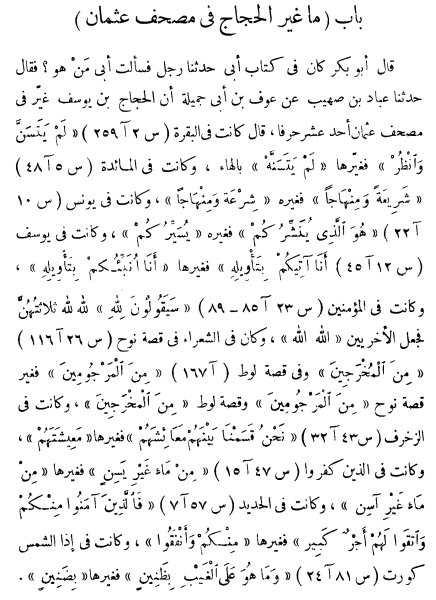

The translation of the report is as follows:
Section: What al-Hajjaj Had Changed in `Uthman's Mushaf?
Abu Bakr said that it was there in the book of my father that a man told; I asked my father, "Who was that man?". He said, "Abbad ibn Suhayb told us from Awf ibn Abi Jamila that al-Hajjaj bin Yusuf changed in `Uthman's mushaf 11 letters". He said in
al-Baqarah (2:259) lam yatasanna wanzur without ha to lam yatasannah with ha.
and in al-Ma'idah (5:48) shari`atan wa minhajan was changed to shir`atan wa minhajan
and in Yunus (10:22) huwal-ladhi yunash-shirukum was changed to yusay-yirukum
and in Yusuf (12:45) ana-atikum bita'wilihi was changed to ana onabbio'kum bita'wilihi
and in Mu'minun (23:85-89) sayaquluna lillah....lillah....lillah he made the two last occurrences allah....allah
and in al-Shu`ara in the story of Nuh (26:116) it was minal mukhrajina and in the story of Lut (26:167) it was minal marjumina. It was changed in the story of Nuh to minal marjumina and in the story of Lut to minal mukhrajina
and in al-Zukhruf (43:32) it was nahnu qasamna baynahum ma` ishahum and he changed it to ma`ishatahum
and in al-ladhina kafaru (47:15) min ma`inn ghayri yasin was changed to min ma`inn ghayri asin
and in al-Hadid (57:7) he changed fal-ladhina amanu minkum wat-taqaw lahum ajrun kabir to minkum wa anfaqu.
and in "When the Sun is folded up" (81:24) wa ma huwa `ala-l-ghaybi bidhanin to bidanin[1]
In other words, the report says that al-Hajjaj made eleven changes in `Uthman's mushaf and these changes are documented.
Instead of reading carefully what has been mentioned in the report, the Orientalists and missionaries have involved themselves in myth-making and taking it to almost delirious levels. Based on this report al-Hajjaj has been accused of "undertaking a completely new recension" or a "minor recension" or even changing the `Uthmanic recension of the Qur'an. Let us list them one by one.
According to Arthur Jeffery, the action of al-Hajjaj resulted in an "entirely new recension of the Qur'an" and that al-Hajjaj ordered the "new copies of his text sent to the great metropolitan centres."
When we come to examine the accounts of the activity of al-Hajjaj in this matter, however, we discover to our own surprise that the evidence points strongly to the fact that his work was not confined to fixing more precisely the text of the Qur'an by a set of points showing how it was to be read, but he seems to have made an entirely new recension of the Qur'an, having copies of his new text sent to the great metropolitan centres and ordering the destruction of earlier copies in existence there, much as `Uthman had done earlier. Moreover, this new text promulgated by al-Hajjaj seems to have undergone more or less extensive alterations.[2]
Obviously the report in Kitab al-Masahif does not say any such thing as what has been claimed by Jeffery. Taking a clue from Arthur Jeffery, a Christian apologist called Chad VanDixhoorn states:
Others yet hold that the final form was not finally settled until the recension of al-Hajjaj b. Yusuf.
The author of the article "The Qur'an" in the book Arabic Literature To The End Of The Ummayad Period prefers "a minor recension" instead of an "entirely new recension of the Qur'an". He conjectures:
On the other hand we have the tradition in Ibn Abi-Da'ud that al-Hajjaj was responsible for eleven changes in the consonantal text. If this is so, he is responsible for a minor recension at least.[3]
According to the claim of missionary John Gilchrist
During the caliphate of Abd al-Malik in the first century of Islam the governor of Iraq, al-Hajjaj ibn Yusuf, took steps to correct Uthman's text. He is said to have made eleven direct changes to the Qur'an text as it stood in its consonantal form, all of which are reflected in the Qur'an as it stands today.... The whole section continues to name each one of the amendments made by al-Hajjaj so that the Qur'an text as we have it today is not only the Uthmanic text but also a subsequent minor recension of it by the Iraqi governor.
Gilchrist claims that the alleged changes made by al-Hajjaj, as seen in Kitab al-Masahif, were made to the "`Uthmanic text" and that it was a "minor recension". The Qur'an that we have today is a combination of "`Uthmanic text" and the"minor recension".
That the "Qur'an of Uthman" has been altered is also championed by "Brother Mark". He says:
The insistence that this was 'merely' altering the Qur'an of Uthman from one set of 'accepted readings'to another is little comfort to people who have been taught that NO CHANGES have ever occurred to the Qur'anic text.
Similarly, the missionary Jochen Katz has fantasized the following about the changes that al-Hajjaj made to "Uthman's Koran":
he gave himself the liberty to change several words of Caliph Uthman's Koran, which is an indication that he did not believe that the Koran was verbally inspired or was inscribed in a "tablet preserved".
The next in the category are those missionaries whose statements can be called demented. According to Steven Masood, al-Hajjaj was "accused" of making eleven changes in the text (sorry, who accused whom!):
Al-Hajjaj Ibn Yusaf (694-714), the viceroy of Iraq, is said to have directed the work. He was also accused of making changes in the text. Ibn Abi Dawood lists these amendments in considerable detail in the chapter Ma Ghaira al-Hajjaj fi Mushaf Usman - 'What was altered by al-Hajjaj in the Uthmanic text'.[4]
Another missionary in this category is Joseph Smith. He claims that the eleven "distinct" amendments that al-Hajjaj made were reduced to "seven readings"!
We also know from Muslim tradition that the Uthmanic Qur'an had to be reviewed and amended to meet the Caliph's standard for a single approved text even after Uthman's death. This was carried out by al-Hajjaj, the governor of Kufa, who made eleven distinct amendments and corrections to the text, which were later reduced to seven readings.
Summarizing, the report says that al-Hajjaj made eleven changes in `Uthman's mushaf. This has been mysteriously and mythically transformed as if al-Hajjaj "undertook a completely new recension" or a made "minor recension" or even completely changed the `Uthmanic recension of the Qur'an! Apart from such absurdities, neither the Orientalists nor the missionaries checked the authenticity of the report; a method frequently employed to supress the information and to attack the Qur'an. Let us now check the authenticity of this report mentioned in Ibn Abi Dawud's Kitab al-Masahif.
3. Hadith Criticism Of The Report: The Study of Isnad
Hadith critics at first look at the isnad and if it is defective, they call the hadith defective, without scrutinizing the subject matter; because a hadith, according to their criteria, cannot be authnetic unless both its parts are correct.[5] Using this criteria let us first study the isnad.
The isnad of this report is Awf bin Abi Jamila  `Abbad Ibn Suhayb Abu Bakr Father of Abu Bakr. Study of reliability of narrators in this isnad shows that `Abbad Ibn Suhayb is the one who had been declared weak and his hadith is rejected.
`Abbad Ibn Suhayb Abu Bakr Father of Abu Bakr. Study of reliability of narrators in this isnad shows that `Abbad Ibn Suhayb is the one who had been declared weak and his hadith is rejected.
Al-Bukhari very tersely says in his Du`afa al-Saghir:

228 - `Abbad Ibn Suhayb al-Basri: Abandoned.[6]
Similarly al-Nasa'i says in his Du`afa wa-l-Matrukin:

(411) `Abbad Ibn Suhayb al-Basri: His hadith is rejected (matruk al-hadith).[7]
Ibn Abi Hatim comments in his Kitab al-Jarh wa-l-Ta`dil:
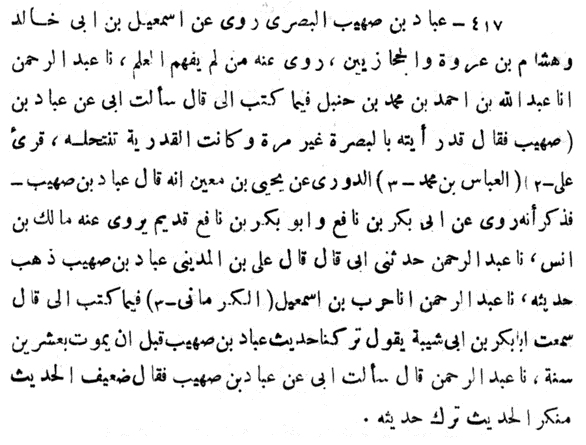
417 - `Abbad Ibn Suhayb al-Basri narrated from Isma`il Ibn Abi Khalid and Hisham Ibn `Urwah and the two Hijazis. Narrated from him people who did not understand the science. `Abd al-Rahman told us that `Abdullah Ibn Ahmad Ibn Muhammad Ibn Hanbal wrote to us: "I asked my father about `Abbad Ibn Suhayb." He said: "I saw him in Basra several times. The qadariyyah used to claim him." It was read to al-`Abbas Ibn Muhammad al-Duri from Yahya Ibn Ma`in that he mentioned `Abbad Ibn Suhayb and said that it was narrated from Abu Bakr Ibn Nafi` - and Abu Bakr Ibn Nafi` is a senior from whom Malik Ibn Anas narrated - that `Abd al-Rahman told us: My father told me: "`Ali Ibn al-Madini said: 'The hadith of `Abbad Ibn Suhayb is gone.'" `Abd al-Rahman told us, Hab Ibn Isma`il [al-Kirmani] wrote to me: "I heard Abu Bakr Ibn Abi Shaybah say: 'We forsook the hadith of `Abbad Ibn Suhayb twenty years before he demised.'" `Abd al-Rahman told us: "I asked my father about `Abbad Ibn Suhayb. He said: 'His hadith is weak (da`if). His hadith is disavowed (munkar). His hadith is forsaken.'"[8]
Similarly Ibn Hibban says in Kitab al-Majruhin min al-Muhaddithin wa-l-Du`afa wa-l-Matrukin:
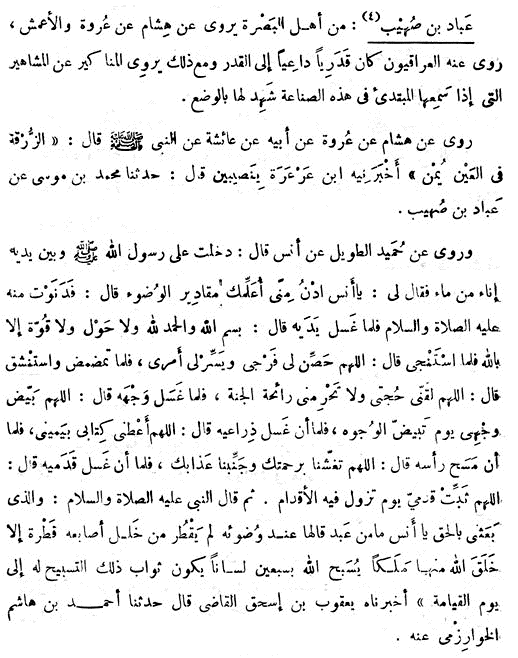
`Abbad Ibn Suhayb: From Basra. He narrated from Hisham Ibn `Urwah and al-A`mash. The Iraqis narrated from him. He belonged to the qadariyyah and called to it. On the top of that, he narrated disavowed narrations from famous people, such narrations, if heard by a beginner in this field, he would deem them forged.
It was narrated from Hisham Ibn `Urwah from his father from `A'ishah that the Prophet - peace be upon him - said: "Blue eyes are a blessing." Ibn `Ar`arah informed me of this narration in Nasibin saying: "Muhammad ibn Musa said on the authority of `Abbad Ibn Suhayb."
It was narrated from Humayd al-Tawil that Anas said: "I entered at the Messenger of Allah - peace be upon him. There was a recipient full of water before him. He told me: 'Anas, come close to me so that I teach you how to perform wudu'.' I went close to him - peace be upon him. When he washed his hands, he said: 'In the name of Allah, praise to Allah, there is no power nor strength except in Allah'. Then when he performed the istinja', he said: 'O Allah, preserve my chastity and ease my affairs.' When he washed his mouth and nose, he said: 'O Allah, teach me my argument and do not deprive me from the scent of Paradise.' When he washed his face, he said: 'O Allah, make my face white on the day when the faces become white.' When he washed his arms, he said: 'O Allah, give me my book in the right hand.' When he wiped his head, he said: 'O Allah, overwhelm us with Your mercy and protect us from your punishment.' When he washed his feet, he said: 'O Allah, make my feet unshakable upon the day when the feet falter.' Then, the Prophet - peace be upon him - said: 'By the One Who sent me with the truth, Anas, whoever says the same in his wudu', from each drop that falls from his fingers, Allah creates an angel that praises him in seventy tongues, the reward of which lasts until the day of resurrection.'" This was narrated to us by Ya`qub Ibn Ishaq al-Qadi on the authority of Ahmad Ibn Hisham al-Khawarizmi, from him.[9]
Al-Dhahabi says in his Mizan al-I`tidal fi Naqd al-Rijal:
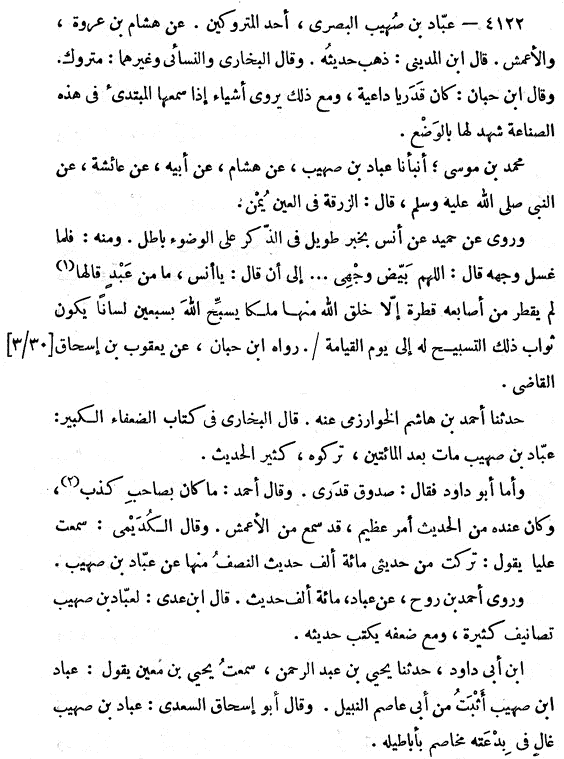
4122 - `Abbad Ibn Suhayb, one of the abandoned. He narrated from Hisham Ibn `Urwah and al-A`mash. Ibn al-Madini said: "His hadith is gone." Al-Bukhari, al-Nasa'i and others said: "Abandoned." Ibn Hibban said: "He belonged to qadariyyah and called to it. On the top of that, he narrated disavowed narrations from famous people, such narrations, if heard by a beginner in this field, he would deem them forged."
Muhammad Ibn Musa said, `Abbad Ibn Suhayb informed us on the authority of Hisham from his father from `A'ishah that the Prophet - peace be upon him - said: "Blue eyes are a blessing."
A lengthy but fabricated hadith was narrated from Humayd on the authority of Anas concerning the wudu' from which we quote: "When he washed his face, he said: 'O Allah, make my face white...'" until he said: "'Anas, whoever says the same in his wudu', from each drop that falls from his fingers, Allah creates an angel that praises him in seventy tongues, the reward of which lasts until the day of resurrection.'" Narrated by Ibn Hibban on the authority of Ya`qub Ibn Ishaq [3/30] al-Qadi, from Ahmad Ibn Hisham al-Khawarizmi, from him.
Al-Bukhari said in Kitab al-Du`afa' al-Kabir: `Abbad Ibn Suhayb died after year 200. He was forsaken, his hadith is abundant.
Abu Dawud said: "He is truthful (saduq) and qadari". Ahmad said: "He was not a liar and had plenty of hadith. He heard from al-A`mash." Al-Kudaymi said: "I heard `Ali say: 'I forsook 100 thousand hadiths of mine, half of which come from `Abbad Ibn Suhayb'."
Ahmad Ibn Rawh narrated from `Abbad 100,000 hadiths. Ibn `Adiyy said: "`Abbad Ibn Suhayb has many writings, and although he is weak, his hadith is written by Ibn Abi Dawud."
Yahya Ibn `Abd al-Rahman told us: "I heard Yahya Ibn Ma`in say: '`Abbad Ibn Suhayb is more reliable than Abu `Asim al-Nabil.'" Abu Ishaq al-Sa`di said: "`Abbad Ibn Suhayb exaggerated in his innovation and disputed for his falsehoods."[10]
Similar statements are made by Ibn Hajar in his Lisan al-Mizan.[11] The bottomline here is that `Abbad Ibn Suhayb has been abandoned and his reports are rejected. The terms used to describe `Abbad Ibn Suhayb are the most severe possible [matruk al-hadith]. It is not correct to describe his narrations as 'weak', which is an understatement. Rather, his narrations are fabricated, pure and simple. He has reached the lowest levels of Jarh in the sciences dealing with al-Jarh wa 'l-Ta`dil ("The disparaging and declaring trustworthy") of the narrators.
It is also clear that Ibn Abi Dawud wrote the hadith from `Abbad Ibn Suhayb even though the hadith scholars before and after Ibn Abi Dawud have considered the hadith from `Abbad Ibn Suhayb to be rejected. It is not that the Orientalists and the missionaries are unaware of this fact. Jeffery, whose book Materials For The History Of The Text Of The Qur'an: The Old Codices is often used by the Christian missionaries for polemical purposes to attack the Qur'an, clearly says:
Much of the material given by Ibn Abi Dawud regarding the history of the text of the Qur'an, though extremely unorthodox, yet agrees so closely with the conclusions one had reached from quite other directions that one feels confident in making use of it, however weak orthodoxy may consider its isnads to be.[12]
Jeffery gives no reasons for is new found confidence. Commenting on Jeffery's attainment of "confidence" from "quite other directions" Yasir Qadhi says:
This clear double standard on Jeffery's part is not suprising; whenever an Orientalist finds some information that he feels can be used to discredit Islam and cast doubts on it, no matter what the context, authenticity or actual implications of the text may be.... Therefore the reason that these narrations are authentic, according to Jeffery, is because they agree with preconceived conclusions that were arrived from 'quite other directions'; unnamed and unknown directions, it should be pointed out![13]
In the absence of Jeffery's unknown and unnamed directions for his confidence in the material of Ibn Abi Dawud, we go for something that is known, that is, the rejection of the hadith from `Abbad Ibn Suhayb. The case on the issue of the changes made by al-Hajjaj in `Uthman's mushaf can be considered null and void. It is worth reminding that there exists no parallel reports similar to the one discussed in order to authenticate the isnad and matn.
4. Hadith Criticism Of The Report: The Study of Matn
This report does not provide any clue of the nature of alleged changes that were made by al-Hajjaj in `Uthman's mushaf. An in-depth study shows that they are the differences in the Qira'at. Dr. `Umar Ibn Ibrahim Radwan did research on the issue alleged changes that al-Hajjaj made for his Ph.D thesis at the University of Imam Muhammad Ibn Saud. His thesis was published as a book from Riyadh in two volumes. The book is called Aara' al-Mustashriqin Hawl al-Qur'an al-Karim wa Tafsir: Dirasah Wa Naqd ("The Views Of The Orientalists About The Holy Qur'an & Its Interpretation: Study and Criticism").
After quoting the report of Ibn Abi Dawud, Dr. Radwan mentions in the footnotes about the Qiraa'aat which the changes are associated with.
al-Baqarah (2:259) lam yatasanna wanzur without ha to lam yatasannah with ha.[14]
Comments: Both readings are among The Seven as it is mentioned by Ibn Zanjalah in Hujjat al-Qira'at, page 142/143, where he says that Hamzah and al-Kisa'i read lam yatasanna without the letter ha in wasl [i.e., in case they didn't stop at the word yatasanna while reading] and the five other readings read yatasannah keeping the ha even when they didn't stop.[15]
and in al-Ma'idah (5:48) shari`atan wa minhajan was changed to shir`atan wa minhajan.[16]
Comments: al-Nakh'i and Ibn Waththab read with a fathah on the letter shin [i.e shar`atan] and the whole community of readers read shir`atan and I found nobody mentioning shari`atan.[17]
and in Yunus (10:22) huwal-ladhi yunash-shirukum was changed to yusay-yirukum[18]
Comments: Both readings are among The Seven. They were mentioned by Ibn Zanjalah in his book Hujjat al-Qira'at, page 329, where he says that Ibn `Amir read yunash-shirukum and the other readers read yusay-yirukum.[19]
and in Yusuf (12:45) ana-atikum bita'wilihi was changed to ana onabbio'kum bita'wilihi[20]
Comments: al-Hasan read ana-atikum with a long hamzah having a fathah followed by the letter ta having a kasrah and a silent ya. And in wasl [i.e., when not stopping on the word], Nafi` and Abu Ja`far read ana onabbio'kum as it is mentioned by Ahmad `Abdul Ghani al-Dumyati in his book Ithafu Fudala' ilbashar Fil Qiraa'aat Ilarba'a 'Ashar, page 265.[21]
and in Mu'minun (23:85-89) sayaquluna lillah....lillah....lillah he made the two last occurrances allah....allah[22]
Comments: All these readings are among The Seven as mentioned by Ibn Zanjalah in Hujjat al-Qira'at, page 490, where he says that Abu 'Amir read allah...allah with an alif and the others read lillah...lillah and all readings agreed on the first occurrence [i.e., lillah].[23]
and in as-Shu`ara in the story of Nuh (26:116) it was minal mukhrajina and in the story of Lut (26:167) it was minal marjumina. It was changed in the story of Nuh to minal marjumina and in the story of Lut to minal mukhrajina[24]
Comment: I didn't find anybody who mentioned what the author has said.[25]
and in az-Zukhruf (43:32) it was nahnu qasamna baynahum ma` ishahum and he changed it to ma`ishatahum.[26]
Comments: The reading of the community [jumhoor] of readers is ma`ishatahum in singular. Al-'Amash and `Abdullah and Ibn `Abbas and Sufyan read ma`ishahum in plural as mentioned by Abu Hayyan in Al-Bahr al-Muhit, VIII - page 13.[27]
and in al-ladhina kafaru (47:15) min ma`inn ghayri yasin was changed to min ma`inn ghayri asin.[28]
Comments: The Seven except Ibn Kathir read ghayri asin with a madd [a long vowel], as for the reading yasinin it is shadhdh and was mentioned by Abu Hayyan who reported it using the words it was said that .... Refer to Hujjat al-Qira'at in page 667 by Ibn Zanjalah and the interpretation of Al-Bahr al-Muhit, VIII - page 79.[29]
and in al-Hadid (57:7) he changed fal-ladhina amanu minkum wat-taqaw lahum 'ajrun kabir to minkum wa anfaqu.[30]
Comment: I could not find the one who mentioned this reading.[31]
and in "When the Sun is folded up" (81:24) wa ma huwa `alal-ghaybi bidhanin to bidanin.[32]
Comment: Ibn Kathir and Abu `Amr and al-Kisa'i and Rees and Ibn Mahran from Rawh read with the letter dha and the others read with the letter dad, and so it is in all the Codices (the books). Refer to Al-Nashr fil Qira'at il'ashr, II - page 398/399.[33]
Dr. Radwan went on to say:
These readings as I have just highlighted are among the correct (Sahih), Mutawatir and well established that we can read in any form it has been drawn into and among them are ones I could not verify which make us doubt about their being attributed to al-Hajjaj, especially because he was not isolated from the Ummah. Much more, in his time, no Muslim would let him change or replace anything traced back to the Prophet(P) whether it concerned Qur'an or hadith.
All these arguments rebut the claims of the Orientalists. And the following points confirm the validity of my opinion:
- Al-Hajjaj being loyal to `Uthman [or from his court] and since he wouldn't forgive those who let `Uthman down on the day of al-Dar [or the house], how could he question `Uthman and his codex and make changes in it.
- The codex of `Uthman was spread everywhere and its copies in the time of `Uthman were countless. How about their number in the Umayyads time? Undoubtedly, their number has increased. Moreover, al-Hajjaj was the mere governor of one county of the huge Islamic land. Supposing that he was able to change the copies of his county how could he reach the ones in the other districts while there were thousands of copies! Much more, history did not mention contradictions between the Codices of Iraq and the other Codices. It is well known that the Great Book is saved in the chests of Muslims as much as it is saved in written form. If al-Hajjaj managed to change the lines how could he reach what is inside the chests of thousands of Muslims?
- It is known as well that the Abbassid dynasty was established on the ruins of the Umayyads and that they changed many of the policies of Bani Umayyah in the administration of the lands. They didn't spare any effort in showing the negative aspects of Bani Umayyah and in getting close to the people by spreading justice and defending it. If the Abbassids had found any changes in the Holy Book, it would have been the greatest opportunity for them to show how misleading Bani Umayyah were and, thus, give their own rule some additional legitimacy.[34]
These observation speak of themselves. Even if we assume that this incident is authentic, the question that arises is: so what? Al-Hajjaj supposedly made changes in 11 places, and even these places are documented to the last detail. Orientalists and missionaries, as usual, take some trivial piece of information (forgetting the fact that it is fabricated!) and make, not just a mountain, but an entire planet, out of an anthole.
Let us now move to the Christian polemical sources such the letter of Byzantine Emperor Leo III to `Umar II and the apology of `Abd al-Masih al-Kindi on the claim that al-Hajjaj was responsible for present day Qur'anic text.
5. The Christian Polemical Sources: Letter Of Leo III & `Abd al-Masih al-Kindi
There is a persistent tradition in the eastern Christian churches, often referred to by oriental Christians even in the present day, to the effect that early during the 8th century, there had been an exchange of letters on the question of the respective merits of Christianity and Islam, between the Ummayad Caliph `Umar II and the Byzantine Emperor Leo III. In the letter to `Umar II, the Byzantine Emperor Leo III writes:
In brief you admit that we say that it [i.e., the Qur'an] was written by God, and brought down from the heavens, as you pretend for your furqan, although we know that it was `Umar, Abu Turab and Salman the Persian, who composed that, even though the rumour has got around among you that God sent it down from the heavens.[35]
This is a rather peculiar statement from Leo III, as Jeffery comments in the footnotes. By Abu Turab, Leo III meant `Ali, son-in-law of the Prophet(P). Continuing the letter to `Umar II, Leo III writes:
As for your (book), you have already given us examples of such falsifications, and one knows, among others, of a certain Hajjaj, named by you as the governer of Persia, who had men gathered up your ancient books, which he replaced by others composed by himself, according to his taste, and which he propagated everywhere in your nation, because it was easier by far to undertake such a task among the people speaking a single language. from this destruction, nevertheless, there escaped a few works of Abu Turab, for Hajjaj could not make them disappear completely.[36]
Commenting on the issue, Jeffery states:
It would thus seem that some revision of the text, as well as clarification by division and pointing, was undertaken by al-Hajjaj, and that this was known to the Christians of that day, and naturally exagerrated by them for polemical purposes.[37]
It becomes quite obvious as to whether the document between `Umar II and Leo III is authentic. Jeffery says:
The question remains as to the genuineness of this correspondence, and that is a matter for the historians to argue on the basis of the material itself.[38]
Now that the authenticity of this document has fallen on the grounds of suspicion, we would like to push the question even further and consider the ramifications. Patricia Crone and Michael Cook in their book, Hagarism: The Making Of The Islamic World, used the aforementioned Christian polemic to reconstruct Islamic history before even verifying the facts.
Now both Christian and Muslim sources attribute some kind of role to Hajjaj in the history of Muslim scripture. In the account attributed to Leo by Levond, Hajjaj is said to have collected and destroyed the old Hagarene writings and replaced them with others composed according to his own tastes.[39]
John Wansbrough, reviewing Hagarism: The Making Of The Islamic World, makes a mockery of the poor scholarship of Crone and Cook and says:
The material is upon occasion misleadingly presented, e.g., Ephrem certainly did not prophesy an exodus of Hagarenes from the desert, nor did Levond report Leo's description of Hajjaj destroying old Hagarene writings.[40]
In other words, the account attributed to Leo by Levond (or Ghevond) is a forgery that was constructed to scandalize the question of al-Hajjaj by some later Christian writer. This possibility was also echoed by Neal Robinson in his book, Discovering The Qur'an: A Contemporary Approach To a Veiled Text, where he states:
The letter ascribed to Pope Leo may simply be a convenient literary device used by a Christian polemicist living at a later date. Even if it is authentic, and the allegations which it contains have some substance, the activity of Hajjaj may have been limited to destroying the sectarian writings, and early codices of the Qur'an which preserved the surahs in a different order.[41]
Now that the issue of Leo has been closed, let us now move over to the other Christian polemic associated with al-Hajjaj; the apology attributed to `Abd al-Masih al-Kindi. The composition of the apology has seen some serious disagreement among the Western scholars. The Encyclopaedia Of Islam says:
Taking as evidence the historical data supplied by the text, mention of caliph al-Ma'mun (198-218/813-33), of the sack of Mecca by Abu 'l-Saraya (199/815) and the revolt of Babak al-Khurrami (204/819), W. Muir believes that the date of the composition of the letter can be fixed at 215/830. But L. Massignon believes the composition to be later than the year 300/912, seeing that the author borrowed from al-Tabari (d. 310/923) his criticism of an opinion of the Hanbali al-Barbahari (d. 329/940). Similarly, observing a parallelism between certain criticisms contained in the letter and in the work of a Muslim heretic Ibn al-Rawandi (d. 298/910), P. Kraus concludes that the Christian author borrowed these criticisms from the latter and therefore the letter can only have been composed at the beginning of the 4th/10th century.[42]
It appears that the most authentic view is that the letter was composed in the beginning of the 4th/10th century. The letter of al-Kindi played a very important role in the East as well as in the West in the polemic between Christians and Muslims. It was translated in Latin in 1141 by Peter of Toledo and revised by Peter of Poitiers. Its English translation was done by William Muir.[43] The claim of al-Kindi is that al-Hajjaj gathered together every copy that he could lay hold of and caused to omit from the text a great many passages. Among these were the verses revealed concerning the Bani Umayyah with names of certain persons and concerning the Bani `Abbas also with certain names. Al-Hajjaj then sent six copies of his version of the Qur'an to Egypt, Syria, Makkah, Madinah, Kufah and Basra. After that he called in and destroyed all the preceding copies, just as `Uthman had done before. Al-Kindi then says that he has drawn this account from the Muslim authorities.[44]
To begin with, no such Muslim authorities mention what has been claimed by al-Kindi. Hence is it nothing but a polemical exagerration. Jeffery says:
The Christian writer al-Kindi in his polemical work known as the Apology of al-Kindi, makes a controversial point out of the alterations he claimed that al-Hajjaj, as everyone knew, had made in the text of Qur'an, but this was regarded by scholars as just a polemical exagerration such as one might expect in a controversial writing.[45]
Similarly, polemical nature of al-Kindi's apology rather than its factual basis is also echoed by Beesten et al.
It is difficult to assess the role of al-Hajjaj. We may ignore the arguments of the Christian `Abd al-Masih al-Kindi that al-Hajjaj was very much responsible for our text, as these have a polemical rather than factual basis. The account most widely found has him ordering Nasr bin `Asim to introduce the markings to safeguard the protection of the text. This is a plausible reason for the innovation, and the story is unchallenged, despite strong hostility of the sources towards al-Hajjaj.[46]
From a historical point of view, al-Kindi's claim is based upon conjecture rather than "Muslim authorities" and smacks of delirium. For al-Hajjaj was merely one of the generals in the Ummayad regime, with little influence and almost no ability to do the Qur'an any harm. In fact, he was utterly incapable of effecting any change in the most elementary laws of Islam, not to speak of the Qur'an, which is the foundation of Islamic faith, and pillar of Islamic laws. One wonders how he could influence any change in the Qur'an after it had gained currency in the vast Muslim empire. Not a single historian or commentator has chronicled this change, the importance of which should not have escaped their notice. No contemporary Muslim ever objected to this, and even after his rule, the Muslims seem to have condoned this abominable fact. Moreover, if it is all believed that he managed to withdraw all the copies of the Qur'an, and replacing it with his new codex, how could he eradicate it from the hearts of great numbers of Muslims who had committed it to memory? Had there been anything in the Qur'an which was uncomplimentary to the Ummayads, Mu'awiyah would have been the first to see it omitted because, compared to al-Hajjaj, he was more influential and powerful. Of course, if Mu'awiyah had done this, the companions of `Ali would have argued with him, the way they did on many occasions, as recorded in the books of history, hadith and theology. An example would be of the battle of Siffin (AH 37), 27 years after the death of the Prophet(P), and five years after `Uthman's copies were distributed.
Mu'awiyah's troops fixed sheets from the Qur'an on their spears to interrupt the battle. However, nobody accused anyone else of using a 'partisan' version of the text, which would have made a splendid accusation against the enemy.[47]
The pretence that the Qur'an has been tampered with has no substance whatsoever.
Al-Hajjaj was one of the most, if not the most, notorious figures in Islamic history and is well-known for his brutality against Ibn al-Zubayr as well as restive population of Iraq. It, therefore, comes as no surprise that lots of spurious accounts are found regarding him, in both Islamic and Christian literature, which try to show him as being even more evil than he was. The report in Kitab al-Masahif of Ibn Abi Dawud and polemics of Leo III and al-Kindi are obvious over-exagerrations and spurious.
6. Conclusions
To conclude the issue of al-Hajjaj and the changes he made in the Qur'an, it has been shown that the report in Kitab al-Masahif of Ibn Abi Dawud is false. This is because the reporter `Abbad Ibn Suhayb is the isnad has been declared abandoned in hadith and all his hadith are rejected. Analysis of matn of the hadith shows that the alleged changes that were made related to the Qira'at that are mutawatir. Muslims have accepted various Qira'at as authentic provided they satisfy certain conditions. Furthermore, the hadith in Kitab al-Masahif is only known to us through one chain. There exists no parallel chains to authenticate the matn or text of the report.
It is clear that there was no new recension after `Uthman united Muslims on the basis of single text. Muslims have a complete agreement over it. Al-Hajjaj's role is rather well documented in the literature dealing with Sciences of the Qur'an.
Summarizing the Christian sources: We see that the Christian sources of Leo III and `Abd al-Masih al-Kindi have a purely polemical purpose and exaggerate the events that took place during al-Hajjaj's time. The sources lack factual basis and their historicity itself is doubtful. This view is solidified by modern scholarship. As pointed out earlier, how could al-Hajjaj, who was governor of Iraq, a small part of Muslim land, able to change the Qur'anic text completely. The complete change of Qur'an is not documented in the Islamic history at all. And above all how could he change what was commited in the memory of Muslims in the vast Islamic empire.
And Allah knows best!
References
[1] For Kitab al-Masahif see Arthur Jeffery's, Materials For The History Of The Text Of The Qur'an: The Old Codices, 1937, E. J. Brill, Leiden, pp. 117-118.
[2] A. Jeffery, The Qur'an As Scripture, 1952, Russell F. Moore Company Inc., New York, p. 99.
[3] A. F. L. Beeston, T. M. Johnstone, R. B. Serjeant and G. R. Smith (Ed.), Arabic Literature To The End Of The Ummayad Period, 1983, Cambridge University Press, p. 243.
[4] S. Masood, The Bible And The Qur'an: A Question Of Integrity, 2001, OM Publishing: Carlisle, p. 36.
[5] M. M. Azami, Studies In Early Hadith Literature, 1992, American Trust Publications: Indianapolis, p. 305; Also J. Robson, "Tradition: Investigation And Classification", Muslim World, 1951, Volume XLI, pp. 102-104; See also "Al-Djarh Wa'l Ta`dil", Encyclopaedia Of Islam, New Edition, 1965, Volume II, p. 462 for judging the reliability of a narrator.
[6] Abi `Abdullah Muhammad Ibn Isma`il al-Bukhari, Kitab Du`afa al-Saghir, 1976 [1396 AH], Dar al-Wa`y: Halab, p. 76.
[7] Abi `Abd al-Rahman Ahmed Ibn Shu`ayb al-Nasa'i, Kitab al-Du`afa wa-l-Matrukin, 1976 [1396 AH], Dar al-Wa`y: Halab, p. 75.
[8] Abi Muhammad `Abd al-Rahman Ibn Abi Hatim Muhammad Ibn Idris Ibn al-Mundhir al-Tamimi al-Hanzali al-Razi, Kitab al-Jarh wa-l-Ta`dil, 1941-53, Volume III, Matba`at Majlis Da'irat al-Ma`arif al-`Uthmaniyah: Hyderabad al-Dakkan, p. 81-82
[9] Muhammad Ibn Hibban Ibn Ahmad Abi Hatim al-Tamimi al-Busti, Kitab al-Majruhin Min al-Muhaddithin wa-l-Du`afa' wa-l-Matrukin, 1975 [1395], Volume II, Dar al-Wa`y: Halab, pp. 164-165.
[10] Abi `Abdallah Muhammad b. Ahmad b. `Uthman al-Dhahabi (d. 748 AH), Mizan al-I`tidal fi Naqd al-Rijal, 1963, Volume II, Isa al-Babi al-Halabi: Cairo, p. 367.
[11] Shihab al-Din Abi al-Fadl Ahmad Ibn `Ali ibn Hajar al-`Asqalani, Kitab Lisan al-Mizan, 1911-13 [1329-31], Volume III, Matba`at Majlis Da'irat al-Ma`arif: Hyderabad al-Dakkan, pp. 230-23.
[12] A. Jeffery, Materials For The History Of The Text Of The Qur'an: The Old Codices, Op Cit., p. viii.
[13] Abu Ammar Yasir Qadhi, An Introduction To The Sciences Of The Qur'aan, 1999, Al-Hidaayah Publishing And Distribution: Birmingham (UK), pp. 386-387.
[14] A. Jeffery, Materials For The History Of The Text Of The Qur'an: The Old Codices, Op Cit., p. 117.
[15] Dr. `Umar Ibn Ibrahim Radwan, Aara' al-Mustashriqin Hawl al-Qur'an al-Karim wa Tafsir: Dirasah Wa Naqd, Volume I, 1992, Dar al-Tibah: Riyadh, p. 430.
[16] A. Jeffery, Materials For The History Of The Text Of The Qur'an: The Old Codices, Op. Cit., p. 117.
[17] `Umar Ibn Ibrahim Radwan, Aara' al-Mustashriqin Hawl al-Qur'an al-Karim wa Tafsir: Dirasah Wa Naqd, Op. Cit., p. 430.
[18] A. Jeffery, Materials For The History Of The Text Of The Qur'an: The Old Codices, Op. Cit., p. 117.
[19] `Umar Ibn Ibrahim Radwan, Aara' al-Mustashriqin Hawl al-Qur'an al-Karim wa Tafsir: Dirasah Wa Naqd, Op. Cit., p. 430.
[20] A. Jeffery, Materials For The History Of The Text Of The Qur'an: The Old Codices, Op. Cit., p. 117.
[21] `Umar Ibn Ibrahim Radwan, Aara' al-Mustashriqin Hawl al-Qur'an al-Karim wa Tafsir: Dirasah Wa Naqd, Op. Cit., p. 431.
[22] A. Jeffery, Materials For The History Of The Text Of The Qur'an: The Old Codices, Op. Cit., p. 118.
[23] `Umar Ibn Ibrahim Radwan, Aara' al-Mustashriqin Hawl al-Qur'an al-Karim wa Tafsir: Dirasah Wa Naqd, Op. Cit., p. 431.
[24] A. Jeffery, Materials For The History Of The Text Of The Qur'an: The Old Codices, Op. Cit., p. 118.
[25] `Umar Ibn Ibrahim Radwan, Aara' al-Mustashriqin Hawl al-Qur'an al-Karim wa Tafsir: Dirasah Wa Naqd, Op. Cit., p. 431.
[26] A. Jeffery, Materials For The History Of The Text Of The Qur'an: The Old Codices, Op. Cit., p. 118.
[27] `Umar Ibn Ibrahim Radwan, Aara' al-Mustashriqin Hawl al-Qur'an al-Karim wa Tafsir: Dirasah Wa Naqd, Op. Cit., p. 431.
[28] A. Jeffery, Materials For The History Of The Text Of The Qur'an: The Old Codices, Op. Cit., p. 118.
[29] `Umar Ibn Ibrahim Radwan, Aara' al-Mustashriqin Hawl al-Qur'an al-Karim wa Tafsir: Dirasah Wa Naqd, Op. Cit., p. 431.
[30] A. Jeffery, Materials For The History Of The Text Of The Qur'an: The Old Codices, Op. Cit., p. 118.
[31] `Umar Ibn Ibrahim Radwan, Aara' al-Mustashriqin Hawl al-Qur'an al-Karim wa Tafsir: Dirasah Wa Naqd, Op. Cit., p. 431.
[32] A. Jeffery, Materials For The History Of The Text Of The Qur'an: The Old Codices, Op. Cit., p. 118.
[33] `Umar Ibn Ibrahim Radwan, Aara' al-Mustashriqin Hawl al-Qur'an al-Karim wa Tafsir: Dirasah Wa Naqd, Op. Cit., p. 431.
[34] Ibid., pp. 430-431.
[35] A. Jeffery, "Ghevond's Text Of The Correspondence Between `Umar II and Leo III", 1944, Harvard Theological Review, p. 292.
[36] Ibid., p. 298.
[37] Ibid.
[38] Ibid., pp. 330-331.
[39] P. Crone & M. Cook, Hagarism: The Making Of The Islamic World, 1977, Cambridge University Press, p. 18.
[40] J. Wansbrough, "Review of Hagarism: The Making Of The Islamic World", Bulletin Of The School Of Oriental And African Studies, 1978, Volume 41, p. 156.
[41] N. Robinson, Discovering The Qur'an: A Contemporary Approach To a Veiled Text, 1996, SCM Press Ltd, p. 56.
[42] "Al-Kindi, `Abd al-Masih", Encyclopaedia Of Islam, New Edition, 1986, Volume V, p. 120.
[43] W. Muir, The Apology Of Al-Kindy, 1882, London. Also published in Egypt in the "Nile Mission Press" whose chairman was Dr. S. M. Zwemer.
[44] Also see Alphonse Mingana's discussion on the apology of al-Kindi in "The Transmission Of The Qur'an", Journal of The Manchester Egyptian and Oriental Society, 1916, pp. 41-42.
[45] A. Jeffery, The Qur'an As Scripture, Op. Cit, p. 99.
[46] A. F. L. Beeston, T. M. Johnstone, R. B. Serjeant and G. R. Smith (Ed.), Arabic Literature To The End Of The Ummayad Period, Op. Cit, p. 243.
[47] Ahmad von Denffer, `Ulum al-Qur'an, 1994, The Islamic Foundation, p. 56.