بِسْمِ اللهِ الرَّحْمٰنِ الرَّحِيْم
Review of “Disproving Islam”
Review & Refutation by quranandbibleblog contributor Abu Safiyah
Introduction
The author of this book attempts to write the ultimate guide to disproving Islam. Upon analysis and an unbiased reading of his book, one can infer that it is generally poorly written with numerous false ideas. Much of the content of the book can be found in other anti-Islam sources, his main reference clearly being Joseph Jay Smith, a Christian apologist who is known for his dishonest misrepresentation of facts.
Basically, all of the author’s key points can be found in Jay’s videos, almost always copied word for word. This refutation is most certainly not intended to be a correction or proofreading of the book as hopefully, in shaa Allāh, his main points from just one chapter shall be refuted to demonstrate the poor quality of the book in general.
Section 1: The Petra Theory & The “Invention” of Islam
The author claims here that Petra is the birthplace of Islam, not Makkah. He justifies his claim based on the theory proposed by Dan Gibson, whose erroneous statements were debunked by David A. King. In addition to these statements, the author exaggerates claims and even makes numerous ridiculous baseless statements such as:
- The existence of pre-Islamic mosques
- ALL the early mosques facing Petra, not Makkah
- If a mosque faces Petra, then it was intentional
- All Qur’anic manuscripts from the 1st Century AH can be falsified as C-14 (carbon-14) dating is inaccurate
The author provides no proof whatsoever for any of these claims. It is worth noting that no serious scholar or academic historian believes that this theory is true.
In this section, we shall look into the inaccuracies, deception, and false statements made by the author and also look into the evidence in shaa Allah.
- Did the Early Mosques intentionally face Petra?
David King states:
“…the first generations of Muslims had no means whatsoever for finding the direction of Petra [or Mecca either] accurately to within a degree or two, not least because they had no access to any geographical coordinates, let alone modern ones, and no mathematics whatsoever.”[1]
- Pre-Islamic Mosques?
The author repeatedly asserts that there are pre-Islamic mosques facing Petra. What is surprising is he does not give a single example of any of them.[2]

The author is probably referring to churches (!) that are pre-Islamic. I do not think that even Gibson claims there are pre-Islamic “mosques”.
- Did all the Early Mosques Face Petra?

What our author did here is directly copy Dan Gibson’s chart in his book “Early Islamic Qiblahs”. (All right, fine – he did change the color!)

The problem is: he failed to mention that even hundreds of years after the supposed shift to Makkah, mosques were (supposedly) built facing Petra.
An example from the Mansouri Great Mosque, which was built in 1294 CE, yet according to Gibson, faces Petra. This is also against the claims made by Jay Smith.
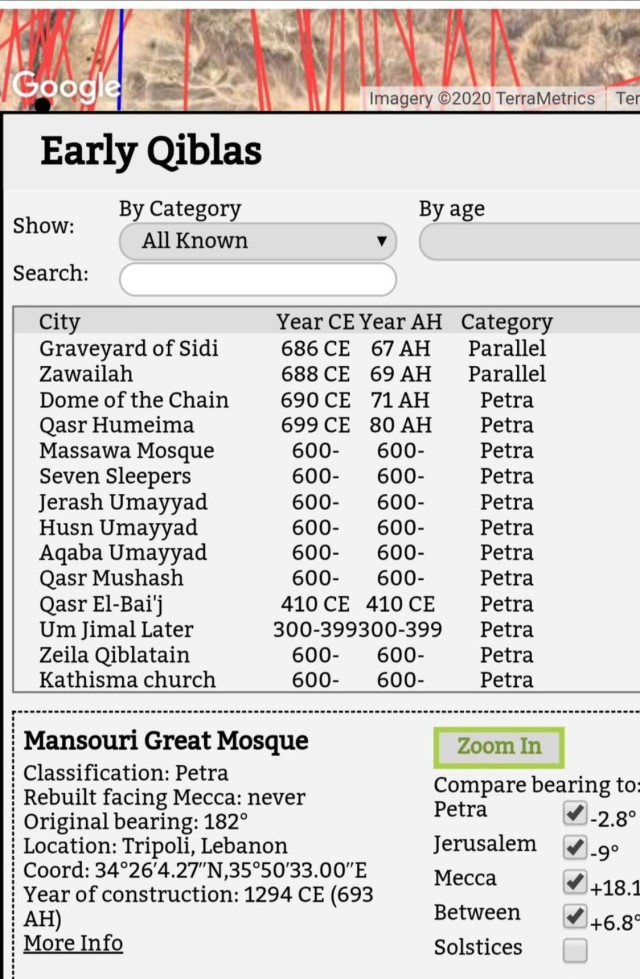
Why, if Gibson’s own research is reliable, were mosques built (supposedly) facing Petra centuries after the (imaginary) shift?
Gibson himself stated that it is impossible to say whether some of the earliest 7th-century CE mosques faced Petra or not. He classifies a number of early mosques as having “unknown Qiblahs”.
According to actual experts like David King, the Ka’bah itself is astronomically aligned and all mosques, by means that Gibson has not mastered, align towards it. He states that historical qibla directions cannot be the same as modern qibla directions, and thus one should not use modern directions of Makkah or Petra to accurately determine whether the mosques faced Makkah or Petra.
Of course, the author claims to have “debunked” David King, after writing one page, with obvious misrepresentation of facts. One can tell from the fact that he heavily relies on Jay Smith (which shall be observed later on) and Gibson that he is not knowledgeable regarding this issue.
This theory is rejected by all experts, such as Ian D. Morris, Sean Anthony, and numerous others. For a concise refutation of this absurd theory, refer to David King’s article “From Petra Back to Makka – From ‘Pibla’ Back to Qibla” (see note #1).
- Islamic Inscriptions in Makkah & Petra
The Petra theory (the shift from Makkah to Petra) necessitates a massive cover-up. The earliest Islamic inscription in Petra is from 727 CE, which is exactly (according to Gibson) the year that mosques started to face Makkah and leave Petra. Why then are the Islamic inscriptions from Petra dated to after this supposed shift?
 There are even Islamic inscriptions from Petra that date to 809 CE. By then, wouldn’t the Muslims have left Petra permanently?
The author claims that there is a lack of evidence for the existence of Makkah in the 7th-century CE. In actual fact, there is a severe lack of evidence for Petra to be the birthplace of Islam instead. The Islamic inscriptions from Makkah come earlier than those of Petra. An example is this inscription from Makkah dated to 80 AH (699–700 CE):

Section 2: Qur’anic Manuscripts
The author of “Disproving Islam” wrote his book with no knowledge on the actual evidence for Islam.
He argues that the Qur’an as well as Islam were invented later on by the Umayyad caliph Abd Al-Malik and was only finalized much later. He also erroneously claims based on the lies spread by Christian apologist Jay Smith, that it is impossible to find today’s Qur’an in manuscripts before 1924. He also claims that since carbon-dating is unreliable, he can “debunk all the 1st century AH manuscripts “ and shift them to the 8-9th century CE.
There are a number of palaeographically datable manuscripts from the 7th Century CE, or at least to the 1st century AH. Examples of these manuscripts are:
- Codex Parisino Petropolitanus
- DAM (Dar Al Makhtutat) 01-25.1
- DAM (Dar Al Makhtutat) 01-29.1
- Codex Arabe 328c
- Arabe 330g
- DAM 01-27.1
- Codex Is. 1615 I
- Topkapi Manuscript
The author states about the Topkapi Manuscript:
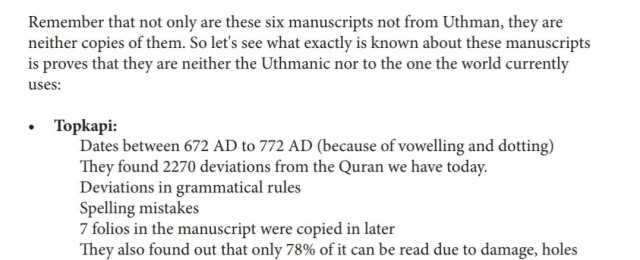
The author says about the Topkapi Manuscript that it is full of spelling mistakes. The orthographic differences in the Topkapi Manuscript are not mistakes. They were how words were spelled during that time period. Here is what Dr. Altikulaç, who is one of the Turkish scholars who had studied this manuscript, has to say about the 2,270 differences:

None of these differences affect how the words are recited, neither do they change the meaning. Words likeعلى and حتى were simply spelled asعلا and حتا more than 780 times; this explains why there are 2,270 orthographic differences.
- Differences in the Topkapi Manuscript?

In the above image, our author lists 5 of what he claims are variations from today’s Qur’an. Our author might have assumed that nobody would bother to actually verify these examples. Unfortunately for him, I did and discovered that out of these 5 examples, four are false, while the other one can be easily disproved.
Example 1: Surah 14:38
This is an incorrect example given by Keith Small, who ignorantly translated the word below as “he revealed”, which would actually be “a’lan”:

That is not possible as there is no letter Alif at the start of the word, thus clearly a misreading by Small. It is possible, though, that the word read “yu’lin”. However, the standard “nu’lin” is found in many earlier manuscripts such as DAM 01-29.1, Codex Parisino Petropolitanus, and others, as shown in the following:

Example 2: Surah 3:158
This example is also false and was fabricated by Jay Smith to spread his lies that the Qur’an was only standardized in 1924 and prior to that, the Qur’anic text was different.
Jay Smith claims that this example was provided by Keith Small in his book. However, this is nowhere to be found in Small’s book. In fact, this verse in the manuscript is clearly identical to the Qur’anic text today.

There are no additional phrases as Jay Smith claims. The only difference is an orthographic difference. In the phrase لإلى الله” “, there is an Alif after “laa”, which does not affect the pronunciation or the meaning. This orthographic difference is found in many of the earliest manuscripts such as Arabe 328a & Ms Qaf 47.
Example 3: Surah 66:8
This is another false example copied directly from Jay Smith word for word. Jay Smith deceptively translates the words in the manuscript and the verse differently to make it seem like the verse is different. The only problem for him is that the verse in the manuscript is clearly identical to the verse read today. There was an insertion but only in the word “Allah”, clearly accidental unless Jay Smith believes the original verse read: Repent to the letter Alif.

Original Text: Repent to ا
After Insertion: Repent to الله (Allah)
Those using this insertion to prove change need to learn basic Arabic. The letter “Alif” is clearly there and the verse obviously refers to Allah. The scribe must have forgotten to complete the word and it was corrected later on. Anyway, the verse is present perfectly in earlier and later dated manuscripts.
Example 4: Surah 23:86
This example is copied from Daniel Brubaker’s “20 corrections in Early Qur’anic Manuscripts”. The only problem is that Brubaker listed this as a correction in a DIFFERENT manuscript (Arabe 327)!
There is NO insertion of the word “7” as the word was clearly there originally. Our author lists it here to make it seem like the Topkapi Manuscript has many differences in it. The verse is clearly identical to what is recited today.
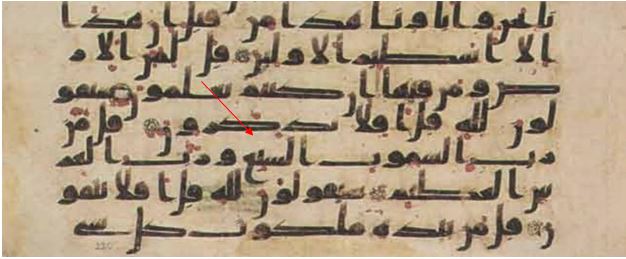
The verse is perfectly fine (i.e., identical to the standard text) in manuscripts that are earlier than the one Brubaker used anyways, such as Codex Parisino Petropolitanus, the Tubingen Fragments, and others, thus clearly showing the initial omission in Arabe 327 (NOT the Topkapi Manuscript) was accidental.
Example 5: Surah 73:20
This is the only example where our author did not resort to fabrication or misrepresentation of evidence. According to him (actually Brubaker), there was an erasure between the words “thuluthayil” & “al layla”, which contained an unknown word not found in the standard text:
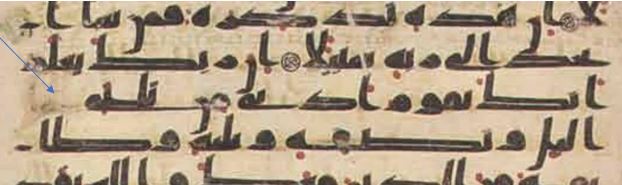
However, there is no missing word in earlier and similar dated Qur’anic manuscripts such as DAM 01-29.1 (7th-century CE):
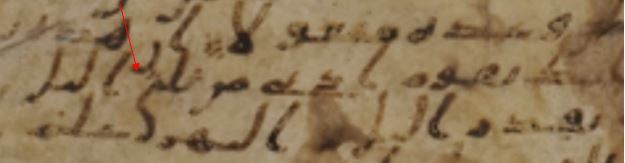
- Difference in Codex Parisino Petropolitanus, Surah 14:37
Our author states that, in Codex Parisino Petropolitanus, the verse has “wa” instead of “fa”. The author fails to mention how minor this is. This example was copied from Jay Smith, who in turn was quoting Keith Small’s book. This time, at least, it was actually mentioned in Small’s book. However, the problem is that Keith Small made yet another error in his reading, as the text clearly had the letter “fa”!

This manuscript has many faded words, which were later retraced. Even though the words are faded sometimes, the original text can be clearly seen. This example is one such case. The letter is clearly “fa” as the dotless letter is extended (i.e., continued) Another major clue is the fact that the traces of the connection of the dotless letter to the Alif are visible. A later scribe failed to retrace the faded part of the word properly.
The letter “fa” is also clearly visible in similar or earlier dated manuscripts such as DAM 01-29.1 (7th-century CE, shown below) and Or. 2165 (1st-entury AH):

- Difference in The Sana’a Mushaf
The author makes many erroneous claims when talking about the Sana’a manuscripts. He fails to understand that there aren’t just 1 or 2 Sana’a manuscripts, there are hundreds. This lack of understanding is evident from his examples:
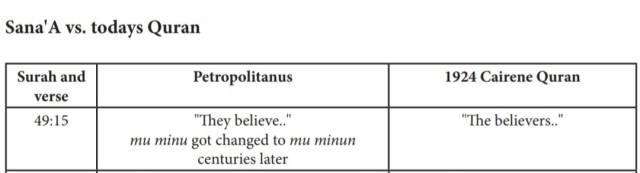
This example, taken from Jay Smith, is (supposedly) found in the Sana’a Mushaf attributed to Ali, not in the Sana’a Palimpsest.

Original: إنما المؤمنو الذين يؤمنون (The Mu’minu are only the ones)
After Insertion of “nun”: إنما المؤمنون الذين يؤمنون (The believers are only the ones…)
Unfortunately, the author assumed that Jay Smith’s translation of the original text was correct. However, “mu’minu” definitely does not mean “they believe”, which is actually “yu’minoona”. The omission of the letter “nun” is obviously a scribal error.
- The Sana’a Palimpsest
The author illustrates his lack of understanding of the Qur’anic Manuscripts by repeating word for word what Jay Smith “preaches”:

- The Sana’a Lower Text is not the “only Qur’aan with no diacritical marks and vowelization”. This is what Jay Smith erroneously claims due to his ignorance. The fact is that the earliest manuscripts did indeed contain diacritical dots. The earliest Qur’anic manuscript (thought to be) completely free of dots is actually from much later!
- Jay Smith also erroneously claims there are only 63 verses in the Sana’a Lower Text. This is also factually incorrect, there are at least 500 verses in the Lower Text, and many more yet to be analyzed from the 40 folios in the Eastern Library. Sixteen of the variants being “entire sentences” is another misleading statement by Jay Smith.
- The Upper Text definitely does not have 1000 variants compared to today’s Qur’aan. Asma Hilali lists 17 minor letter variants, 1 of which is a misreading by her. Other differences, if any, can be classified as orthographic differences.
- The Upper Text of the Sana’a Palimpsest does not “jump from Surah 19 to 22” as he claims. Folio 14A of the Upper Text (shown below) clearly shows the changeover from Surah 21 to Surah 22, despite it being fragmented. The verses above the empty space clearly represent parts of 21:110-112, while the verses after the empty space represent part of Surah 22:1-2, thus there definitely is not a “jump from Surah 19 to 22” in the Upper Text (see below).
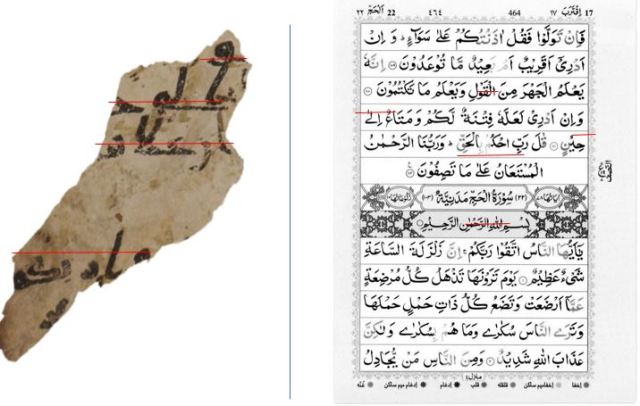
- The Surah order in the Upper Text is the standard Surah arrangement, thus Smith is incorrect in stating that it is “different in Surah arrangements“.
- There are very few later insertions or corrections, if any, in the Upper Text.
- Codex Parisino Petropolitanus

- In order to make it seem like there are no earlier Qur’anic manuscripts, the author dates Codex Parisino Petropolitanus to the early 8th Rather, experts such as Francois Déroche date it to the third quarter of the 7th-century CE.[3] Whether it is from the 7th-century CE or not, most scholars generally agree it is from the 1st-century AH.
- The statement that the codex “disagrees with the 1924 Cairene Qur’aan 93 times”, is directly copied from Jay Smith, who was quoting Déroche, but had conveniently forgotten to mention that of the 93 minor letter variants, 75 of them are in agreement with Homs and where Déroche had stated that “the text as a whole corresponds to the Uthmanic vulgate.”[4]
- The author claims it was later modified with “…eraser [?] and additions.” The majority of these erasures are due to the text being faded or to add verse markers.

The text was written over, yet it is identical to the text it was written over. The lower text can be clearly seen and is identical to the upper text; thus, it was most likely written as the words had faded.

- The Husseini Manuscript
The author states about the Husseini Manuscript:

This is, unsurprisingly, taken from Jay Smith.

The “coverings” that appear on the Husseini Manuscript are definitely not signifying hiding. The Husseini Manuscript has 1087 folios, with only 2 folios missing. Strangely, the coverings mainly appear on one particular side of the codex. There are almost no more coverings after the 450th folio. Strangely, the author failed to mention the folios contain more than 99% of the Qur’anic text. (I wonder why!)
- Could these coverings be to hide or censor the original text?
Coverings are present on random letters of words, such as below, where the word is clearly “منهم”, yet there is a covering. There is certainly nothing to hide, especially since this is a relatively late Qur’anic Manuscript.

Another covering appears in Surah 6:75, where the word covered is supposed to be “samāwati”, with only the “sa” (i.e., the first letter) covered. Could this have been a different word?
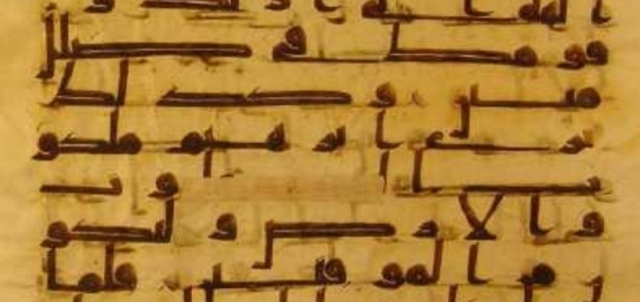
The answer is no, it could not have been a different word. The phrase “wal ard” almost always follows after the word “samāwati”. What makes it even more obvious is the fact that the letters “maawaati” can be seen clearly. These eliminate the possibility of them “trying to censor the original text”.
Let’s take a look at one of the examples of these coverings provided by Jay Smith in Surah 3:161:
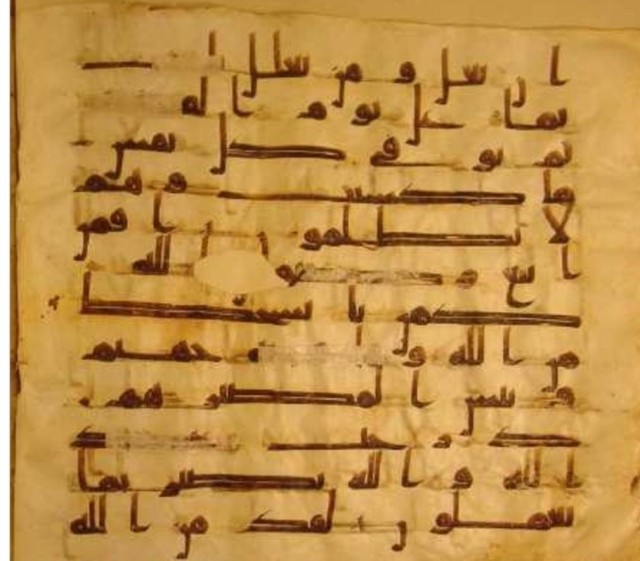
Coverings are present over random letters, some of which can still be seen. Yet, the standard text is found perfectly fine in numerous earlier manuscripts including Codex Parisino Petropolitanus, Is. 1615 I, and numerous others.

These coverings can simply be due to the poor condition of the folios, as there are some instances of coverings where there is no text. And of course, no actual expert, such as Dr Marijn Van Putten or Hythem Sidky, believes these coverings were to hide the original text.
- The Birmingham Folios
The author states that the Birmingham Folios (2 folios) have nothing to do with Islam since they only contain parts of Surah 18, 19 & 20.
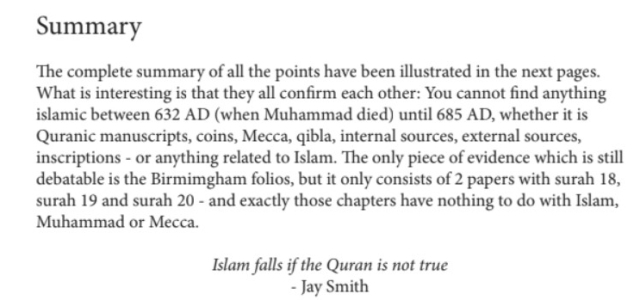
He fails to realize that the folios are part of a bigger codex – Codex Arabe 328 (c), which has 16 additional folios (32 pages) and definitely “have to do with Islam”. It contains Surah 10, almost all of Surah 11, all of Surahs 21 and 22, and parts of Surahs 20 and 23, and they are arranged in the standard Uthmanic order.

- Were Ahadith written in the 8-9th centuries CE?
The author claims that the Sirah and Ahadith were written in the 8th or 9th centuries CE:

Not having a surviving early manuscript is not proof that the Ahadith were not written early on. Ironically, the author accepts the traditional dates for the writing of the Gospels (I wonder why!) or even the Chronicles of Sebeos, for which there is no complete manuscript prior to the 17th century CE.
Islamic tradition states that there were indeed early compilations of Ahadith from the 7th-century CE, such as the Sahifah of Hammam Ibn Munabbih, which has 138 narrations – 98 of which are recorded in the later Sahih Bukhari & Muslim.[5]
Islamic tradition also states that Imam Malik wrote the Muwatta, obviously during his own lifetime. And for this, we do indeed have manuscript evidence dated to 795 CE (within his own lifetime).[6]
Jay Smith also seems to ignore these in his amazing conversation with the author:

- Was the Qur’an only written later?
The author states that an Islamic coin from the late 7th-century that has part of a verse is different from the Qur’anic verse, which according to him is proof that the Qur’an was only completed later on.
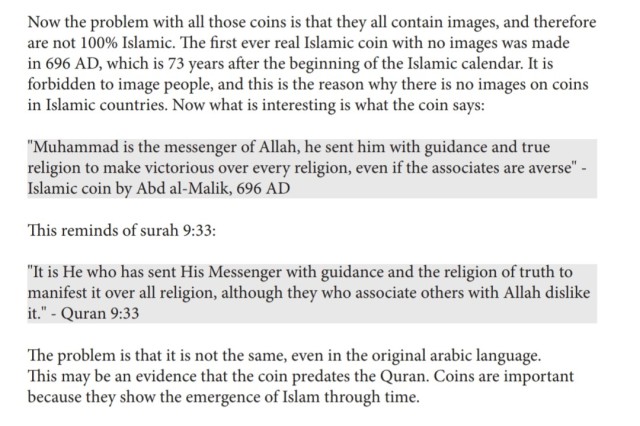
The problem is: the author translates the same Arabic text differently for the text on the coin and the verse. He also adds a phrase NOT found on the coin to make it suit his false claim that the Qur’an was completed later.
The coin quotes part (or most) of Surah 9:33. The text on the coin is:
محمد رسول الله أرسله بالهدى و دين الحق ليظهره على الدين كله
The translation is: Muhammad is the Messenger of Allah, who he sent with guidance, and the religion of truth to manifest it over all religion.
The text of the verse is:
هو الذي أرسل رسوله بالهدى و دين الحق ليظهره على الدين كله ، و لو كره المشركون
The translation is: “It is He who has sent His Messenger with guidance and the religion of truth to manifest it over all religion, although they who associate others with Allah dislike it.”

- A Qur’anic Inscription from Makkah
Here is another example of the author translating the same Arabic Text differently to suit his false ideas.

- The rock inscription is definitely not the first in Makkah, and definitely does not “predate the Quran” (whatever that is supposed to mean!)
- Both Qur’an 2:21 and the inscription have the phrase “يأيها الناس“. However, for the inscription, he translates it as “O People”, while for the verse, he translates it as “O Mankind”.
- Actually, this inscription is a blend of 3 Qur’anic verses.

This is not the only instance where the author has resorted to obvious deception. Below is a part of page 82, where the author claims that the “characters” of Islam were invented by Abd al-Malik.
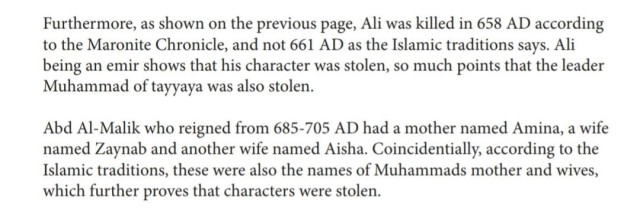
From what I researched:
- Abd Al Malik did not “coincidentally” have a mother named Amina.
- He did not have a wife named Zaynab, neither did he have a wife named A’ishah. A’ishah was the name of his mother.
Why did the author lie? So that he could convince his readers, who he thought would not verify the information (and indeed, most will not), that Abd Al-Malik invented Islam.
- Do Islamic sources show that the Qur’an has been changed?
Needless to say, the misrepresented ahadith the author quotes were all listed by Jay Smith.
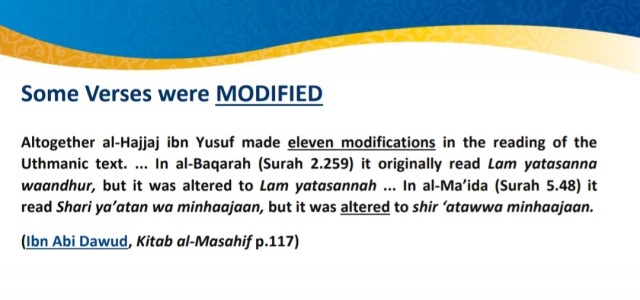
- Did al-Hajjaj change the Qur’an?

The above was taken from a series of “lectures” by Jay Smith.
- The Authenticity of the Report
Unfortunately, Jay Smith had failed to mention that the authenticity of the narration is doubted, as it contains Abbad Ibn Suhayb in its chain. Al-Bukhari stated regarding ‘Abbad Ibn Suhayb al-Basri that was “abandoned”.[7] In other words, his narrations were not to be trusted. al-Nasa’i also confirmed this and that Abbad’s hadith is “rejected”.[8]
- Further Proof Al-Hajjaj did not change the Qur’an
Another thing Jay Smith failed to mention is that all of the recitations are present in the sahih and well-known Qira’ah. Jay Smith states that al-Hajjaj changed Surah 5:48 from “shari’atan wa minhajatan” to “shir’atawwa minhajatan”. A less misleading transliteration would be “shir’atan wa minhajatan”. Unsurprisingly, the author of “Disproving Islam” blindly copied Smith’s transliteration. About this supposed alteration by al-Hajjaj, Dr. Umar Ibn Ibrahim Radwan states:
“Al-Nakh’i and Ibn Waththab read with a fathah on the letter shin [i.e shar`atan] and the whole community of readers read shir`atan and I found nobody mentioning shari`atan.”[9]
- Islamic Inscriptions & The Conclusions of Archaeologist Edgar
Here our author falsifies an inscription from the year 24 AH because it has dots, which he claims was only “introduced in the 8th and 9th century AD”.

However, there is physical evidence to show these dots were in use at the time. Perf 558, a papyrus from a year earlier, also contains dots. This is why no actual expert believes the inscription has been falsified “because it has dots”. This is one problem in taking the words of Jay Smith as a reliable source of information.

- Addressing some other claims

- Are “the 6 Qurans not the same as the one today, and neither will (agree with) each other”?
No, this is against what actual experts state. As Marijn van Putten explains:
“Sadeghi defines the Uthmanic text type as agreeing with the text of the 1924 Cairo Edition of the Quran, a tradition that “reportedly began with the codices ʿUthmān disseminated as the ancestors of all the manuscripts in the textual tradition”. These codices all agree on: 1. the order of the surahs; 2. the order of the verses within each surah; and 3. the content of these verses in terms of individual words (Sadeghi and Bergmann 2010: 347).”[10]
- Did the Prophet Muhammad “not write the Quran according to traditions”?
There is no narration that states or implies that the Qur’an was not written down. In fact, the narrations clearly state the opposite.
- Did the Prophet Muhammad not exist?
The same scholars the author has appealed to throughout his “book” agree that the Prophet Muhammad (peace be upon him) existed. The late Patricia Crone, whom the author praised as someone “who knows 15 different languages …”, stated:
“There is no doubt that Mohammed existed, occasional attempts to deny it notwithstanding. His neighbours in Byzantine Syria got to hear of him within two years of his death at the latest.”[11]
No actual historian or academic takes the Petra theory or the claim that Prophet Muhammad (peace be upon him) did not exist seriously. Unfortunately, our author now boldly claims “Muhammad didn’t exist” and that “Mecca didn’t exist in the 7th century AD”.
Conclusion
Some may think these are the only (major) errors and deception in the author’s book. This is clearly false. There are numerous other misleading or incorrect statements present, which I did not address here. Other parts of his book show a severe lack of knowledge of Islam. His arguments that are supposed to be a refutation of Islam are not much better:


And of course, any unbiased person would have realized by now that his book is clearly plagiarizing word for word from the “works” of others. His book being a draft as he claims (yet still wants people to promote) is not an excuse for these.
To the best of my ability, I have consulted experts and have done extensive research to ensure that whatever is mentioned above is factual information.
[1] https://muslimheritage.com/pibla-back-to-qibla/
[2] All screenshots of the author’s claims are taken directly from his book, which relies heavily on the pseudo-scholarly work of Christian apologists like Jay Smith. All screenshots of Smith’s claims are taken from here: https://www.answeringislam.info/chinese/images/files/historicalProblems.pdf
Unless otherwise indicated, all pictures of Qu’ran manuscripts and Islamic inscriptions are taken from https://corpuscoranicum.de/ or https://www.islamic-awareness.org.
All screenshots of Qur’anic verses are taken from: https://quran.com/.
[3] https://www.islamic-awareness.org/quran/text/mss/arabe328a.html
[4] www.islamicmanuscripts.info/news/20090910/Deroche-2009-summary.pdf
[5] https://www.islamic-awareness.org/hadith/hadith.html
[6] https://www.islamic-awareness.org/hadith/perf731
[7] https://www.islamic-awareness.org/quran/text/hajjaj
[8] Ibid.
[9] Ibid.
[10] Marijn van Putten, “’The Grace of God’ as evidence for a written Uthmanic archetype: the importance of shared orthographic idiosyncrasies”, Bulletin of the School of Oriental and African Studies, 82, no. 2 (June 2019), p. 272, https://doi.org/10.1017/S0041977X19000338.
[11] https://www.opendemocracy.net/en/mohammed_3866jsp/


