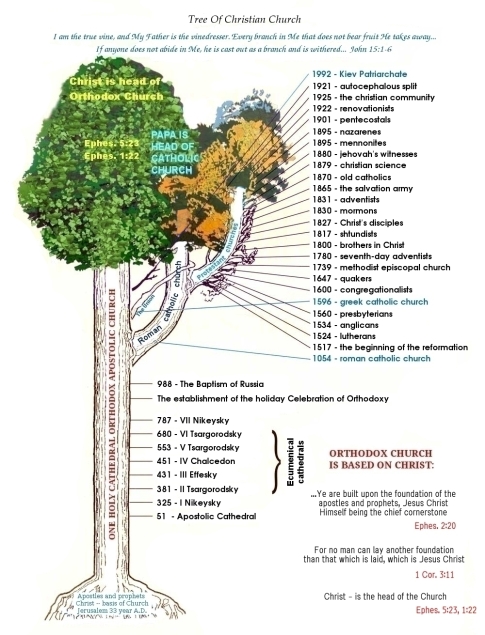
Tree of Christian sects from an Eastern Orthodox point of view.
Most Christians know very little about there church history. They have no idea about the wide variety of beliefs of the early Christian sects, including the Ebionites, Marcionites, Arionists, and Gnostics. Most have no idea about the history and development of the multitude of biblical canons or the forging of orthodox Christian theology. Many fundamentalist Christians are lead to believe the following fairy tale, which I will later contrast with the facts about early Christianity.
The Christian Fairy Tale
- God, the creator of the universe, chose the Jews to be his people.
- Jews were monotheistic (believed in only 1 god) from the start. Only rebellious Jews ever worshipped other gods.
- God gave Jews the Hebrew Bible (which contains the exact same books as the Old Testament of the bible of my sect of Christianity) as a guide on how to please Him and live good lives. This included many animal sacrifices.
- The Jews constantly disobeyed God.
- The Jews were punished by having their kingdom(s) destroyed and by being scattered throughout the world.
- Jesus was born around 0 A.D. (Anno Domini, in the year of our Lord) to the virgin Mary. (I will use CE, and BCE)
- He is both the god of the Old Testament (OT) and is the son of the god of the OT. He is also the Holy Spirit.
- Around the age of 30 he began his ministry.
- Around the age of 33 he was sacrificed on the cross. He rose from the dead 3 days later and ascended to heaven.
- His sacrifice atones those who believe in him for their sins. There is no need for further animal sacrifices or obedience to most OT diet and lifestyle laws other than sex restrictions.
- True Christians will go to heaven for eternity when they die.
- All others will burn forever in hell after death.
- The early Christian church was united and had one perfect set of doctrines.
- The New Testament (NT) is the perfect word of god that completes the OT.
- Early Christians had no disagreement about the 27 books of the NT, which were established shortly after 33 CE.
- The doctrines and canon of [insert name of Christian sect of childhood] have been the doctrines of Christians since the time of Christ.
- Christianity is confirmed by the Dead Sea Scrolls and other archaeological evidence.
The above picture shows a tree of Christian sects from the point of view of the Eastern Orthodox church. Many other churches teach a similar history of Christianity, claiming that their particular sect is exactly like the original Christian church and all other branches are flawed. Notice that the Easter Orthodox part of the tree has beautiful green leavers while the other sects have ugly brown leaves. Also notice that the base of the tree is Jesus and the apostles in Jerusalem in 33 CE.
Here is a more generic tree of Christian sects from Wikipedia.
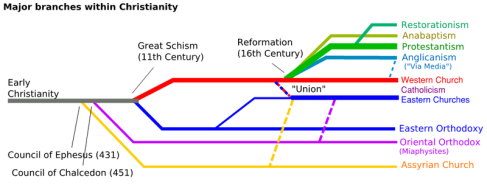
Tree of Christian sects from Wikipedia.
This tree is a little better, because it shows some divisions prior to the Catholic – Eastern Orthodox split. However, it still shows one base known as “Early Christianity”. Wikipedia also notes that “Protestantism in general, and not just Restorationism, claims a direct connection with Early Christianity.” For example, the Church of Christ is one of many sects that believes they are most similar to the original Christian church.
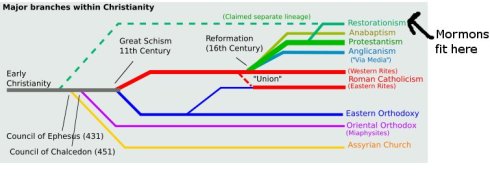
A Mormon blogger to the Wikipedia tree of Christian sects and altered it to show that Mormonism restored original Christianity.
None of the above trees are accepted by scholars (fundamentalist Christian or secular) as fully accurate. The tree of Christian sects below is from the University of California. It more accurately reflects the true nature of the development of Christianity. Most importantly, it represents the multitude of Christian sects that existed prior to the council of Nicea.
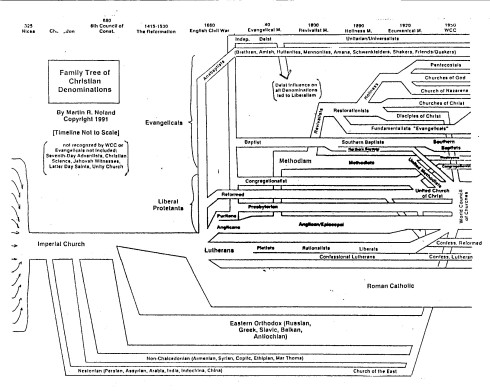
Tree of Christian sects from the University of California.
Notice that the base of the tree is very wide and has many arrows leading to the Imperial Church. These arrows represent the multitude of sects that existed prior to the Council of Nicea in 325 CE.
The following map (also from the University of California) shows many sects that existed at 325 CE, including the Ebionism in Jerusalem, Marcionism in Caesarea, Arianism in Alexandria, Gnosticism in Damascus, and others. The next section of this blog will focus on what some of these early Christian sects believed.
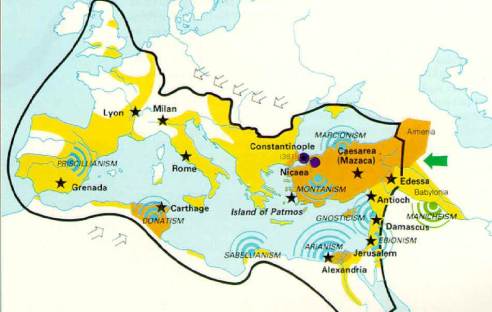
Map displaying Christian sects and their major areas of influence at the time of the Council of Nicea.
Scholarly Christianity
Judaism
- Ancient Hebrews evolved from the ancient Canaanite Religion. El Elyon was the most high god of manygods.
- Ancient Hebrews became monolithic. They believed in many gods, but Hebrews should only worship their god named Yahweh.
- Ancient Hebrews evolved into monotheism around 6th century BCE, believing Yahweh was the only god.
- Jews lived under the subjugation of many foreign rules, including Romans in the first century.
- Jews rebelled against Rome in 66 – 73 CE. The Jerusalem Second Temple was destroyed in 70 CE. Masada fell in 73 CE
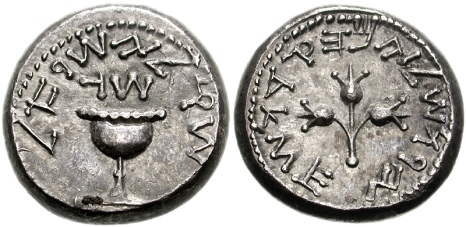
Coins by Jewish rebels in 68 CE proclaim “Jerusalem The Holy.”
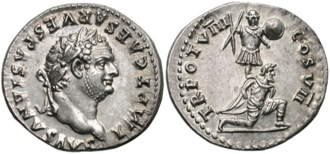
Roman coins around 73 CE show Jewish soldiers kneeling before Romans.
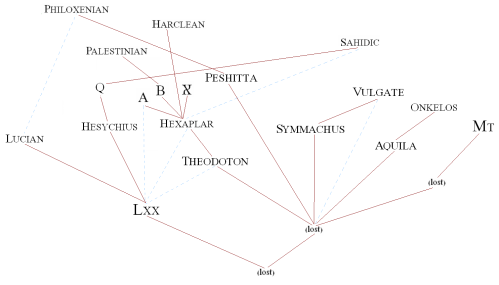
Depiction of the evolution of Old Testament texts. LXX is the Septuagint, MT is the Masoretic Text.
Example of Jewish editing.
Deuteronomy 32 (New International Version):8 When the Most High gave the nations their inheritance, when he divided all mankind, he set up boundaries for the peoples according to the number of the sons of Israel.[b] 9 For the Lord’s portion is his people, Jacob his allotted inheritance.
b: Masoretic Text; Dead Sea Scrolls (see also Septuagint) sons of God
- Many scholars believe this passage in the DSS and LXX form supports polytheism. The Most High (Elyon) god divided mankind into nations, giving each son of god their allotment. The “Lord’s” (Jewish God’s) share were the children of Jacob.
Masoretic Text or Septuagint?
- The authors of the New Testament (NT) used the Greek Septuagint (LXX) when quoting OT books.
- Catholics (46 books in OT), Orthodox (51 books), Ethiopians (46 books, or 50 splitting 1 & 2 Kings, etc), and others use the LXX.
- Protestants use the Hebrew MT and have 39 book in OT.
- Modern Jews use the Hebrew MT.
- The Dead Sea Scrolls (DSS – Hebrew) are used by all sides to claim that the Septuagint supports their canons (set of scriptures considered holy).
Jesus Is Not An Important Person During His Time
- Jesus was not important historically, as he was not mentioned by any contemporary historians, Jewish, Roman, Greek, or otherwise.
- The general scholarly consensus is that Jesus was a Gallilean Jew born between 7 and 2 BCE. who condemned other Jews in particular of not following the laws or the spirit of the laws.
- Jesus is believed to have been crucified by the Romans for rebellion against their authority around 30-36 CE.
- There is a small minority of scholars who claim Jesus never existed. Some also claim Nazareth did not exist in the 1st Century.
- My opinion is that Jesus was a Rabbi who was crucified by Rome. The supernatural deeds recorded in the bible are merely legend.
There were multiple versions of early Christianity with a variety of beliefs about the nature of Jesus and the relationship with Judaism and the OT.
- I will describe Ebionites and Marcionites, Gnostics, Montanism, Arianism and proto-orthodox Christianity.
- There were varieties within the above sects (especially Gnostics), and there were other sects not mentioned in this blog.
Ebionites – Very Jewish Christians From Jerusalem
- Ebionites were very Jewish Christians.
- They believed in 1 god.
- They considered themselves Jews and obeyed the OT laws.
- Only Christian sect recorded by Eusebius as keeping the Sabbath.
- They believed Jesus was completely human and not divine.
- They believed Paul was an arch heretic.
- http://ebionite.org/ – Claim to be modern Ebionites.
- Ebionites or similar groups such as Nazareans, were possibly the groups chastised by Paul for keeping the OT laws.
- Matthew 5 was used by Ebionites to show that followers of Jesus should not abandon OT laws.
- 17 “Do not think that I have come to abolish the Law or the Prophets; I have not come to abolish them but to fulfill them. 18 For truly I tell you, until heaven and earth disappear, not the smallest letter, not the least stroke of a pen, will by any means disappear from the Law until everything is accomplished. 19 Therefore anyone who sets aside one of the least of these commands and teaches others accordingly will be called least in the kingdom of heaven, but whoever practices and teaches these commands will be called great in the kingdom of heaven. 20 For I tell you that unless your righteousness surpasses that of the Pharisees and the teachers of the law, you will certainly not enter the kingdom of heaven.
Marcionites – Very Anti-Jewish Christians
- Marcionites were Gentiles who claimed Jewish practice was harmful for a relationship with god.
- They were followers or Marcion, a real person in the 2nd century.
- They believed in two gods, one Jewish and one Christian.
- They believed Jesus was completely divine and not human.
- They rejected the Old Testament as a book inspired by the inferior god of the Jews.
- They believed Paul was the one true apostle of Christ.
- Jesus revealed himself to Paul because the other apostles failed to comprehend true Christianity because they were too Jewish.
First Christian Canon Created by Marcion, Who Is Now Considered a Heretic
- Marcion (a real person considered a heretic by Proto-Orthodox Christianity) created the 1st Christian NT Canon around 144 CE. It contained a version of the gospel of Luke and 10 of the 13 letters of Paul, namely Romans, 1st & 2nd Corinthians, Galatians, Ephesians, Philippians, Colossians, 1st & 2nd Thessalonians, and Philemon.
- Marion’s canon rejected the OT, Matthew, and John.
- Proto-orthodox canons were a response to the canon created by Marcion.
Gnostics
- Very spiritual and many widely varying subsets.
- Believed Jesus was a spirit and did not suffer, but only appeared to suffer.
- They believed in salvation through mysterious knowledge.
- This world is full of ignorance and suffering; salvation comes not by making it better but by escaping it.
- They had little church structure and taught equality of all members.
- Coptic Gnostic texts were discovered in Nag Hamadi, Egypt, in 1945.
- The Coptic Apocalypse of Peter:
- “He whom you saw on the tree, glad and laughing, this is the living Jesus. But this one into whose hands and feet they drive the nails is his fleshly part, which is the substitute being put to shame, the one who came into being in his likeness. But look at him and me.”
- Warns against those who “will cleave to the name of a dead man, thinking that they will become pure”.
First Listing Of Four Gospels Is A Response To Gnostics, Against Heresies
- Around 180 CE, proto-orthodox Christian Bishop Iranaeus wrote Against Heresies to show the errors of gnostics.
- The first time that 4 and only 4 gospels are listed as divinely inspired occurs in an argument against Gnostics.
- “It is not possible that the Gospels can be either more or fewer in number than they are. For, since there are four zones of the world in which we live, and four principal winds, while the Church is scattered throughout all the world, and the pillar and ground of the Church is the Gospel and the spirit of life; it is fitting that she should have four pillars, breathing out immortality on every side, and vivifying men afresh. From which fact, it is evident that the Word, the Artificer of all, He that sits upon the cherubim, and contains all things, He who was manifested to men, has given us the Gospel under four aspects, but bound together by one Spirit.” (Against Heresies, 3:11:8)
- The reasons listed above to have four and only four gospels are considered humorous by many, including me.
Montanism – Early Pentecostals
- 2nd Century Christian sect founded by Montanus.
- Known as New Prophecy by followers, Montanism by critics.
- Led to Cataphrygian and Phrygian groups that lasted until the 6th Century.
- Prophetic movement that called on reliance of the Holy Spirit and a conservative personal ethic.
- Parallels have been drawn to Pentecostals today.
- Montanus, Prisca and Maximilla spoke via ecstatic visions.
- Opponents claimed they were possessed by evil spirits.
Arianism – Much of the Nicene Creed is a Response to Their Claim that God and Jesus are Different
- 3rd Century sect founded by Arius.
- Arius asserted that the Son of God was a subordinate entity to God the Father.
- The Son of God did not always exist, but was created by—and is therefore distinct from—God the Father.
- Based on John 14:28 – …If you loved me, you would be glad that I am going to the Father, for the Father is greater than I.
- How could Jesus “go to the Father” if he and the “Father” were the same person?
- How could Jesus and the “Father” be equal if “the Father is greater than I”?
- Deemed a heretic at Nicea in 325 CE
- Much of the Nicene Creed was written as a response to Arianism.
Proto-Orthodox Christians – All of the above
- All of the Above Christians.
- Jesus was a) Human b)Divine c) All of the Above
- Jesus is a) God the Father b) God the Son c) God the Holy Spirit d) All of the Above
- Christians scripture includes a) the OT b) the NT c) All of the Above (but do not have to follow all OT laws)
- Claimed ancient roots for their religion.
- Rejected unappealing Jewish practices such as circumcision.
- Had strong church leadership and hierarchy.
- Communicated with one another.
Arsenal of the Proto-Orthodox
- Stressed that they were unified and all the other sects were not unified (similar to Church of Christ , Catholic, Eastern Orthodox and other claims today).
- Had their own versions of sense & nonsense, truth & error.
- Claimed apostolic succession, as opposed to Marcion, Montanus, Arius.
- Started developing creedsin response.
- Wrote forgeries and falsifications of their opponents views.
- Charged non-orthodox with reprobate activity.
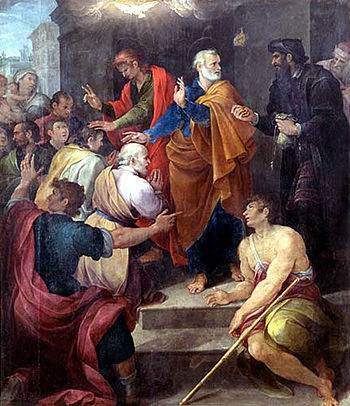
Peter’s conflict with Simon Magus by Avanzino Nucci, 1620. Simon is on the right, dressed in black.
Proto-Orthodox Legends of Simon Magus
- Simon Magus (a magician and new convert) in Acts 8 is chastised for seeking the power to give Holy Spirit to new converts.
- Little more is said about Simon in the bible, but he is considered the source of heretical views in later writings.
- Many claims of reprobate activity of non-orthodox Christians, including several involving Simon Magus.
Orthodox Christianity
- Orthodox Christianity was forged over 3 centuries, culminating in the Council of Nicea in 325 CE.
- The Proto-Orthodox Christians increased in power and started discussing their own canons and doctrines (partly due to influence of Marcion and the Gnostics).
- The Roman Emperor Constantine converted to Christianity in 312 CE.
- Edict of Milan in 313 made Christianity legal.
- Constantine Ordered the Council of Nicea(present day Iznik, Turkey) in 325 to settle disagreements on Christian doctrine.
- The Nicene Creed and Constantinople Creed in 381 formalized Christian doctrine.
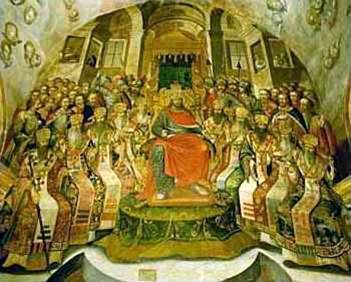
Painting The Council Of Nicea by F. Pavlovskyi, I. Maksimovych, and A. Galik and others at the Gate Church of the Trinity, Kiev, 18th Century.
The Nicene Creed Is A Response To Heresy
We believe in one God,
the Father, the Almighty,
maker of heaven and earth,
of all that is, seen and unseen.
We believe in one Lord, Jesus Christ,
the only Son of God,
eternally begotten of the Father,
God from God, Light from Light,
true God from true God,
begotten, not made,
of one Being with the Father.
Through him all things were made.
For us and for our salvation
he came down from heaven:
by the power of the Holy Spirit
he became incarnate from the Virgin Mary,
and was made man.
[The creed lines above claim that Jesus and God are the same, they are one, they are divine, and they are human – all responses to the “heretics”.]
For our sake he was crucified under Pontius Pilate;
he suffered death and was buried.
On the third day he rose again
in accordance with the Scriptures;
he ascended into heaven
and is seated at the right hand of the Father.
He will come again in glory to judge the living and the dead,
and his kingdom will have no end.
[The creed lines in bold above refute the heretical claim by Gnostics and others that Jesus only appeared to die.]
We believe in the Holy Spirit, the Lord, the giver of life,who proceeds from the Father and the Son.
With the Father and the Son he is worshiped and glorified.
He has spoken through the Prophets.
We believe in one holy catholic and apostolic Church.
We acknowledge one baptism for the forgiveness of sins.
We look for the resurrection of the dead,
and the life of the world to come. Amen.
[The creed lines above link the father, son and holy spirit as one. It states there is only one church, not multiple Christian sects.]
The New Testament – Forged Over Centuries
- The Christian NT was forged over several centuries.
- The “heretic” Marcion created the first canon.
- Lists and canons were created by several early Christians after Marcion.
- Constantine ordered Eusebius to produce 50 bibles in 331. He had 340 scribes working for him to complete this task. No such bible exists today, but it is believed that this set influenced future canons.
- The first list of the currently accepted 27 NT books was not until 367 CE in a letter from Athanasius.
- Many Christians are led to believe that the New Testament was used by the Apostles in 34 CE.
- Many Books Not In The New Testament Today Were Considered Scripture By Early Chritianities.
- Many books in the NT today have been edited. Most changes are insignificant, but some are very significant.
- There are more variations in early Christian manuscripts than there are words in the NT.
- Today, Christian churches generally agree on the books of the NT.
- See http://www.ntcanon.org/table.shtml for excellent information on the development of the New Testament.
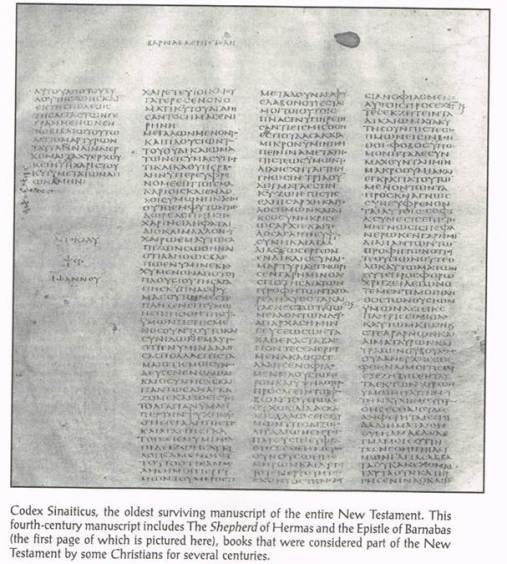
Courtesy of Bart Ehrman. The Codex Sinaiticus is the oldest collection of the 27 books of the New Testament. It also contains the Shepherd of Hermas and the Epistle of Barnabas. Nothing indicates that these two books are considered of lesser value than the other 27.
Protestants, Catholic, and the Apocrypha
- Christians still do not agree on books of the OT, and some sects accepts additional books.
- Jewish leaders had there own synods which developed over centuries into today’s approved MT.
- Martin Luther did not like some Catholic doctrines, many of which were supported by verses in Maccabees. He got rid of Maccabees by rejecting books in the LXX that were not in the MT in his bible. He published the NT in 1522 and the OT in 1534.
- Luther also did not believe in the authority of NT books Hebrews, James, Jude and Revelation.
- The Catholic Church responded by approving the Deuterocanonical books in 1546. These books are now considered equal in authority to all previously canonized books. The vote was 24 yes, 15, no, and 16 abstaining. Only 44% of those present approved this important decision! It is now officially heretical to question the authority of these books!
- Protestants started putting these books in an apocryphal (doubtful) section, as the 1611 King James Version (KJV) did.
- Protestants have now removed these books completely, as the official 1895 KJV did.
- Today’s official KJV is more recent than The Origin of Species!
Christian Canons Today Have Major Differences
Most Americans think in terms of Protestant and Catholic. However, there are many other Christian churches, including Ethiopian, Coptic, and Syrian. The websites below have many lists of accepted texts and can be used to compare the canons of various modern Christian sects.


