Tuesday, 20 February 2024

A response to the objection, the Qur’ān copied from apocrypha Gospels and is ignorant of the historical Jesus


The NT mentions not everything related to Jesus is documented


Scholars mention how historically “inspired” Books and writings within the Bible were lost.


Hence Qur’ān mentioning something about Jesus not found in the present Bible, doesn't necessitate it's false As the Philosophers say, “Absence of evidence is not evidence of Absence” Scholars Admit the Qur’ān didn't copy from the Infancy Gospel, but it's the other way around.


Moreover, The only two surviving manuscripts date from 1299 AD and the 15th/16th century in Arabic.


The Scholars they say, there were no Christian groups to have copied the Qur’ān from.


Even the Bible, wasn't translated at the time of the Prophet , as acknowledged by many scholars.


"the Gospel that the Qurʾān confirms is not the Gospel as Christians recognized it in the Qurʾān’s own day" The Bible In Arabic pp.74 (Sidney H. Griffith)


--------------------------

In the Eight and Ninth century the Bible started translating.


20th century greatest Textual Scholar, Bruce Metzger, mentions likewise.


If the Qur’ān copied the Bible, it'd have copied the Mistake as well, The Bible Mentions Pharoah not with regards to Moses, but at the time of Joseph as well, Qur’ān on the other hand mentions King in relation to Joseph, and Pharaoh at Moses's time.


Archeologists mention, “Pharoah” wasn't used before 1,500 BC and is Anochronistic, but rather “King” was used. The Qur’ān didn't “copied” this mistake, but rather corrected. Alḥamdulillāh


Jeffrey J. Bütz mentions how the Islāmic understanding of Jesus is in line with Jesusʼ original first-century Jewish followers.


Ebionites, the earliest followers of Christ Jesus all rejected his pre-existence and divinity They rejected Paul as a liar, Apostate, enemy of Christ


The New Jerome Biblical commentary admits, Jesusʼ message of abiding by the Torah contradicts Paul. Mattew and James abided by Jewish Christianity which was defeated by Paulinism... Later re-born as Islam.


Does the Qur'an know the Bible?


Recently, some Christians that I encountered have alleged that the Qur'an does not actually know the Bible. Although I have written on this topic before, the following is my latest response to this issue.


by Ibn Anwar


In critiquing the Qur'an, Christian apologists often accuse it of having no knowledge of actual Christian scriptures, i.e., the Bible(s). They allege that the Qur'an often misrepresents what Christians believe or simply fails to address Christian doctrines and that to them indicate the Qur'an's supposed unawareness of Christianity and its holy book, the Bible. This is absolutely false. It can be demonstrated rather convincingly that the Qur'an has intimate awareness and knowledge of not only what Christians believe but what their scriptural books contain. Consider the following examples of how the Qur'an exhibits familiarity with the Bible(s):


1. The Bible famously claims that God created the heavens and the earth but that astronomical task taxed the Almighty:


"By the seventh day God had finished the work he had been doing; so on the seventh day he rested from all his work." (Genesis 2:2)


The above is repeated in Exodus 21:11:


"For in six days the LORD made the heavens and the earth, the sea, and all that is in them, but he rested on the seventh day. Therefore the LORD blessed the Sabbath day and made it holy."


Seeing the apparent difficulty in saying that the All-Powerful needed to rest after a hard week's worth of work, the Christian apologist would typically claim that the 'rest' meant in those verses is not the 'rest' that means a 'break from exhaustion,' but it is the kind of 'rest' that means 'to stop' or 'to cease' from doing something, e.g., "the car rested on the road abruptly when he pulled the breaks." This amelioratory attempt might work if Exodus 31:17 didn't actually define 'rest' in those verses to actually mean "exhaustion":


"It will be a sign between me and the Israelites forever, for in six days the LORD made the heavens and the earth, and on the seventh day he rested and was refreshed.'"


The above is rather self-explanatory and it evidently refutes the excuse that the Christian apologist suggested. The 'resting' that is meant is clearly that of relaxation after tiresome work as the word 'refreshed' indicates. Also, Psalm 44:23 which describes God as being 'asleep' ("Awake, why do you sleep, O Lord?) certainly doesn't help the Christian apologist's case.

Refuting all of the above biblical texts that impugn on God's divine nature as the One that is All-Powerful, the Qur'an declares:


"We created the heavens, the earth, and all that is between them in six days without experiencing any fatigue." (Qur'an, 50:38)


One does not need theological training to notice that the Qur'an in the verse above is clearly addressing the biblical texts that speak of God having experienced fatigue or tiredness after creating the heavens and the earth in six days. And refuting Psalm 44:23 which suggests God sleeps, the Qur'an unambiguously declares the following:


"Neither slumber nor sleeps overtakes Him (God)." (Qur'an, 255)


2. The Bible has a knack at tarnishing the characters of God's messengers and prophets. One such prophet whose dignity was violated by the Bible was Solomon. The Bible claims that even after God had appeared to Solomon, he turned to other gods thereby becoming a disbeliever:


"For when Solomon was old his wives turned away his heart after other gods, and his heart was not wholly true to the Lord his God, as was the heart of David his father. For Solomon went after Ashtoreth the goddess of the Sidonians, and after Milcom the abomination of the Ammonites. So Solomon did what was evil in the sight of the Lord and did not wholly follow the Lord, as David his father had done. Then Solomon built a high place for Chemosh the abomination of Moab, and for Molech the abomination of the Ammonites, on the mountain east of Jerusalem. And so he did for all his foreign wives, who made offerings and sacrificed to their gods." (1 Kings 11:4-8)

Rescuing and exonerating Prophet Solomon a.s. from such a horrendous and abominable allegation as disbelief and idolatry, the Qur'an declares concisely that Solomon a.s. never fell into such blameworthiness:


"And follow that which the devils falsely related against the kingdom of Solomon. Solomon disbelieved not; but the devils disbelieved, teaching mankind magic and that which was revealed to the two angels in Babel, Harut and Marut. Nor did they (the two angels) teach it to anyone till they had said: We are only a temptation, therefore disbelieve not (in the guidance of Allah). " (Qur'an, 2:102)


Indeed, the holy messengers of God are free from the indignities that the Bible falsely attributes to them.


There are many other Qur'anic texts that showcase the Qur'an's great familiarity with the Christian scriptures, but the two examples given above sufficiently demonstrate our point. Confirming that the Qur'an does indeed illustrate that it is well acquainted with Christian scriptures and refuting the Christian apologists that allege that it is not, respected Christian scholar Professor Sidney Griffith, who is professor of Early Christian Studies at the Catholic University of America, writes:


"The Qur'an is very conscious of the Bible and sometimes presents itself as offering once again a revelation previously sent down in the Torah and the Gospel...One of the first things that the historian of Arabian Judaism and Christianity notices on approaching the Qur'an is that for all its obviously high degree of biblical awareness, the Qur'an virtually never actually quotes the Bible." [1]


Professor Griffith's observation is quite clear: That although the Qur'an does not directly quote the Bible, it, nevertheless, betrays great familiarity with the contents of the Bible.

It is quite clear, then, that the Christian apologists' allegation against the Qur'an lies on a gossamer and it is doubtless a very fragile gossamer that is easily ruined by the slightest swipe of a hand.


Notes:

[1] Griffith, S. H. (2013). The Bible in Arabic: The Scriptures of the "Pople of the Book" in the Language of Islam. New Jersey: Princeton University Press. p. 51-56

Tuesday, 13 February 2024

Are There Any Hadith Collections From Early Islam?


Are There Any Hadith Collections From Early Islam?

بِسۡمِ ٱللهِ ٱلرَّحۡمَـٰنِ ٱلرَّحِيمِ

Kaleef K. Karim

Yes there are early Hadith collections. One of the claims hurled at Muslims by Christian missionaries and Hadith-rejecters are that they say, “there are no hadiths collections from early Islam”. According to them, Hadith came into existence 250 to 300 years after the Prophet Muhammed’s (p) demise. In this article I will show evidences from non-Muslim Scholars that Hadith existed way before the dates they have brought forth.

First Century Hadith Collections

Sahifa Hamman B. Munabbih

It is well-known fact among Muslim scholars that Hammam B. Munabbih was a student of Abu Huraira. The earliest hadith collection we have extant is Sahifa b. Munabbih which was written by the student of Abu Huraira. The Books name is ‘Sahifah Hammam b.Munabbih’.

1. American Scholar William Albert Graham who is a Professor of middle eastern studies states:

“…..Of the four remaining collections, the earliest is the Sahifah of Hammam b. Munabbih (d. Ca. 101-02/719-20). It is a collection of 138 hadiths that dates from around the end of the first Century A.H. and contains some eighteen Divine sayings.” [1]

2. Professor Alfred Felix Landon Beeston also comments on Sahifa Hammam B. Munabbih,

“An example is the Sahifah of Hammam b. Munabbih, (d. 110/719), a Yemenite follower and a disciple of Companion Abu Hurayrah, (d. 58/677), from whom Hammam learned and wrote this sahifah, which comprises 138 hadith and is believed to have been written around the mid-first/seventh Century.
It is significant that Hammam introduces his text with the words: ‘Abu Hurayra told us in the course of what he related from the Prophet’, thus giving the source of his information in the manner which became known as sanad or isnad i.e. the teacher or chain of teachers through whom an author reaches the Prophet, a practice invariably and systematically followed hadith in compilations. [2]

3. In the Book ‘Encyclopaedic Historiography of the Muslim World’, written by Professor Nagendra Kr. Singh, he goes in detail on Hadith and also comments on Sahifa B. Munabbih. Take also notice of him saying that ‘ORAL TRANSMISSION’ OF HADITH was the most favoured. He writes:

Compilation of hadith in a book form had become a known practice even during the prophet’s lifetime. We are told that Ali b. Abu Talib had compiled a small book containing Traditions of the Prophet, ‘Abdullah b. ‘Amr b. Al-As has also collected by permission of the Prophet, some Traditions in a book, which he named as al-Sahifa al-sadiqa. Similarly, Jabir b. Abdillah (d. 78 A.H.) was the compiler of a small collection of hadith. Abu Huraira and Amr b. Hazm are also reported to have gathered some Traditions while the latter had also committed to writing a number of such letters of the Prophet as he had despatched to the neighbouring rulers inviting them to embrace the new faith. Abu Huraira, a close companion of the Prophet, had preserved and transmitted a large number of traditions.

Apart from oral transmission, he is reported to have dictated some traditions to his pupils who committed them to writing. Hammam b. Munabbih compiled a book entitled al-sahifa, of which the manuscripts are found in the libraries of Berlin and Damascus. Its Arabic text along with the Urdu Translation and necessary notes has recently been published by Dr. Hamidullah. Ma’mar b. Rashid, a disciple of Hammam, also compiled a book entitled Jami, Manuscripts of which are in the Ankara University Library and in Istanbul.

Abu Bakr Abd al-Razzaq b. Hammam al-san’ani (126-211 A.H.) was a student of ma’mar and one of the teachers of Ahamd b. Hanbal. He is also the compiler of a book entitled ‘musannaf’. In view of these facts, it would be erroneous to assume, as some of the orientalists do, that the work of hadith-compilation was unknown during the prophet’s lifetimeand hence the entire collection of hadith becomes of questionable authenticity.

We have seen that Abu Huraira, his pupil Hammam b. Munabbih, his disciple Ma’mar and his pupil Rashid, his student Abd al-Razzq and his pupil Ahmad b. Hanbal have made continued efforts in preserving and compiling the hadith literature. After the discovery of these works we may rightly suppose that there must have been some other compiled works which did not come down to us. It should be also kept in mind that because of scarcity and dearth of writing material, oral transmission was a popular practice during the early days of Islam. Furthermore, this had become a common practice since the pre-Islamic days because ‘Days of the Arab’, legends of the Prophets, and the Jahiliyya poetry were transmitted orally. Nay, dictation or writing of such material was rather looked down upon as compared to oral transmission. [3]

‘Musanaf of Abdul Razzaq’ to be a source of Authentic Hadith from the 1st Century’*

Professor Harold Motzki believes ‘Musanaf of Abdul Razzaq’ to be a source of Authentic Hadith from the 1st Century*. His article is massive, I am just going to present his Conclusion.

“While studying the Musannaf of `Abd al-RazzaqI came to the conclusion that the theory championed by Goldziher, Schacht, and in their footsteps, many others – myself included – which in general, reject hadith literature as a historically reliable sources for the first century AHdeprives the historical study of early Islam of an important and a useful type of source.” [4]

Muwatta Imam Malik’ compiled Mid-second century AH

Mālik ibn Anas who was born in the year 711 and died 795 (93 AH – 179 AH ) is another Early Scholar of Islam who collected hadiths. He was one of the most highly respected scholars of fiqh (Islamic Jurisprudence) in Sunni Islam. Imam Malik while he was alive compiled a Hadith book. The Hadith Book’s name is ‘Muwatta Imam Malik’ and we still have this Hadith book extant to this day.

Ilya Pavlovich Petrushevsky (1898–1977) who was a Professor of History of the Near East at the University of Leningrad for twenty years, comments on Imam Malik’s Muwatta.

“The oldest collections of Hadith were compiled according to tariqs that is, the companions of the Prophet were listed in alphabetical order and under each name the hadith issuing from the particular fountain head would be supplied. This principle of compilation was known as ‘ala r-rijal, ‘ on (the names of) the earliest reporters’. Of the EXTANT COLLEXTIONS of this type two are celebrated. One if the Muwatta or Beaten Track of malik b. Anas (d. 795), eponymous founder of the Malikite system…..” [5]

Professor Clinton Bennett

“Topically arranged (musannaf) works also appear in the mid-second/eighth century. The earliest extant musannaf work is the Muwatta of Medinan Scholar malik b. Anas (d. 179 AH/795 CE), the eponymous founder of the Maliki school of Sunni jurisprudence and teacher of Muhammad ibn Idris al-Shafii (d. 204 AH/820 CE).” [6]

I will finish my article of with a last reference by Professor Michael Bonner who refutes Joseph Schacht’s theory that somehow Hadith could not be traced before the year 718 -719. He says:

“Schacht thought that no hadith could be proved to date from before year 100 of the Hijra (718-719 CE). There is much more to Schacht’s theory than this, but here it will suffice to point out that for several decades in the West, much of the argument over the hadith has been an argument over the theories of Joseph Schacht. Nowadays Schacht’s work, together with Goldizher, is less favoured than it was not very long ago. As more texts of hadith and early Islamic law have become available, several scholars have analyzed these materials, correlating the Isnad (the supporting chain of authority for such hadith itself) in more painstaking and systematic ways than Schacht had done in his day. As a result of this work, we can perceive in RICH DETAIL, the activities of transmission of learning and production of written texts, going on in early periods, sometimes before the cutoff date of AH 100 that Schacht declared to be the outer limit.” [7]

Conclusion: From all the evidence presented it just goes to show how reliable early Hadith transmitters and collectors were. Whatever Muslim Scholars of the past have said on Hadith reliability, now non-Muslim Scholars affirm this truth. I believe everything I have brought forth in this article from Academic sources thoroughly debunk missionary and Hadith-rejecter lies.

References:

[1] Divine Word and Prophetic Word in Early Islam (1977) By William Albert Graham page 82
[2] Arabic Literature to the End of the Umayyad Period (2003) By A. F. L. Beeston page 272
[3] Encyclopaedic Historiography of the Muslim World By Nagendra Kr. Singh volume 1 Page 317 [Author Kr. Singh http://www.easternbookcorporation.com/moreinfo.php?txt_searchstring=3769]
[4] The Muṣannaf of ʿAbd al-Razzāq al-Sanʿānī as a Source of Authentic Aḥādīth of the First Century A. H. Harald Motzki Journal of Near Eastern Studies Volume 50, No. 1 (Jan., 1991), pp. 21
[5] Islam in Iran By Professor Ilya Pavlovich Petrushevsky page 105
[6] The Bloomsbury Companion to Islamic Studies by Clinton Bennett page 80
[7] Jihad in Islamic History: Doctrines and Practice By Professor Michael Bonner page 48

Why Did Ali Burn Some Apostates?

 Why Did Ali Burn Some Apostates?


By


Understanding Islam


Question:

A Christian missionary has cited the following Hadith from Bukhari and is demanding an explanation:

Volume 9, Book 84, Number 57:

Narrated `Ikrima:

Some Zanadiqa (atheists) were brought to `Ali and he burnt them. The news of this event, reached Ibn `Abbas who said, "If I had been in his place, I would not have burnt them, as Allah's Apostle forbade it, saying, 'Do not punish anybody with Allah's punishment (fire).' I would have killed them according to the statement of Allah's Apostle, 'Whoever changed his Islamic religion, then kill him.'"

---------------

Can you briefly describe the background, which compelled Hadhrat `Ali to take this action? How valid is the isnad [1] and matn [2] and the legality of such a punishment? If there is an argument that Hadhrat `Ali cited to justify this action, that too is welcome.

Jazakumallah Khaira


Answer:

The referred narrative is placed in the Kitaab Al-Jihaad as well as the Kitaab Istitaabah Al-Murtaddeen by Al-Bukhari in his "Sahih".

Although Bukhari's narratives do not give any details regarding the incident, yet in his exegesis on Bukhari - "Fath Al-Baari" -  Ibn Hajar has mentioned a few other versions of the same incident [3]. Considering all the narratives reporting this incident, the following major variations come to the forefront:

Firstly, there is quite a bit of variation regarding the people, who were subjected to this punishment. According to one version, they were atheists, according to a second version, they were apostates, according to a third version, they were a group of people, who secretly used to practice idolatry and according to a fourth version, they were a group of Rawafidh [4], who believed in the divinity of `Ali (ra).

Secondly, there is a significant difference between the reports regarding the incident itself. Although, the narratives given in Bukhari do not give any details of how the incident happened, yet Ibn Hajar has given a few narratives, which give some details of the happening. According to one version, when `Ali (ra) was informed regarding a people who considered him to be god, he called them and asked them to refrain from such blasphemy. They refused to comply. This went on for three days. Till, finally, `Ali (ra) ordered to dig a deep pit and burn a huge fire in it. The criminals were brought to the fire. `Ali (ra) told them that if they do not agree to refrain from their blasphemy, they would be thrown in the fire. They persisted in their refusal and were, subsequently, thrown in the fire. According to a second version, `Ali (ra) was informed of a people who secretly worshipped idols in a house. `Ali (ra) went to investigate the report. An idol was recovered from the house and, subsequently, the house was burnt to ashes. According to a third version, `Ali (ra) was informed of some apostates. He called for them. When they arrived, `Ali (ra) gave them food to eat and asked them to return to Islam. They refused. At their refusal, `Ali (ra) made them stand in a pit and killed them in it. Subsequently, he burnt them.

These are some of the various versions of the incident as reported in books of history and Hadith. One may take whichever explanation he believes to be more plausible to be accurate.

In my opinion, the second and the third versions of the incident are quite considerable. It seems that:

1.      After it had become evident that the house was secretly being used for idolatry, `Ali (ra) ordered that it be burnt down. However, due to a mistake on the part of one or more of the narrators, the incident has been reported in a way that it gives the impression that the house was burnt down with its inhabitants. Whereas, it may not have been so; or

2.      People were killed for their apostasy and later on their corpses were burnt to ashes. This is clearly implied in the third stated version of the incident.

Nevertheless, if someone is not willing to accept any of the above explanations and is persistent that `Ali (ra) actually burnt these criminals to death, even then the most that can be said is that `Ali's decision of burning the criminals to death was not correct, in view of the directive of the Prophet (pbuh) to the contrary. This, obviously, would amount to a criticism on `Ali's decision - not a criticism on Islam.

After all, `Ali (ra) was but a human being, he may have erred in his decision.

I hope this helps.

October 11, 2000


 [1] That is the chain of narrators of this reporting.

 [2] That is, the text of this reporting.

 [3] Al-Fath Al-BaariKitaab Istitaabah Al-Murtaddeen, Vol. 12, Pg. 270

 [4] i.e. rejecters.


Source: http://www.understanding-islam.com/related/text.asp?type=question&qid=397&sscatid=259

Saturday, 3 February 2024

Responding to Hoaxer Dan Gibson: Did Early Mosques Really Face Petra?


Responding to Hoaxer Dan Gibson: Did Early Mosques Really Face Petra?

By:Hud Lesprit  

Date: April 13, 2023


Dan Gibson is a quack who tried to convince people that, at the time of the Prophet Muhammad (may Allah bless him and grant him peace), the real Makkah was actually Petra, an ancient city located in Jordania.

His thesis consists mainly of cherry-picking verses and narrations from the Islamic tradition and trying to force them to fit his narrative. However, he claims to bring forth some pieces of evidence that are more concerning. What exactly is he babbling on about? Well, according to him, when examining its orientation, most of the early mosques faced Petra and not Makkah!

Gibson’s claim that the early mosques faced Petra, rather than Makkah, has managed to stir up some doubts for a few.

While some have attempted to dismantle Gibson’s thesis logically, very few have actually focused on the empirical flaws in his work. That being said, however, we must not overlook the fact that many early mosques do at least appear to face towards the direction of Petra.

And thus, we are left questioning the legitimacy of Gibson’s claims.

It is high time these doubts were decisively put to rest. We unequivocally reject Gibson’s thesis and aim to provide evidence supporting the traditional orientation of the qiblah towards Makkah. In the course of doing so, it is only appropriate that we also shed light on the distortions pushed by Gibson throughout his observations.

Let us make it very clear from the onset: the early mosques did NOT face Petra.

Gibson has twisted the facts in order to bring them in line with his thesis, and we are obligated to challenge his claims with vigor. It is imperative that we always protect the authenticity of our traditions from misrepresentation and thoroughly dismantle any falsehood that aims to threaten them.

Our faith is built upon centuries of tradition, and we must be vigilant in preserving it.

RELATED: Salman Rushdie: Neo-Orientalism and Western Hypocrisy

Gibson’s Distortion of the Data

Let us start by taking a look at some clear examples of distortion perpetrated by Gibson.

Medmar Mosque

In his fervor to spread his manipulated ideas, Gibson alleges that the Medmar mosque was facing Petra. This is a claim that can easily be debunked with a simple Google Maps search.

It is an undisputed fact that the mosque being targeted by Gibson is not the authentic Medmar mosque, and the true mosque is resolutely oriented towards Makkah, the holy city which lies at the heart of our faith.

In a desperate attempt to defend his baseless claim, Gibson suggests that the mosque underwent restoration and that, during this process, the qiblah was changed. However, his desperation in engineering the facts to support his narrative only underscores the extents to which he is willing to go.


The building used by Gibson for his measurement.


The actual Medmar mosque according to a simple Google Map search.

Hama Mosque

Gibson’s originally stated that this mosque has never been rebuilt and that it was erected by Muslims in 15 AH:


A screenshot taken from his original thesis.

Gibson’s claim that the mosque in Hama, Syria, was facing Petra is not only erroneous but also lacks any historical basis.

Once again, a simple internet search is all that is required to dispel Gibson’s allegations. The Hama mosque in question was originally a cathedral, and its orientation was determined long before the arrival of Islam in Syria. The fact that the cathedral was not destroyed but instead converted into a mosque confirms that the orientation was not changed by Muslims.

It is alarming that Gibson, in his book, which was published in 2022, was forced to retract his original statement after being confronted with his error. It is a sad reflection of the academic illiteracy that some people have been subjected to for decades, all because of Gibson’s blatant disregard for the truth.

When your claims are being falsified by the most basic of searches on the internet, it really calls into question your academic acumen and integrity.

RELATED: The Multi-Faith Prayer Room: Modern Equivalent to the ‘Ibādat Khāna of Akbar?

Fustat Mosque

Gibson’s claim that the Fustat mosque, in Egypt, faced Petra is based on unreliable and distorted sources.

To support his argument, Gibson relies on a passage from Hagarism, written by Patricia Crohn and Michael Cooke. However, this passage does not even actually support his conclusion, i.e., that the mosque was facing Petra. It merely suggests that the mosque was not perfectly aligned with the Ka’bah.

In fact, the very same passage contradicts Gibson’s claim, as it includes a contemporary eye-witness account from Jacob of Edessa, stating that the mosque faced east, towards the Ka’bah.

From the Christian side we have the remarkable statement of Jacob of Edessa, a contemporary eye-witness, that the ‘Mahgraye’ in Egypt prayed facing east towards the Ka’ba (Hagarism, p.24)

Gibson’s attempt to have his cake and eat it too here is nothing short of fraudulent. He quite evidently has some misguided agenda which he is working towards, by manipulating sources and distorting the facts.

Humeima Qasr

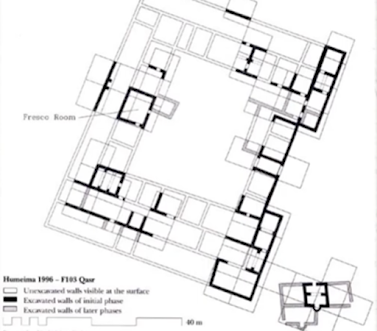
Gibson’s assertion that the mosque of Humeima faced Petra is highly questionable. Upon a closer inspection of the site’s plan, it becomes apparent that there is a sizeable structure with a small mosque, which is facing downwards, located in the southeast region.

Take a look at what Gibson presented in his original thesis:


The red arrow is pointing towards Petra and the green arrow is pointing towards Makkah.

However, what Gibson failed to disclose in his publication was that the large structure was, in fact, a castle, and it did not contain a mihrab. There is no evidence to suggest that it was ever utilized as a mosque. Conversely, the smaller building towards the south has been identified as a mosque since a mihrab-like structure was excavated there. This indicates that Gibson’s claims lack any credibility whatsoever and that they are flawed at their very core.


The larger building shows no evidence of ever being a mosque, but the small building on the bottom right of the image does. Can you guess which building Gibson used as part of his thesis?

RELATED: Why Muslim Women Tend to Fall for the “All Men Are Evil” Myth

The Mosque of Umm al Walid

It appears that Gibson’s claims regarding the mosque of Umm al Walid facing Petra have no factual basis and that they are simply not true. A quick glance at a satellite image of the actual ruins reveals that the mosque is oriented towards the south, not Petra.

But it gets worse. In his presentation, Gibson didn’t even show the real ruins of Umm al Walid. He, in his typical fashion, manipulated the evidence in order to somehow force it to fit his false narrative. Once again, this is yet another clear indicator that he lacks any credibility.


What Gibson presented in his original work as being Umm Al Walid mosque.The real ruins of Umm Al Walid.


And this is not some isolated instance. Gibson makes numerous such blunders throughout his work, only eventually correcting them after others pointed out his glaring mistakes.

It raises some important questions:

Why didn’t he ensure that his “research” was accurate to begin with, rather than leaving it for others to come by and correct him before fixing his “mistakes”?

How incompetent does someone have to be in order to make such an array of amateur “mistakes”?

Isn’t is quite evident by this point that there is a clear agenda here?

How could anyone take such blatantly fraudulent “research” seriously?

Gibson seems to be so extremely desperate in his frantic search to find any “evidence” whatsoever—anything that can somehow be bended to support his claims—that he’s more than willing to actually distort and manipulate the facts if doing so helps to further his nonsensical claims.

True scholarship requires honesty and integrity, and, sadly, Gibson is sorely lacking in both.

Qasr El Bai’j


The red arrow is pointing towards Petra, and the green arrow is pointing towards Makkah.

Let us now delve into Gibson’s claims regarding the castle of El Bai’j.

He alleges that the buildings were facing Petra, but let’s take a closer look at his evidence. According to archaeologist reports, there is no clear qiblah that can be established at this site, and there is no evidence of a mosque.

Yet, despite this, Gibson seems to have a different perspective. He has drawn a qiblah that points towards Petra, despite there being no concrete proof to support his claim.

Again, this raises an important question:

Why would he do that?

It seems that Gibson, in his desperate attempts to find even the smallest shred of evidence to support his theory, deems it perfectly fine to resort to misrepresentation and manipulation of the facts.

RELATED: Debunking the Christian “Miracle of Fátima”

Umm Jimal


When it comes to the Umm Jimal mosque, Gibson seems to once again be stretching the facts. Despite his claims that the mosque faced Petra, the reality is quite different. Archaeologists who have studied the site report that no mosque was found there, and that the buildings themselves predate the Islamic period. I mean, just take a look at this:

Umm al-Jimal is also notable for two important inscriptions relating to its Nabataean culture: an ‘altar’ inscribed in honour of Dushara, a powerful god associated with Zeus and Dionysus, and part of a tomb inscription which is a valuable witness of the transition of Nabataean script to an Arabic style and of the rise in power of the Tanukh, a confederacy of Arab tribes whom the Romans enlisted as part of their frontier forces. Unfortunately, both inscriptions have recently suffered damage due to a lack of protection of the site. In an ideal world, there would be some restoration work to shore up some of the walls that are threatening to collapse. With such a large site, this would be a huge undertaking.

Gibson’s insistence that some of these buildings were possibly used as a mosque is nothing more than mere conjecture. There is simply no evidence whatsoever that can be used to support his baseless assertions.

Gibson is simply more invested in promoting his own despicable agendas than he is in presenting accurate information.

Siraf Mosque


Let us now look into the mosque of Siraf and the claims Gibson makes about it. He asserts that it was built in 750 and was facing Petra. However, his claims are not based on any sort of accurate historical evidence. In fact, archaeologist David Whitehouse confirms that the very first mosque in the city dates back to the 9th century, not the 8th century as Gibson suggests.

Moreover, the testimony of one of the inhabitants of Siraf reveals that this mosque was originally a Sassanid monument and was only converted into a mosque later on. Gibson’s mistake in relation to the date of the mosque’s construction and its origin as a Sassanid monument leads one to seriously question the validity of his claims.

To add to this, an Iranian media outlet states that David Whitehouse found evidence that the earliest mosque in Siraf dates back to the ninth century CE; and that, in 2009, archaeologists identified Sassanid layers and artifacts near the mosque.

This Iranian media outlet stated the following:

In addition to the castle, Siraf is home to an ancient congregational mosque and cemetery. David Whitehouse found evidence that the earliest mosque in Siraf dates to the ninth century CE. He found ruins of a congregational mosque surrounded by many other smaller mosques. Archeologists have identified Sassanid layers and artifacts near the mosque in 2009.

Despite these findings, Gibson’s book still claims that the first mosque in Siraf was built in 750 and that it was facing Petra. Once again, it is clear that his claims are not actually supported by any accurate historical evidence.

Excerpt from Gibson’s latest book, Let The Stones Speak.

Misinterpretation of Mosque Orientation

Gibson’s erroneous claim that early mosques faced Petra is a testament to his flawed interpretation of mosque orientation. When we delve into the orientation of mosques in Africa, Spain and the Middle East, we find that they were all directed to the southeast or southwest. Thus, Gibson’s attempt to create a new variety of mosques which face between Petra and Makkah is baseless, as these mosques were simply oriented towards the southeast.


It would seem that the Africans were not very skilled when it came to directing themselves toward Petra or Makkah…

Furthermore, Gibson’s bias is manifestly evident throughout his thesis. He clearly started with his conclusion and tries his hardest to make the data fit his theory rather than the other way around. He wants us to believe that the mosques facing between Petra and Makkah were pointing at Petra when, in fact, they were just oriented south.

The fact that some orientalists and Islamophobes have credited his theory is only a testament to their own personal lack of intellectual honesty.

It is important for Muslims to remember that some so-called “academics” will go to any lengths necessary in order to try and undermine Islam. Gibson’s theory is just another attempt to rewrite our history and distort our religion.

As Muslims who are true to our faith, we must reject such fraudulent attempts at undermining the teachings of our religion outright and, instead, uphold the traditional orientation of the qiblah towards Makkah, as supported by historical evidence, over fourteen centuries of Islamic scholarship and jurisprudence and the teachings of our beloved Prophet Muhammad (may Allah bless him and grant him peace).

Whenever such people try to manipulate the facts, we must always be ready to debunk the lies and shine a bright light on the truth.

In conclusion, Gibson is both biased and glaringly incompetent. His thesis is extremely flawed. His arguments, as well as their foundations, are baseless. His supposed evidences are merely distortions and factual inaccuracies. His shoddy “research” is nothing more than agenda-driven drivel.

Let us not fall prey to those who seek to undermine our faith, heritage, and history.


Prophet Muhammad's Night Journey To Al-Masjid Al-Aqsa - The Farthest Mosque

  Prophet Mu h ammad's Night Journey To Al-Masjid Al-Aq s a - The Farthest Mosque Islamic Awareness © Islamic Awareness, All Rights Rese...