Monday, 21 November 2016

He or she?


A few years ago, several publications reported the discovery of a rare English Bible called The “She” Bible. This version of the Bible is called The “She” Bible because of a supposed error found in the translation of Ruth 3:15

------------------


The following is an excerpt of my study of Ruth 3:15 taken from my book:
That night, after Boaz finished eating, he came to the threshing floor and went to sleep. Ruth slept by his side. In the middle of the night, Boaz awoke and realized that Ruth was by his side. He told her to stay there with him until morning. In the morning, Boaz gave Ruth six measures of barley and then someone went back to the city.
(But, who went back to the city? It depends on what translation you read.)
The Revised Standard Version reads:
“And [Boaz] said, `Bring the mantle you are wearing and hold it out.’ So she held it, and he measured out six measures of barley, and laid it upon her; then she went into the city” (Ruth 3:15 RSV, emphasis mine).
The New Revised Standard Version reads:
“Then [Boaz] said, `Bring the cloak you are wearing and hold it out.’ So she held it, and he measured out six measures of barley, and put it on her back; then he went into the city” (Ruth 3:15 NRSV, emphasis mine).
The versions disagree on who went back to the city. The following versions agree with the Revised Standard Version and say that Ruth went back to the city:

Sunday, 20 November 2016

Christians got it wrong


"You are not yet fifty years old," they said to him, "and you have seen Abraham!
(John 8:57)

------------------------

Notice from the above text, once read from context we find that the jews and jesus were having a face to face dialogue. Jesus spoke about Abraham that he was waiting to see his days..

“Your father Abraham rejoiced to see My day, and he saw it and was glad.” (v56)

Yet the jews answered back :

"You are not yet fifty years old," they said to him, "and you have seen Abraham!
(John 8:57)

Now why did the jews say YOU ARE NOT FIFTY YEARS OLD? AND YOU HAVE SEEN ABRAHAM?? What difference would it make if jesus was 500 years old since the time gap between Abraham and Jesus would have been 4000 years...

Unless they were speaking of a man who lived during the time of Jesus called Abraham which would make more sense saying your not fifty and you know Abraham.

Its like saying your not 60 years old how can you say you saw JFK ( ex president) now the question is if jesus was meant to declare his divinity then why didnt he say before Adam was Iam?? Thats if we take the Iam as God even though thats not what it means! Why stop at Abraham how about Noah do you see the problem this causes for christians

This tells us according to john there must of been a man during the first century called Abraham whom the jews were taking as a pious man

Here's another problem 

John 8:57

TEXT: "and have you seen Abraham?"
EVIDENCE: p66 Sc A B C D K L W X Delta Theta Pi Psi ff13 28 33 565 700 892 1010 1241 Byz Lect lat vg syr(p,h,pal) most cop(north)
TRANSLATIONS: KJV ASV RSV NASV NIV NEB TEV
RANK: B

--------
NOTES: "and has Abraham seen you?"
EVIDENCE: p75 S* 0124 syr(s) one cop(north) cop(south)
TRANSLATIONS: RSVn NEBn TEVn

------------------------

COMMENTS: A few copyists apparently changed the Jews' question to be more like Jesus' statement in verse 56 ("he would see my day; and he saw [it]").
this changes the entire notion of the IAM saying wouldn't you say!
Textual Variant 


Yahweh feared himself?


A shoot will come up from the stump of Jesse; from his roots a Branch will bear fruit.
The Spirit of the LORD will rest on him-- the Spirit of wisdom and of understanding, the Spirit of counsel and of might, the Spirit of the knowledge and fear of the LORD. And shall make him of quick understanding in the fear of the LORD: and he shall not judge after the sight of his eyes, neither reprove after the hearing of his ears.
(Isaiah 11:1-3)

----------------

Our Christian friends boast this is a prophecy of Jesus the Messiah mentioned in Isaiah, and for the sake of argument they are correct in one way, this actually is a PROPHECY OF THE MESSIAH which Jewish rabbis don't hesitate to admit. But the question is does it fit Jesus and the question is no why u may ask read the above passage carefully its states in verse 2 and 3 THE MESSIAH WILL FEAR GOD!

IF JESUS IS GOD HOW DOES HE FEAR HIMSELF? The the dilemma our Christian friends are in is wether Jesus was the messiah which means he has to FEAR GOD, or was he God which means GOD FEARED HIMSELF? Where does the New Testament say Jesus feared God? If he dint then did he fear himself? If he did then he can't be a God but a Messiah 

Take your pick 

nonsense !!


And I saw an angel standing in the sun, who cried in a loud voice to all the birds flying in midair,"Come, gather together for the great supper of God
(Revelations 19:17)

--------------------

How in the world did john see an angel STANDING IN THE SUN?? What kind of sun glasses did he wear lol pure nonsense

Why does the Qur'an Call Jesus (pbuh) "Al-Maseeh"

Question:

I wish to seek your help regarding the usage of "Al-Maseeh" in reference to the Qur'an.

This is an excerpt of my argument with a Christian regarding the usage of "Al-Maseeh". He was asking these questions:

What did Jesus do, according to the Qur'an, that made him the Messiah? He preached, that's all?  What differentiates the Messiah from any other prophet? Again, the Qur'an's assertion that Jesus is the Messiah is much more nonsensical than any Christian claim.

My argument and response to this was:

Every prophet of God is an anointed one of God, a Messiah, but the title Al-Maseeh or Messiah, or its translation "Christ" is exclusively reserved for Jesus, the son of Mary, in both Islam and in Christianity.  This is not unusual in religion. There are certain other honorific titles which may be applied to more than one prophet, yet being made exclusive to one by usage: like "Rasulullah", meaning "Messenger of God", which title is applied to both Moses (19:51) and Jesus (61:6) in the Holy Quran. Yet "Rasullullah" has become synonymous only with Muhammad, the prophet of Islam, among Muslims (if you have studied Islam, that is). Every prophet is indeed a "Friend of God", but its Arabic equivalent "Khaleellullah" is exclusively associated with Prophet Abraham (pbuh). This does not mean that the others are not God's friends. "Kaleemullah", meaning "One who spoke with Allah" is never used for anyone other than Moses, yet we believe that God spoke with many of His messengers, including Jesus and Muhammad, may the peace and blessings of God be upon all His prophets. Associating certain titles with certain personages only, does not make them exclusive or unique in any way. We honour all in varying terms.

He e-mailed me back his answer to mine:

My main objection is that which is said above. I am unaware of the Qur'an referring to any prophet as a Messiah.  Perhaps you can show me an example. Note specifically that Jesus is called AL-masiiH.  Al is closely equivalent to "the" in English [though the Arabic definite article definitely serves more grammatical functions than the English article];  it is a definite article. Definite articles point to uniqueness and singularity. Notice, one does not say, Jesus was the prophet in Islam. One says, Jesus was a prophet. Messiah is, therefore, as unique of a title as the Seal of the Prophets.  Certain titles do make some of the prophets unique and distinguishable.  Mere historical events and chronology effectively do this.  Muhammad, for example, is unique for many reasons Simple reason merely being that  is the last of all prophets.

I hope you can give me your answer on my question and comments on what this Christian is saying.

Salaam.


Answer:


There are two separate questions that may be asked regarding the usage of the word 'Al-Maseeh' in the Qur'an for Jesus (pbuh). Firstly, it may be asked why has the Qur'an used the word 'Al-Maseeh' for Jesus (pbuh); and secondly, why was Jesus (pbuh) called 'Al-Maseeh'. Both these questions need to be dealt with separately, as it is quite possible that the answers to these questions may, technically be quite different from each other.

As far as the question that why has the Qur'an used the word 'Al-Maseeh' for Jesus (pbuh) is concerned, the answer is quite simple. In the environment of the revelation of the Qur'an - i.e. the pre-Islamic Arabia, Jesus (pbuh) was referred to as 'Al-Maseeh'. The word was an established and a well-known appellation (i.e. laqab in Arabic and Urdu languages) for Jesus (pbuh). The Qur'an, as is its style, under normal circumstances, used the same words for the deliverance of its message, which were generally in vogue in the environment that it addressed. Thus, it is obvious that if Jesus (pbuh) was referred to by the Arabs by some other appellation or name, the Qur'an would then have used that other appellation or name to refer to him, unless there was something wrong in using such appellation for Jesus (pbuh). The fact that Jesus (pbuh) was referred to by the appellation of 'Al-Maseeh' in the pre-Islamic Arabia is so well established that there is no need for citing any references for this purpose. However, to avoid unnecessary details and complications, the following poetic verse of a Christian Arab poet - Samuel - should suffice as evidence of the above point:

And in the final days, came our 'Maseeh' and guided the people of the world to complete peace.

Now let us turn to the second question, i.e. why was Jesus (pbuh) given the appellation of 'Al-Maseeh'. The word 'Maseeh' is generally considered to be a Ta`reeb (i.e. Arabization or adoption in the Arabic language, with some modification in the word) of the Hebrew word "maw-shee-akh", which means anointed. In the Arabic language as well, the word has the same meaning, although, some linguistic sources have also expressed the opinion that the word actually implies 'anointer' rather than 'anointed'. This is primarily due to the fact that in the Arabic language, words similar in sound and construction to 'Maseeh' (like 'Fa`eel', 'Raheem' and 'Rajeem' etc.) in its basic word structure can be used to denote the subject clause as well as the object clause. Thus, the word 'Maseeh' could imply 'Mamsooh' (i.e. the one who is anointed) or 'Maaseh' (i.e. the anointer).

Linguistic scholars of the Arabic language have proposed a number of reasons for the usage of 'Al-Maseeh', as an appellation for Jesus (pbuh) [1]. Some hold that the word means 'truthful', and was used as an appellation for Jesus (pbuh) to imply to his truthfulness. Some hold it was used as an appellation for Jesus (pbuh) because he lived his life without taking for himself a permanent abode (as the Arabic phrase 'Masaha al-Ardh' implies a person who travels a lot). Some think that the reason for this appellation was that Jesus (pbuh) used to correct others of their diseases merely by the touch of his hands, and thus was called 'Al-Maseeh', implying the one who anoints for removing disease. Some hold that the reason for this appellation was that Jesus (pbuh) was anointed with blessings. While, some hold that the appellation was given to Jesus (pbuh) because he came into this world out of his mother's womb, naturally and divinely anointed with oil.

One may hold any of the opinions given above (or even one besides these), which in his opinion gives an acceptable reason for the particular appellation for Jesus (pbuh). In my opinion, the opinion recorded last, i.e. because of coming in this world from his mother's womb, naturally and divinely anointed with oil seems to be the reason for this appellation. All the other explanations, except for the last two could only be accepted as probable explanations for the appellation, had the word 'maw-shee-akh' also entailed these meanings in the Hebrew language. However, it is believed that the Hebrew word 'maw-shee-akh' meant 'anointed'. Thus, it seems more probable that the reason for giving Jesus (pbuh) this name had something to do with his anointment.

It is clear from a number of verses of the Old Testament that anointment was a Hebrew tradition, which generally implied one of the following three things:

1.      Appointment of the anointed as a priest [2];

2.      Appointment of the anointed as a ruler, or a king (it seems that this is a Hebrew tradition since the time when kings or rulers were appointed by divine authority) [3]; and 

3.      Making something clean and holy (this was, generally, anointing with reference to things rather than people) [4]

Thus, anointment of a person generally meant his appointment as a prophet (priest) or a king. Keeping this Hebrew tradition in perspective, it seems that the appellation of 'Al-Maseeh', i.e. the anointed also implied 'the appointed'. As I have stated earlier, I am inclined toward taking the reason for this appellation to be that contrary to the prophets and kings preceding him, Jesus (pbuh) was naturally and divinely anointed, implying his divine appointment as God's prophet.

Whatever one holds to be the correct reason for the referred appellation of Jesus (pbuh), the fact remains that it was, nevertheless, an established and a well-known appellation for him. The Qur'an has referred to Jesus (pbuh) by this name because this was the name, which was commonly used for Jesus (pbuh) in the pre-Islamic Arabia.

I hope this helps.


 1) For details, refer to the word 'Al-Maseeh' in the Arabic dictionary 'Lisaan al-Arab'. 

 2) See for instance Exodus 28: 41, Exodus 29: 1 - 9, Exodus 40: 13 - 15 etc.

 3) See for instance, 1Samuel 9: 16, 1Samuel 15: 1, 1Samuel 16: 8 - 13, 1Kings 1: 32 - 34, 1Kings 19: 15 - 16, Psalms 23: 5 - 6 etc.

 4) See for instance: Exodus 29: 35 - 37, Exodus 30: 22 - 29, Exodus 40: 9 - 11 etc.,

 By Moiz Amjad

Did he really sacrifice himself ?

Christians your Jesus was killed by the Jews? Meaning he didn't sacrifice himself rather he was killed?? So where is the sacrifice?


For some of the Jews killed the prophets, and some even killed the Lord Jesus. Now they have persecuted us, too. They fail to please God and work against all humanity 
(1 Thessalonians 2:15)


When he had received the drink, Jesus said, "It is finished." With that, he bowed his head and gave up his spirit. (John 19:30)


Seems like he was poisoned wouldn't u say that's before he was forsaken 


And at three in the afternoon Jesus cried out in a loud voice, "Eloi, Eloi, lema sabachthani?" (which means "My God, my God, why have you forsaken me?").
(Mark 15:34)


Then he went HELL
(1 Peter 3:19)


Bear in mind Paul tells us he was killed, again where's the sacrifice if one is killed?

For some of the Jews killed the prophets, and some even killed the Lord Jesus. Now they have persecuted us, too. They fail to please God and work against all humanity (1 Thessalonians 2:15)

If Jesus was sinless then Yahweh is a sinner!


Think of it Christians brag that Jesus never sinned he was a sinless lamb, he never killed anyone never hurt anyone never cursed anyone etc etc.. If this is the case then Yahweh must be a super Sinner since he was the cause of many violence as found in the Old Testament killing people children's women's animals cursing people torturing people etc etc.. 

Now Christians may say well Jesus was God so God can't be a sinner, then how do you explain the God of the Old Testament was he a different God? You can't have the cake and eat it. Either Jesus was the God of the new and Old Testament which would make him a a violent evil God or he was a human and has nothing to do with the Old Testament ?? Take your pick

Below is a screenshot from facebook. read how christians out of frsutration called me an Atheist!


(69:40) that this is the speech of an honourable Messenger,


--------------------

Here, “a noble Messenger” implies the Prophet Muhammad (peace be upon him) and in( Surah At- Takweer, Ayat 19). the angel Gabriel, the argument being that after describing the Quran as the word of an honorable Messenger, it has been said: It is not the word of a poet nor of a soothsayer, and obviously the disbelievers of Makkah branded the Prophet Muhammad (peace be upon him) and not Gabriel as a poet and soothsayer. On the contrary, in Surah At-Takweer, after describing the Quran as the word of “a noble messenger” it has been said: That Messenger has great power, and has high ranks with the Owner of the Throne: there he is obeyed and held as trustworthy. And Muhammad (peace be upon him) has seen him on the bright horizon. (verses 20-23). Almost the same thing has been stated in (Surah An-Najm, Ayats 5-10) about Gabriel. 

Here, the question arises; In what sense has the Quran been described as the word of Muhammad (peace be upon him) and of Gabriel. The answer is: the people were hearing it being recited by the tongue of the Prophet (peace be upon him) and the Prophet (peace be upon him) by the tongue of Gabriel. Thereupon, in one way it was the word of the Prophet (peace be upon him) and in another way of Gabriel, but a little below it has been explicitly stated: It is indeed a Revelation from the Lord of the worlds, which is being presented before Muhammad (peace be upon him) by the tongue of Gabriel and before the people by the tongue of Muhammad (peace be upon him). The word Messenger itself points to the truth that the word belongs to neither of them but they have presented it as Messengers of the One Who has sent it down.

Saturday, 19 November 2016

Torah corruption confirmed by New Testament Bible scholars!


And when you have crossed the Jordan, set up these stones on MOUNT EBAL, as I command you today, and coat them with plaster. 
(Deuteronomy 27:4 Masoretic text). 


                                                                     Compare to
  

And when you have crossed the Jordan, set up these stones on MOUNT GERIZIM, as I command you today, and coat them with plaster. (Deuteronomy 27:4 Samaritan text)

---------------

The above problematic verses have only one solution, and that is which one is correct and which is corrupted?  Thanks to the bible scholars we have a confirmation that the Torah has been tampered with. Let's read the commentary for these verses.


And therefore it shall be, when ye be gone over Jordan,.... Some time after they had passed that river: 


that ye shall set up these stones, which I command you this day, in Mount Ebal; a mountain near Shechem in Samaria, and was, as Benjamin of Tudela says (r), dry as stones and rocks itself, and perhaps had its name, as some think (s), from the root in the Arabic language which signifies to strip a tree of its leaves, and a derivative from it, white stones and a mountain in which such are found. Hither the stones commanded to be set up were to be brought, and fixed here; from whence it is not certain; it may be from some part of the mountain. Here the Samaritan version has Gerizim instead of Ebal, which is generally thought to be a wilful corruption of the Samaritans, in favour of their temple built at Gerizim: 

Adam Clarke Commentary 


Not only that, we can see another interesting account by Adam Clarke, a Christian commentator where he shows another intentional corruption made by the Jews against the Samaritans. He said in his commentary on Deu 27:4 –


“Set up these stones – in Mount Ebal – So the present Hebrew text , but the  Samaritan has Mount Gerizim. Dr. Kennicott has largely defended the reading of the Samaritan in his second dissertation on the present state of the Hebrew text , and Dr. Parry has defended the Hebrew against the Samaritan. Many still think Dr. Kennicott’s arguments unanswerable, and have no doubt that the Jews have here corrupted the text through their enmity to the Samaritans. “

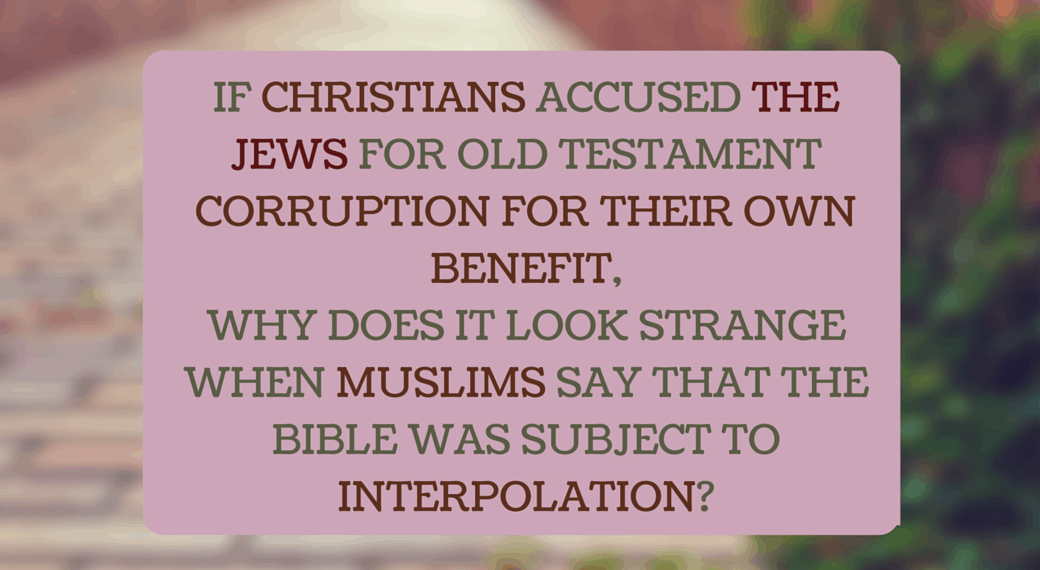
Notice how blatantly the commentators are using the word “CORRUPTION” to inform the reader that such tampering had taken place This is sufficient evidence to prove that the Torah has been corrupted even if it's one word it's still proof of distortion. This also shows the Torah you have is not “100%” the word of God. And there's many more places we can show you where changes have been made.
So here again Adam Clarke didn’t just accuse the Jews for corrupting the manuscripts due to their hostility with Christians only, but also they did the same with Samaritans, and with Muslims when they changed the name of Abraham's offered son to Isaac (Pbut).

How about this to make matters even worse.

"When the LORD your God brings you into the land and helps you take possession of it, you must pronounce the blessing at Mount Gerizim and the curse at Mount Ebal. (Deuteronomy 11:29)

The above verse in the Masoretic text explicitly makes the distinction between the two mountains, “Mount Gerizim and Mount Elba”. Just in case Christians try to say the Samaritan and Masoretic speaks of the same mountain which has two different names. Sorry there’s no way out on this one.

These may be just some examples of what I have seen from Christian writings, and for sure if we dug more through various books, we may find more issues showing other issues. Actually if we went through early and medieval Muslim writings, we may find many quotes from Jewish and Christian writings talking about Prophet Muhammad (Pbuh) in a very explicit way which are not present in the Bible. But if the Jews are actually proven to behave  the way described above, then I tend to believe Muslim scholars, especially that this is against both Christian and Jewish beliefs.


Jewish corruption of the Old Testament

This section shall highlight some of the corruptions made by the Jews in the Old Testament and how early Christians accused the Jews of corruption.

Justin Martyr

The first example is Justin Martyr(an early church father who died at about 150 AD) says in his dialogue with Trypho, a Jew:

Chap. LXXII. — Passages Have Been Removed by the Jews from Esdras and Jeremiah.

And I said, “I shall do as you please. From the statements, then, which Esdras made in reference to the law of the passover, they have taken away the following: ‘And Esdras said to the people, This passover is our Saviour and our refuge. And if you have understood, and your heart has taken it in, that we shall humble Him on a standard, and….. thereafter hope in Him, then this place shall not be forsaken for ever, says the God of hosts. But if you will not believe Him, and will not listen to His declaration, you shall be a laughing-stock to the nations.’…… And again, from the sayings of the same Jeremiah these have been cut out: ‘The Lord God remembered His dead people of Israel who lay in the graves; and He descended to preach to them His own salvation.

So Justin Martyr here is explicitly accusing the Jews of corrupting the Old Testament by hiding some verses talking about salvation. But is it that easy that verses are removed from the Bible?
Jewish corruption of the Old Testament

John Chrysostom

Let’s see what John Chrysostom (church father who lived in the fourth century) says in his Homilies on Gospel Matthew when he came to the verse quoting the Old Testament” which was spoken by the prophets, He shall be called a Nazarene.”:

And what manner of prophet said this? Be not curious, nor overbusy. For many of the prophetic writings have been lost; and this one may see from the history of the Chronicles. For being negligent, and continually falling into ungodliness, some they suffered to perish, others they themselves burnt up  and cut to pieces. The latter fact Jeremiah relates; the former, he who composed the fourth book of Kings, saying, that after a long time the book of Deuteronomy was hardly found, buried somewhere and lost. But if, when there was no barbarian there, they so betrayed their books, much 56 more when the barbarians had overrun them. For as to the fact, that the prophet had foretold it, the apostles themselves in many places call Him a Nazarene. ”

So simply John Chrysostom is not just accusing the Jews of being negligent who are not caring for their books, but also of destroying their own books. If these are accusations made by Christians, who are supposed to share the Jews their belief in the Old Testament, how could Muslims trust the Jews and consider that they were really honest and followed God’s commandment to keep Hi s books, not to add or remove or replace?

Adam Clarke

Not only that, we can see another interesting account by Adam Clarke, a Christian commentator where he shows another intentional corruption made by the Jews against the Samaritans. He said in his commentary on Deu 27:4 –

“Set up these stones – in Mount Ebal – So the present Hebrew text , but the  Samaritan has Mount Gerizim. Dr. Kennicott has largely defended the reading of the Samaritan in his second dissertation on the present state of the Hebrew text , and Dr. Parry has defended the Hebrew against the Samaritan. Many still think Dr. Kennicott’s arguments unanswerable, and have no doubt that the Jews have here corrupted the text through their enmity to the Samaritans. “

So here again Adam Clarke didn’t just accuse the Jews for corrupting the manuscripts due to their hostility with Christians only, but also they did the same with Samaritans, and with Muslims when they changed the name ofAbraham’s offered son to Isaac.

These may be just some examples of what I have seen from Christian writings, and for sure if we dug more through various books, we may find more issues showing other issues. Actually if we went through early and medieval Muslim writings, we may find many quotes from Jewish and Christian writings talking about Prophet Muhammad in a very explicit way which are not present in the Bible. But if the Jews are actually proven to behave  the way described above, then I tend to believe Muslim scholars, especially that this is against both Christian and Jewish beliefs

---------

Justin Martyr affirms the Qur'anic claim that the Bible was corrupted

Much to the consternation of Christians, Muslims insist that the texts of their scripture, the Bible, have undergone changes, alterations, or in other words, corruption. The Muslims' insistence is based on several Qur'anic passages that seem to testify to the fact that they, the Jews (and Christians), have manhandled the scriptures that they were given:

"So woe to those who write the "scripture" with their own hands, then say, "This is from Allah," in order to exchange it for a small price. Woe to them for what their hands have written and woe to them for what they earn." [Quran 2:79]

"Of those who are Jews (there are those who) alter words from their places and say: We have heard and we disobey and: Hear, may you not be made to hear! and: Raina, distorting (the word) with their tongues and taunting about religion; and if they had said (instead): We have heard and we obey, and hearken, and unzurna it would have been better for them and more upright; but Allah has cursed them on account of their unbelief, so they do not believe but a little." [4:46]

While the Qur'an's preservation is ensured by Allah, for He says that He Himself would see to its preservation, in 15:9 ("Indeed, it is We who sent down the Quran and indeed, We will be its guardian."), the preservation of previous scriptures were entrusted to the people that received them [Qur'an 5:44], but, unfortunately, they failed to live up to their responsibility:

"“But because of their breach of their covenant, We cursed them, and made their hearts grow hard; they change the words from their (right) places and forget a good part of the message that was sent them, nor wilt thou cease to find them- barring a few – ever bent on (new) deceits: but forgive them, and overlook (their misdeeds): for Allah loveth those who are kind.” [Qur'an 5, verse 13]

It is rather quite surprising that the Christians would be surprised by the Qur'anic charge since it is by no means a unique accusation. Hundreds of years before the revelation of the Qur'an, major Christian Church Fathers* actually testified to the Jewish corruption of scripture. One such Church Father or patristic personality was Justin Martyr, who, in his dialogue with Trypho, indicts the Jews of corrupting the Old Testament:

"from the ninety-fifth (ninety-sixth) Psalm they have taken away this short saying of the words of David: ‘From the wood.’ For when the passage said, ‘Tell ye among the nations, the Lord hath reigned from the wood,’ they have left, ‘Tell ye among the nations, the Lord hath reigned.'" [1]

In the book, i.e., Justin Martyr's 'The First Apology', the above quotation comes under the chapter "[THE WORDS] "FROM THE WOOD" HAVE BEEN CUT OUT OF PS [PSALM] XCVI." According to Justin Martyr, then, the Jews, driven by theological purposes, had tampered with the text of Psalm 96 and removed words from their original text. Writing on Justin Martyr's testimony concerning the corruption of the Bible at the hands of the Jews, professor emeritus and former chair of the Humanities Department at Wilbur Wright College, Dr. Sheldon W. Liebman writes:

"Justin Martyr went so far as to accuse the Jews of corrupting their Bible (i.e., rewriting it) "so as to obscure the scriptures' plain prophetic testimony to Jesus as the Christ." [2]

Lest we are accused of misreading Justin Martyr, the scholarly appraisal of Sheldon Liebman above reinforces our point.

Christians should not be too surprised by the Qur'an when it disavows their scriptures for having been corrupted, because this allegation is by no means unique to the Qur'an. Around 400 years before the Qur'an even came to the scene, this charge was made by their own "Holy Spirit-inspired" Church Fathers, such as Justin Martyr.

Notes:

* According to Catholic.com, Church Fathers are "...so called because of their leadership in the early Church, especially in defending, expounding, and developing Catholic doctrines. For the first two centuries, most of these men were bishops, although in later years certain priests and deacons were also recognized as Fathers."

[1] Justin Martyr (2007). The First Apology. In Alexander Roberts, James Donaldson & Arthur Cleveland Coxe (eds), The Ante-Nicene Fathers, Volume 1: The Apostolic Fathers with Justin Martyr and Irenaeus. New York: CosmoClassics. p. 235

[2] Liebman, S. W. (2018). The Great Betrayal: Christians and Jews in the First Four Centuries. Eugene, Oregon: Wipf & Stock. p. 384

CHIEF PRIESTS LYING?


Christians often tell us that the Jews did not corrupt the Torah, the Torah is pure and has always been preserved by the rabbis?

This is a very bold claim made by Christians. We know from the Quran (Surah 5:44)  and Christian Scripture (Romans 3:2)  that the Torah was entrusted to the Rabbis. But, the question is did they do as they were told, that is to look after the Torah?

If Christians believe that the Rabbis protected the Torah by preserving the book from any alterations or tampering, then one has to challenge how honest were High Priest (chief priest) and rabbis during ancient times? In order to dismantle this absurd claim made by Christians we don't have to go too far, the New Testament gives us the answer.


The story of Jesus found  in the New Testament  tells us how evil and corrupt the Jewish rabbis were They were condemned by Jesus on several occasions, he would often curse them and call them names (Matthew 12:29, Matthew 23:33)

Here's where the real problem starts. We are told in the book of Matthew that the chief priests asked the soldiers to LIE!


11 While the women were on their way, some of the guards went into the city and reported to the chief priests everything that had happened. 12 When the chief priests had met with the elders and devised a plan, they gave the soldiers a large sum of money, 13 telling them, “You are to say, ‘His disciples came during the night and stole him away while we were asleep.’ 14 If this report gets to the governor, we will satisfy him and keep you out of trouble.” 15 So the soldiers took the money and did as they were instructed. And this story has been widely circulated among the Jews to this very day (Matthew 28:11-15)

-----------------------------

An interesting passage that needs serious attention. We read that after the women had seen the alleged resurrection of Jesus the guards found out of the empty tomb, and they went to the chief priests and them of what had happened. "THE CHIEF PRIEST DEVISED A PLAN AND PAID THE SOLDIERS MONEY?  AND HIS WAS WIDELY CIRCULATED AMONGST THE JEWS TOLL THIS DAY"?

Let's analyse this.  Matthew is telling us that the CHIEF PRIEST TURNED TO DECEPTION  by making a plan and resulting to making the soldiers lie by bribing them. This would be highly unlikely when their very Torah says :

“You shall not steal; you shall not deal falsely; you shall not lie to one another. (Leviticus 19:11)


A gift given in secret soothes anger, and a bribe concealed in the cloak pacifies great wrath. (Proverbs 21:14)

The above verses cannot be more emphasised to say that lying, dealing falsely, taking or giving bribe is a great sin, how then could the chief priest commit such and act?


If the chief priests can lie and give a false testimony, how trustful would he or his people be to protect the Torah from alterations? If deceiving people can be done much the chief priests then changing the Torah would be no problem Thanks to Matthew he exposed the Jewish rabbis showing us how dishonest they were ! 

ASK YOURSELF CAN DO YOU STILL BELIEVE  THE JEWISH RABBIS  PRESERVED THE TORAH?


For I know that after my death you are sure to become utterly corrupt and to turn from the way I have commanded you. In days to come, disaster will fall on you because you will do evil in the sight of the LORD and arouse his anger by what your hands have made (Deuteronomy 31:27-29)

How can you say we are wise and have the Torah of the Lord with us when it's been corrupted by the scribes (Jeremiah 8:8)


Prophet Muhammad's Night Journey To Al-Masjid Al-Aqsa - The Farthest Mosque

  Prophet Mu h ammad's Night Journey To Al-Masjid Al-Aq s a - The Farthest Mosque Islamic Awareness © Islamic Awareness, All Rights Rese...